


What Your Paint Color Is Telling You About Which Wallpaper Will Actually Work

You spent three weeks choosing the perfect paint color. You held up samples, watched how they shifted from morning to afternoon, debated warm whites versus cool grays, and finally committed. The walls look great.
Then you found a wallpaper you loved online — a floral pattern that stopped you mid-scroll. You ordered a sample, taped it to the wall, and something felt wrong. Not bad, exactly. Just off. The colors looked muddier than they did on screen. The pattern clashed with the room in a way you could not quite explain.
This happens constantly. And it is rarely the wallpaper’s fault.
It is an undertone mismatch — the invisible color bias hiding inside your paint that changes how every pattern, fabric, and finish reads against it. Designers check for this before they even look at wallpaper options. Most homeowners do not know it exists.
This guide shows you how to read your walls, understand what your paint color is actually doing to the light in your room, and choose a floral wallpaper that works with it instead of against it.
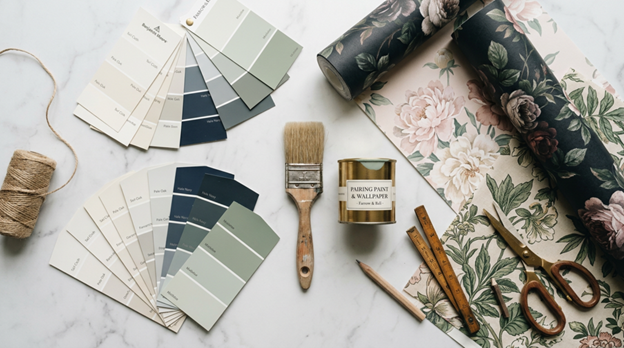
Why Your Paint Color Comes First (Not the Wallpaper)
The instinct is to browse wallpaper first, fall in love with a pattern, and then try to make it work. I have watched clients do this dozens of times. They show me a gorgeous dark peony print they found on Instagram and ask me to build a room around it. Sometimes that works. More often, the wallpaper arrives, and the room already has paint, furniture, and lighting that pull the whole thing in a different direction.
The reason is straightforward: your paint color is not neutral. Even colors that look white or gray on the chip carry an undertone — a subtle lean toward yellow, pink, green, blue, or violet that you might not see until something else exposes it. That something else is usually a patterned wallpaper, because patterns concentrate color. A floral print with soft pink blooms will look rosy and warm against a wall that shares its warm base. Put that same print against a wall with a cool blue-gray undertone, and the pink suddenly reads muddy or salmon.
This is why I always start with what is already on the wall.
The 60-Second Undertone Test
You do not need a design degree for this. You need a sheet of printer paper and five minutes.
Hold a plain white sheet of paper flat against your painted wall in natural daylight — not direct sun, not under a lamp. Look at the gap between the true white of the paper and your wall color. Whatever tint appears in that gap is your undertone.
If your wall looks yellowish or creamy next to the paper, you have a warm undertone. Most Benjamin Moore and Sherwin-Williams off-whites fall here — Cloud White, Alabaster, Greek Villa, Swiss Coffee.
If your wall looks slightly blue, gray, or lavender, you have a cool undertone. Think Chantilly Lace, Decorator’s White, Passive, or Silver Strand.
If your wall looks greenish or like it could go either way, you are in the neutral-to-warm greige territory. Agreeable Gray, Revere Pewter, Balboa Mist, Pale Oak.
Write down what you see. It changes the wallpaper conversation entirely.
The Matching Principle (And When to Ignore It)
The basic rule is simple: warm undertone paint pairs with warm-toned wallpaper. Cool undertone paint pairs with cool-toned wallpaper. When the underlying color temperatures align, everything in the room feels cohesive — even if the specific colors are quite different.
This does not mean a warm-painted room can only have warm wallpaper. But when you break the rule, you need to do it deliberately and with enough contrast that it reads as intentional, not accidental. A bright white wall with a moody dark floral? That is deliberate contrast, and it works beautifully. A slightly warm greige wall with a slightly cool lavender floral? That is where things start to feel unsettled, and most people cannot figure out why.
The pairings below show what this looks like in practice.
Pairing 1: Benjamin Moore Cloud White + Soft Pastel Peony

The paint: Cloud White (OC-130) sits at LRV 87 with a warm yellow undertone anchored by a soft taupe base. It is one of the most popular off-whites in residential design — and one of the most misunderstood. It looks like “just white” on a chip. On a wall, it is noticeably creamy.
What works: A floral wallpaper with soft pink peonies, blush tones, or warm cream backgrounds. The shared warmth between Cloud White’s yellow base and the wallpaper’s rosy tones creates a bedroom that feels enveloping without being saccharine.
What to avoid: Cool-toned florals with blue or gray grounds. Against Cloud White’s warmth, a blue-toned pattern will look slightly discordant — the wallpaper reads colder than it should, and the paint reads yellower than you want it to.
Where it works best: Primary bedrooms and nurseries. The softness of both the paint and the pastel floral creates a restful environment. Research on biophilic design has consistently linked floral imagery to lower cortisol levels and improved mood — this pairing is the practical application of that science.
Designer tip: If your room gets strong afternoon light from a west-facing window, the warm undertones will amplify. In that case, pick a peony pattern with slightly cooler pink tones (closer to mauve than peach) to keep the room from skewing too warm after 3 PM.
Pairing 2: Sherwin-Williams Agreeable Gray + Muted Botanical Wildflower

The paint: Agreeable Gray (SW 7029) is the most popular paint color in America for a reason. At LRV 60, it is a warm greige that works in nearly any room. Its undertone is a balanced mix of warm beige and soft gray, which makes it versatile but also means it can look flat on its own.
What works: A wildflower or botanical pattern in muted, earthy tones — sage green, dusty terracotta, dried lavender, warm ochre. These organic colors share Agreeable Gray’s warm-neutral base while adding the visual complexity that greige alone does not provide. The wallpaper essentially gives the room the personality that the paint deliberately holds back.
What to avoid: Bright, saturated florals. A vivid magenta or electric blue floral will look jarring against AG’s quiet warmth. The contrast is too sharp, and neither element reads as intentional.
Where it works best: Living rooms and home offices. Agreeable Gray is already a whole-house workhorse — adding a wildflower accent wall in one room gives that space its own identity without disrupting the flow.
Designer tip: When pairing wallpaper with a greige, match the wallpaper’s background color, not its flowers, to the paint. If the wallpaper has a cream or warm ivory background, it will blend seamlessly at the edges where paint meets paper. A white-ground wallpaper against greige walls creates a visible frame effect, which can be intentional, but be aware of it.
Pairing 3: Benjamin Moore Hale Navy + Light Floral on a Pale Ground
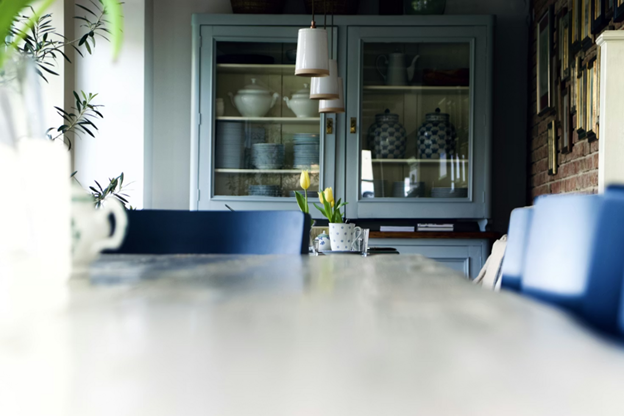
The paint: Hale Navy (HC-154) has an LRV of about 8. It is one of the most refined dark blues available — deep enough to make a statement, warm enough to avoid looking corporate. The undertone is slightly green, which keeps it from reading as true navy in warm light.
What works: A delicate floral on a white or pale cream ground. Think watercolor-style blooms, loose botanical linework, or soft ditsy prints. The contrast between the dark painted walls and the light wallpaper creates a framing effect — the wallpaper becomes the focal point, like a painting you hung on every inch of that wall.
What to avoid: Dark-ground florals. If you put a moody, dark floral wallpaper on a Hale Navy wall, the two compete. Both are trying to be dramatic, and neither wins. The room just feels heavy.
Where it works best: Dining rooms and powder rooms. Hale Navy already has the confidence for a high-impact room. Adding a light floral wallpaper on one wall — or the ceiling — gives the space an unexpected elegance that guests notice immediately.
Designer tip: With a dark paint and light-ground wallpaper pairing, trim color matters more than usual. Bright white trim creates a crisp boundary. Warm off-white trim creates a softer transition. Painting the trim to match the wallpaper’s background color is the most seamless option.
Pairing 4: Sherwin-Williams Alabaster + Dark Moody Floral

The paint: Alabaster (SW 7008) sits at LRV 82 — a warm white that reads clean without feeling clinical. It is the paint you pick when you want white walls that still feel like someone lives there.
What works: This is where you go bold. A dark moody floral — think midnight backgrounds, rich emerald leaves, deep burgundy, and blush blooms in the style of Dutch Golden Age still-life paintings. Against Alabaster’s bright, warm white, a dark floral wallpaper becomes pure theater. The white walls give your eye a place to rest. The wallpaper commands the room.
What to avoid: Other bright whites alongside this pairing. If you are doing Alabaster walls plus dark floral wallpaper, make sure your trim does not skew too cool. A blue-white trim next to Alabaster will make the paint look yellow, and that throws the whole balance off.
Where it works best: Powder rooms. This is the room where you take your biggest swing. Guests are in there for 90 seconds, and in those 90 seconds, a dark floral wallpaper against clean white walls creates the kind of moment that makes people say,y “I love what you did in there.” It is also a small enough space that one roll of premium wallpaper covers the job — low cost, high impact.
Designer tip: In a powder room, consider papering all four walls instead of creating an accent wall. With a dark, moody floral, full immersion is more dramatic and more intentional than a single feature wall. The small footprint means it feels cozy, not overwhelming.
Pairing 5: Benjamin Moore Revere Pewter + Warm Vintage Floral

The paint: Revere Pewter (HC-172) is a warm greige at LRV 55 — darker and more decisive than Agreeable Gray. It has a noticeable warm brown-green undertone that gives rooms a grounded, organic feeling. It is the color you reach for when “neutral” needs to have some weight.
What works: Vintage-inspired florals with warm grounds — hazelnut, cream, dusty rose, or antique gold. The grandmillennial aesthetic (what designers call “granny chic, but make it modern”) works especially well here. Think trailing wildflowers, toile-adjacent prints, or classic English garden patterns with a muted, aged quality.
What to avoid: Pastels. A soft baby pink or powder blue floral will look childish against Revere Pewter’s earthiness. The paint is too grounded for airy, delicate patterns — it overpowers them.
Where it works best: Breakfast nooks, reading corners, and entryways. Revere Pewter already creates warmth. A vintage floral adds charm and visual interest to transitional spaces that often get forgotten.
Designer tip: This pairing rewards texture. If you can choose a wallpaper with a textured finish — linen-effect or slightly matte — it will echo Revere Pewter’s own substantial feel. A glossy wallpaper against this paint reads as a mismatch in visual weight.
Pairing 6: Sherwin-Williams Sea Salt + Cool-Toned Botanical

The paint: Sea Salt (SW 6204) is that soft green-gray-blue that everyone pins on Pinterest and then second-guesses at the store. At LRV 63, it shifts constantly — sometimes it reads sage green, sometimes blue-gray, sometimes barely tinted at all. It depends entirely on the light.
What works: Cool-toned botanical prints — blue-green leaves, eucalyptus branches, muted sage florals, or watercolor botanicals with gray and green undertones. Sea Salt and a cool botanical wallpaper together create the most natural-feeling biophilic environment you can achieve without actual plants. The colors echo each other without matching exactly, which is what makes it feel organic rather than coordinated.
What to avoid: Warm-toned florals. A peach or coral floral against Sea Salt will fight. The warm pink tones expose the cool blue in the paint, making both colors look less like what you intended.
Where it works best: Bathrooms and spa-like bedrooms. Sea Salt already suggests water and calm. A cool botanical wallpaper on one wall turns a basic bathroom into something that feels deliberate and restorative.
Designer tip: Sea Salt shifts dramatically based on light direction. North-facing rooms pull out the gray. South-facing rooms pull out the green. Test your wallpaper sample in the actual room, at the actual time of day you use it most.
The Renter’s Advantage: Why Peel-and-Stick Changes This Equation
Everything above still applies if you are renting — maybe even more so, because you probably did not choose the paint color. You are working with whatever the landlord’s painter used last, and it is almost certainly a builder-grade warm white or off-white.
The good news: most rental walls play well with warm-toned floral wallpaper because most builders use warm white paint. A floral peel-and-stick wallpaper lets you test a pairing without any long-term commitment. It goes on in an afternoon, comes off cleanly when your lease ends, and transforms a room in a way that paint alone never could.
With the peel-and-stick wallpaper market projected to hit $7.2 billion by 2034 — nearly doubling from today — rental-friendly wallpaper has gone from a niche workaround to a legitimate design strategy. Around 38% of all residential peel-and-stick wallpaper sold today goes into rental homes. If that number surprises you, spend five minutes on Instagram or TikTok searching “rental transformation.” The best ones almost always involve a floral accent wall.
My recommendation for renters: Start with the powder room. It is the smallest room, so you need the least material. It is also the room where bold wallpaper has the highest impact-to-effort ratio. A dark, moody floral or a bold vintage print in a rental powder room will make the space feel like you actually live there — which, psychologically, matters more than most people realize.
When to Break the Rules: Contrast as a Conscious Choice
Not every pairing needs to be an undertone match. Some of the most striking rooms I have designed use deliberate contrast — warm walls with cool-toned wallpaper, or cool walls with warm florals — but the keyword is deliberate.
Contrast works when the gap between the two temperatures is wide enough that it reads as a design choice, not a mistake. A cool gray wall with a burnt orange and terracotta floral? That is a clear decision, and it creates energy. A slightly cool gray wall with a slightly warm blush floral? That is the uncanny valley of interior design — close enough to matching that the mismatch feels wrong.
If you want contrast, commit to it. Go bold with one element and quiet with the other. A dramatic dark floral wallpaper against plain white walls is the most reliable version of this approach, and it works in virtually every room.
The Practical Takeaway
Your paint color is not just a backdrop. It is an active participant in every design decision you make after it. Before you fall in love with a wallpaper online, hold up that sheet of printer paper, identify your undertone, and use it as a filter.
It will not guarantee you love the final result — no guide can do that. But it will eliminate the pairings that never had a chance, and push you toward the ones that will feel right the moment the paper hits the wall.


Comments