


Sherwin Williams Shoji White vs Repose Gray: The Comparison That Actually Helps You Decide

Updated: 7 hours ago
Shoji White and Repose Gray are two of Sherwin Williams' most consistently specified and most discussed neutrals - both sophisticated, both complex in their undertones, and both appearing constantly on designer shortlists. Both have devoted followings. Both are frequently described as chameleon colours that shift with the light. And yet they create completely different rooms and suit completely different briefs. The confusion between them is understandable on a chip, but the difference on a wall is significant and immediately visible.
Shoji White SW 7042 reads as a warm off-white. At LRV 74 it has genuine depth and a warm beige-greige undertone with a subtle grey-green quality - earthy, sophisticated, and warm in a way that shifts quietly with the light. Repose Gray SW 7015 reads as a cool grey-greige. At LRV 58 it is deeper, more committed, and fundamentally cooler - its complex violet-green undertone creates a sophisticated contemporary character that is entirely different from Shoji White's warm earthiness. The grey-green quality that appears in both colours' descriptions is not the same thing in both colours. In Shoji White it sits within a warm beige-greige base. In Repose Gray it sits within a cool grey-violet base. That difference defines everything.
This guide covers exactly how Shoji White and Repose Gray differ in undertone, LRV, light behaviour, and room application - with a clear verdict on which one to choose and when, and a direct answer on the trim question for each.

At a Glance
| Shoji White SW 7042 | Repose Gray SW 7015 |
Brand | Sherwin Williams | Sherwin Williams |
LRV | 74 - warm off-white with real depth, reads between off-white and light greige | 58 - medium cool grey-greige, reads as a colour |
Colour category | Warm off-white - earthy, sophisticated, reads as a warm neutral | Cool grey-greige - reads as a deliberate cool neutral with depth |
Undertones | Warm beige-greige with subtle grey-green - earthy, warm, chameleon-like | Cool grey with violet-purple and green components - complex, cool, light-sensitive |
Character | Sophisticated, earthy, quietly warm off-white with real body | Sophisticated, complex cool grey-greige with depth and presence |
North-facing | Good - grey-green adapts gracefully to cool indirect light, reads earthy | Risky - violet undertone surfaces in cool indirect light, can read lavender |
South-facing | Beautiful - reads warm and creamy, grey-green recedes | Excellent - warm light suppresses violet, greige quality at its best |
Open-plan | Very good - adapts reliably across varied light conditions | Good - needs consistent warm light; challenging if north zones present |
On walls | Warm off-white backdrop with body and earthy presence | Sophisticated cool grey-greige - deliberate colour decision |
On trim | Works as warm trim in tonal warm schemes | Not used on trim - too deep for trim applications |
Use together? | Not on adjacent surfaces - warm vs cool undertone contrast is clear | Keep in separate zones if both appear in same home |
Trim for each | Alabaster SW 7008; Pure White SW 7005 for crisper result | Pure White SW 7005 or Extra White SW 7006 only - no warm whites |
Style fit | Organic modern, Japandi, transitional, coastal, warm contemporary | Contemporary, transitional, organic modern - cool and mixed palettes |
Architect's pick | When sophisticated earthy warm off-white is the brief | When sophisticated cool grey-greige with depth is the brief |
SW Shoji White SW 7042 - What It Really Looks Like

Shoji White has an LRV of 74 and a warm beige-greige undertone with a subtle grey-green quality. It is warm but never obviously yellow or cream. The grey-green component is the source of its chameleon quality - in warm south-facing light it reads as beautifully warm and creamy; in cooler indirect light the grey-green comes forward slightly and it reads as more muted, earthy, and greige. It shifts with the light in a way that feels intentional and sophisticated rather than unpredictable.
The critical thing to understand about Shoji White's grey-green is that it sits within a warm beige-greige base. The overall temperature of the colour is warm. The grey-green adds complexity and restraint to that warmth but never overcomes it. In any normal residential light condition, Shoji White reads as a warm neutral - the question is only how overtly warm or how quietly earthy it reads at any given moment. For its full standalone behaviour, the Shoji White review covers every condition and application.
For a comparison against a Benjamin Moore grey rather than a Sherwin-Williams one - Balboa Mist, which shares Repose Gray's light-grey category but carries a violet rather than cool-blue undertone - Balboa Mist vs Shoji White guide covers the cross-brand undertone difference and the north-facing light test to run first.
SW Repose Gray SW 7015 - What It Really Looks Like

Repose Gray has an LRV of 58 and one of the most complex undertones in the SW range. The base contains both violet-purple and green components - the same grey-green word appears in descriptions of both Shoji White and Repose Gray, but the context is entirely different. In Repose Gray the green-grey sits within a cool, violet-influenced base. The overall temperature of the colour is cool. In warm south-facing light with 2700K artificial lighting the warm light suppresses the violet and the green-taupe quality comes forward, reading as a beautifully balanced cool greige. In north-facing conditions or under cool daylight-balanced lighting, the violet surfaces and Repose Gray can shift toward lavender or purple-grey.
Repose Gray is not a safe neutral. It is a definite, complex, cool-leaning colour that requires precise specification. The trim rule is non-negotiable: Pure White SW 7005 or Extra White SW 7006 on trim only. Any warm white - including Shoji White, Alabaster, and Greek Villa - on trim alongside Repose Gray walls will activate the violet undertone and make the walls read as more purple. For its full coordination picture, the Repose Gray coordinating colours guide covers every pairing and condition in detail.
The Real Difference Between Shoji White and Repose Gray

Shoji White is a warm off-white. Repose Gray is a cool grey-greige. They both have a grey-green component in their undertone but the base temperature of each colour is fundamentally different - Shoji White reads as warm, Repose Gray reads as cool. That is the single most important distinction in this comparison.
Both colours are chameleon-like and both shift with the light. But they shift in opposite directions. Shoji White shifts between warm and earthy-warm. Repose Gray shifts between balanced cool greige and noticeably cool violet-grey. One chameleon is always warm. The other can become genuinely cold in the wrong conditions.
The trim conflict is the most practically important aspect of this comparison. Shoji White on trim alongside Repose Gray walls is one of the most common same-brand pairing mistakes. The warm beige-greige of Shoji White directly activates Repose Gray's violet undertone - placed on trim and wall together, the walls read as more purple and the trim reads as more yellow-cream than either actually is. Pure White SW 7005 on trim is the only reliable choice for Repose Gray walls. For how Shoji White pairs naturally with the SW neutral that shares its warm family - and works beautifully with it on adjacent trim and wall surfaces - the Shoji White vs Agreeable Gray guide covers the contrast between a harmonious same-brand pairing and this conflicting one.
Not sure which one works for your room? A colour consultation is included in all our design packages - book directly here. |
When to Choose Shoji White
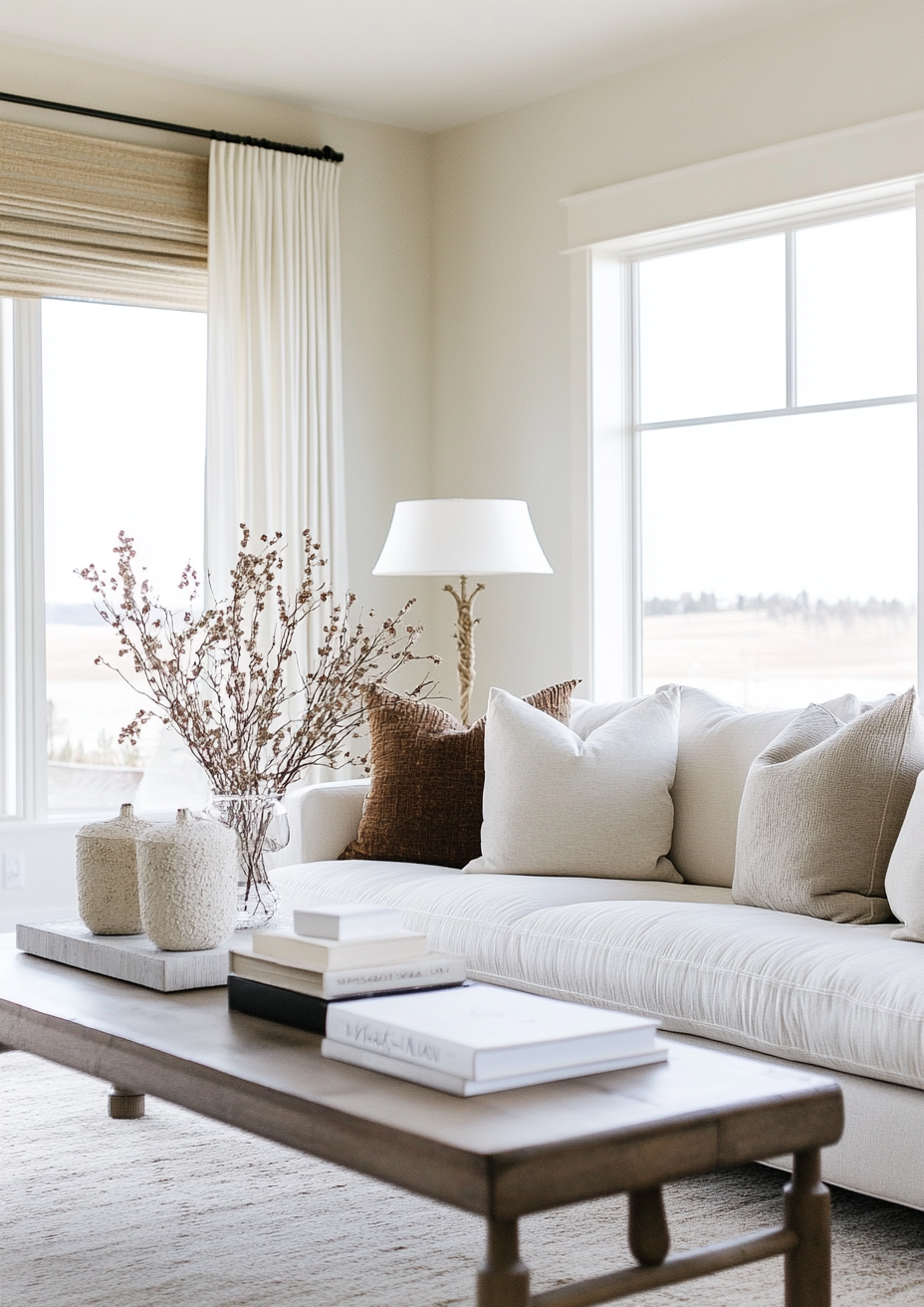
Choose Shoji White when the brief is sophisticated, earthy, quietly warm off-white with real depth and body. Organic modern, Japandi, and transitional interiors where warmth needs to be felt rather than announced. Rooms with warm wood floors, stone, rattan, and natural materials where the beige-greige complexity anchors naturally in the palette. Open-plan spaces where a warm off-white needs to handle varied light conditions reliably - the grey-green quality adapts gracefully across orientations without the violet-risk that Repose Gray carries in cool conditions.
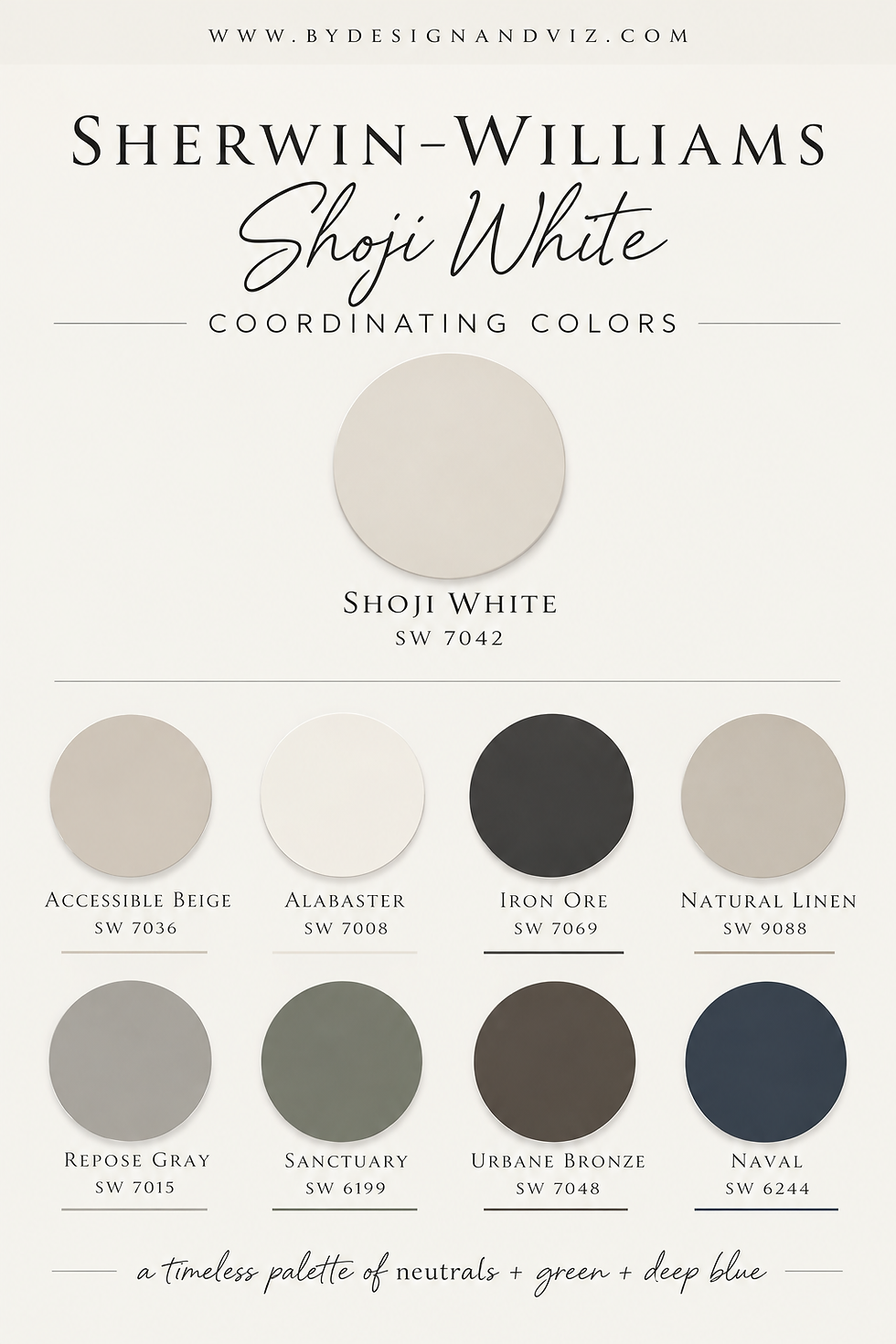
Shoji White is also the warmest and most natural trim choice alongside Agreeable Gray walls within the SW system - a pairing that highlights exactly where Shoji White's warm character shines against the right companion neutral. Trying to build a full palette around Shoji White rather than just choosing between it and Repose Gray? The Shoji White coordinating colors guide covers the best wall, trim, and accent pairings room by room.
When to Choose Repose Gray

Choose Repose Gray when sophisticated cool grey-greige depth is the brief. Contemporary, transitional, and organic modern interiors where the walls need to contribute a precise, architectural character. Rooms with good south-facing light or warm 2700K artificial lighting where the warm light suppresses the violet and the green-taupe quality comes forward. Open-plan kitchen-diners where a cool grey backdrop works with stone countertops, mixed metals, and contemporary joinery.
Avoid Repose Gray in rooms with north-facing light and no warm artificial lighting - in those conditions the violet undertone dominates and the colour reads as distinctly grey or lavender. Always sample it across a full day in your specific room before committing. The light sensitivity is real and varies dramatically between rooms.
How the Pairings Differ

For Repose Gray on walls, Pure White SW 7005 on trim is the only broadly reliable choice - the near-neutral quality provides clean definition without amplifying the cool undertone. Extra White SW 7006 gives a slightly brighter result. Shoji White on trim is one of the most common and most visible same-brand pairing mistakes with Repose Gray - the warm beige-greige activates the violet and makes both colours look worse. Alabaster SW 7008 has the same problem. No warm white works on trim for Repose Gray walls.
For Shoji White on walls, Alabaster SW 7008 on trim is the most natural pairing - the warm cream-greige bridges the beige-greige warmth without fighting the grey-green component. Pure White SW 7005 gives a cleaner, more contemporary result. Repose Gray on trim alongside Shoji White walls does not work - the cool grey depth reads as a mismatched colour rather than a trim white.
For flooring, Shoji White works most naturally with warm wood floors, warm stone, and natural materials - the warm beige-greige undertone creates an instinctively cohesive relationship with organic warm tones. Repose Gray works best with cool-to-neutral floor materials - white oak, light stone, limestone, and polished concrete suit the cool undertone. Warm wood floors alongside Repose Gray can work in south-facing rooms with 2700K lighting but require careful sampling.
For hardware, Shoji White suits warm metals - aged brass, warm bronze, and matte gold - and handles matte black in organic modern and Japandi schemes. Repose Gray is strongest with cool metals - brushed nickel, chrome, and matte black - though aged brass also works in warm-lit transitional schemes where the 2700K lighting suppresses the violet undertone.
Architect's Verdict - Shoji White or Repose Gray?

These two colours are not competing for the same brief. Both are sophisticated. Both have grey in their undertone family. But one is warm and one is cool - and that fundamental difference means they serve entirely different rooms and entirely different design intentions.
If the brief is sophisticated, earthy, quietly warm off-white with real depth - a colour that wears its warmth with restraint and adapts beautifully across varied conditions - Shoji White is the answer. Alabaster SW on trim. Warm wood floors. Organic and natural materials.
If the brief is sophisticated, complex cool grey-greige with genuine depth and contemporary precision - a colour that reads as a considered grey rather than a warm neutral - Repose Gray is the answer, with Pure White SW 7005 on trim, warm 2700K lighting, and cool-to-neutral floor materials. Never use Shoji White on trim alongside Repose Gray walls.
The test: decide whether the room needs to feel warm or cool. Shoji White always reads warm. Repose Gray reads cool in most conditions and needs warm light to read balanced. That single question decides it cleanly.
Frequently Asked Questions

Is Shoji White lighter than Repose Gray?
Yes - by 16 LRV points. Shoji White has an LRV of 74 and Repose Gray has an LRV of 58. Shoji White reads as a warm off-white with depth and body. Repose Gray reads as a medium cool grey-greige with real presence. The gap is clearly visible on a wall and the two colours sit in entirely different categories despite both being described as complex SW neutrals.
Can I use Shoji White on trim with Repose Gray on walls?
No - this is one of the most common same-brand pairing mistakes with Repose Gray. Shoji White's warm beige-greige undertone directly activates Repose Gray's violet component, making the walls read as more purple and the trim as more cream than either actually is. Use Pure White SW 7005 or Extra White SW 7006 on trim for Repose Gray walls.
Do Shoji White and Repose Gray have the same undertone?
No - despite both being described as having a grey-green quality, the base temperatures are fundamentally different. Shoji White's grey-green sits within a warm beige-greige base - the overall character is warm. Repose Gray's green component sits within a cool violet-grey base - the overall character is cool. They are different colours that use similar descriptor words for genuinely different qualities.
Which is better for north-facing rooms?
Shoji White handles north-facing rooms significantly more reliably than Repose Gray. The grey-green component adapts gracefully to cool indirect light - the colour shifts toward earthy greige rather than reading cold or flat. Repose Gray in a north-facing room with no warm artificial lighting is a genuine specification risk - the violet undertone surfaces and the colour can read as lavender or purple-grey. For any north-facing condition, Shoji White is the considerably safer choice.
What is the LRV of Shoji White vs Repose Gray?
Shoji White SW 7042 has an LRV of 74 and Repose Gray SW 7015 has an LRV of 58. The 16-point gap places them in different brightness categories. Shoji White reads as a warm off-white with real body. Repose Gray reads as a medium cool grey-greige with settled depth and presence.
Final Thought
Shoji White and Repose Gray are both outstanding colours for the right brief. The most important thing this comparison clarifies is that their grey components - though described with similar words - are entirely different in character and temperature.
Warm, earthy, sophisticated off-white that adapts gracefully across conditions - Shoji White with Alabaster SW on trim. Sophisticated, precise, cool grey-greige that rewards south-facing rooms and warm artificial lighting - Repose Gray with Pure White SW on trim. Never use Shoji White on trim alongside Repose Gray walls. Sample both at large scale in your specific room. The 16-point LRV gap and the warm vs cool character difference will be immediately clear.
Want a complete colour scheme built around Shoji White or Repose Gray? Our design packages cover full palette selection, finish recommendations, and 3D visualisations - see our packages. |
About the Author
Beril Yilmaz is a qualified architect and interior designer based in the UK. She runs BY Design And Viz, a design platform covering paint colour reviews, interior design guidance, and residential design projects. Beril has specified both Sherwin Williams Shoji White and Repose Gray across residential projects in the UK and internationally - Shoji White in organic modern and Japandi schemes where warm earthy sophistication is the brief, Repose Gray in contemporary open-plan schemes with warm artificial lighting and stone or white oak floors. Never together on trim and wall.



Comments