


Walk In Showers: 9 Designer Ways To Give Your Bathroom A Boutique Upgrade

Walk in showers have a reputation for being glossy, hotel-only territory, but they’re actually one of the most practical upgrades you can make to a UK bathroom. Done well, they handle busy weekday mornings, steam from long Sunday showers, and muddy kids or pets, all without feeling like a tight plastic box. The problem is, most people only think about the pretty tile and forget things like drainage, splash zones and where the shampoo will live.
If you’ve ever stood in a shower tray that feels slightly uphill, bumped your elbow on a badly placed screen, or realised your towel is three steps away on a freezing January morning, you’ll know design details matter. Walk in showers demand a bit more planning than “stick a glass panel there and hope for the best.” Layout, tile choice, levels and storage all work together, and when they’re considered, the whole bathroom feels calmer and more streamlined.
In this guide, we’ll walk through everything you need to know about walk in showers: how to plan them in small and large bathrooms, what type of screen and access works best, how to combine tiles, and where to hide the practical bits. Think of it as your designer-approved checklist before you speak
to a plumber or tile shop, so you can explain exactly what you want and avoid expensive mistakes.
At A Glance
What to check before replacing a bath with a walk in shower
How to plan layouts for narrow, square and en-suite bathrooms
Tile, grout and glass choices that look great long term
Where to put niches, benches and towel hooks
Drainage, levels and splash zones people often forget
Designer tips to brief your installer with confidence
1. Walk In Showers: Planning The Layout Before You Touch A Tile
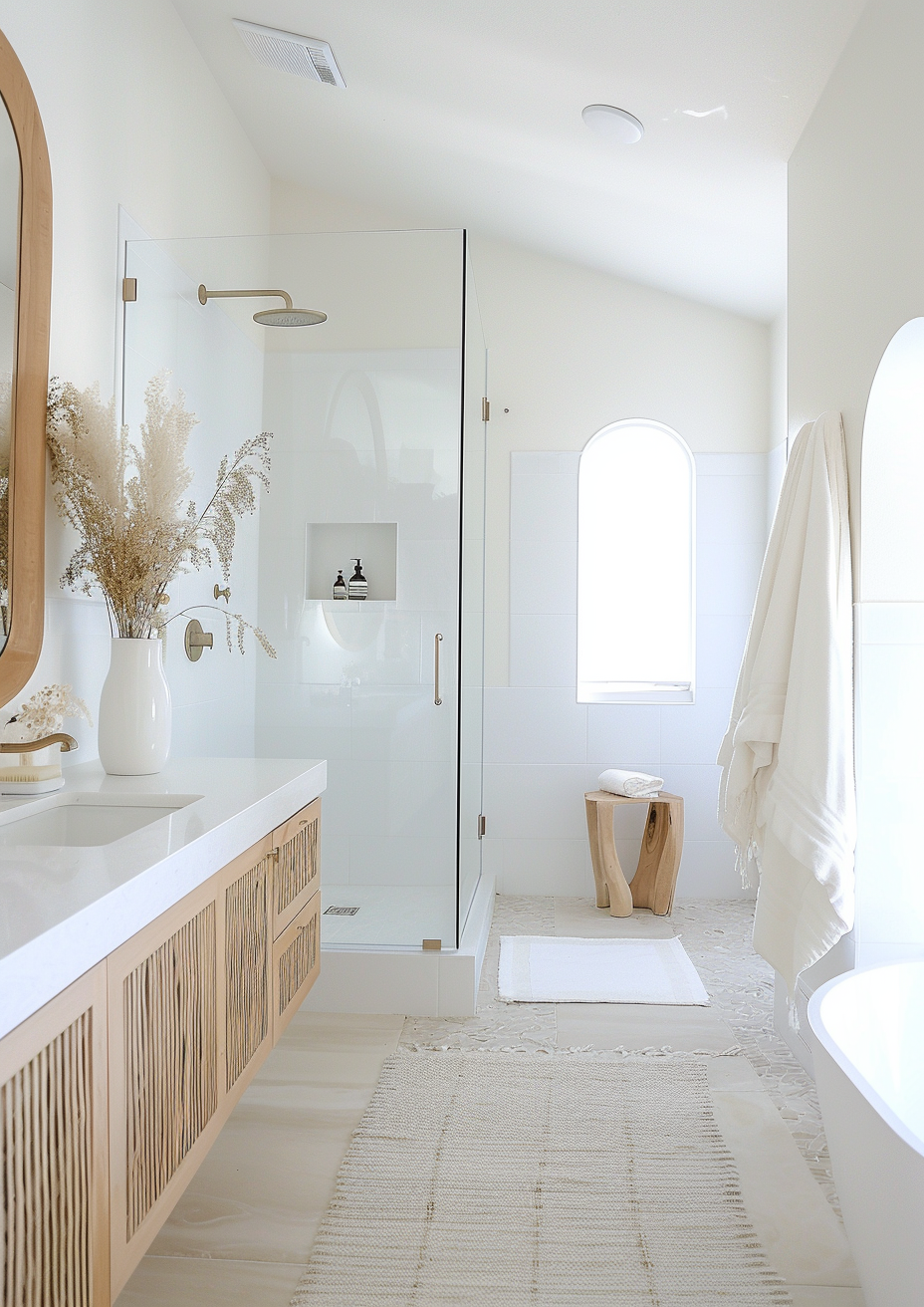
Before you fall in love with a tile sample, you need a clear layout for your walk in shower. Start with the fixed elements in the room: window positions, existing soil pipes, door swing and any sloping ceilings. In many UK homes, the simplest approach is to replace the tub footprint with a walk in shower, keeping plumbing roughly in the same place and giving you a generous, rectangular shower zone.
The key decision is where you’ll enter the shower and where the water will fall. A good rule is to place the main showerhead at the opposite end from the opening so you’re not stepping straight into a spray of water. Your glass screen then becomes a shield, not just a pretty divider. In very narrow rooms, this might mean a fixed glass panel with an open end; in square rooms, you might prefer a walk in shower in one corner with two tiled walls and a single glass front.
Designer Tip: Sketch two or three layout options on graph paper, including rough dimensions, and test them by “walking” the route from door to towel to shower. If it feels awkward on paper, it will feel even more awkward in real life.
2. Walk In Showers: Choosing Between Trays, Wet Rooms And Low-Level Thresholds

When people say walk in showers, they often mean three slightly different things: a standard tray with a glass panel, a low profile tray that almost blends into the floor, or a fully tanked wet room with continuous tiles. Each has its place. A quality tray can be quicker and more budget-friendly while still looking streamlined; a fully tiled wet room gives you a seamless, step-free run that works brilliantly for accessibility and future-proofing.
The right choice depends on your floor structure. Timber floors in older houses might need extra preparation to handle a wet room former and correct fall to the drain. Concrete floors can be easier to adapt but may require more labour to recess a tray. Whichever route you choose, drainage is non-negotiable: the floor must slope slightly towards the waste, and the waste needs enough capacity for the showerhead you specify, especially if you’re going for a generous rain head.
Designer Tip: Ask your installer to confirm the litres-per-minute capacity of your chosen waste and match it to the shower valve and head you want. This one check helps avoid that dreaded shallow puddle that never quite drains away.
3. Walk In Showers: Glass Panels, Doors And How To Stop Splash Zones

The glass is what makes walk in showers feel open and spacious, but it’s also where many bathrooms go wrong. Too short a panel and water escapes straight onto your bathroom floor; too long and it feels like you’re climbing through a letterbox. As a baseline, fixed panels generally work best at around 90–120cm wide, with a clear open end for access. In tight rooms, you might choose a hinged or sliding panel instead, especially if you need extra splash protection near a vanity or WC.
Think about how you’ll clean the glass too. Framed panels with horizontal bars can add a strong design line, but every frame is another edge that gathers limescale. Frameless or minimal-framed glass gives a cleaner look and is easier to squeegee down. Consider a treated glass that resists water marks if you’re in a hard-water area. And don’t forget height: taller panels help hold steam, stop water from escaping at the top, and make the room feel more tailored.
Designer Tip: Mark the proposed glass panel size on the floor with masking tape before ordering. Stand inside, step in and out, and pretend to reach for a towel. If your elbow grazes the “glass” or you feel squeezed, adjust the width before it becomes an expensive sheet of toughened reality.
How We Turn Walk In Showers Into Full Room Transformations
If you’re looking at your floor plan and feeling a bit overwhelmed by drains, glass widths and tile joints, this is exactly where we step in. We can plan your walk in shower layout, select the right tray or wet room system, and pull everything together into a full bathroom design you can hand straight to your installer.
If you’d like your bathroom to feel as considered as the inspiration photos you’ve saved, explore our interior and exterior design packages and see which level of support fits your project.
4. Walk In Showers: Tile Sizes, Layouts And Grout Colours That Work Hard

Tiles can make or break walk in showers. Large-format tiles with minimal grout lines create a streamlined look and are easier to clean, but they need perfectly straight walls and a good tiler. Smaller tiles, like mosaics or hexagons, add texture and grip underfoot but involve more grout, which needs more maintenance. The trick is to balance both: perhaps larger tiles on the walls with a smaller, grippier tile on the shower floor for safety.
Direction matters as much as size. Vertical stacks of rectangular tiles draw the eye up and make ceilings feel higher; horizontal running bond layouts emphasise width and length. You can use this to your advantage in a narrow bathroom by running tiles lengthways along the room, or in a low-ceiling space by stacking them to lead the eye upwards. Grout colour can either contrast to highlight the tile pattern or blend to create a more continuous surface.
Designer Tip: If you’re nervous about pattern, keep the main tiles simple and introduce interest in one focused area, such as a niche back or a single feature wall at the end of the shower. This keeps the look intentional rather than busy.
5. Walk In Showers: Niches, Ledges And Storage That Doesn’t Look Temporary

The fastest way to spoil beautiful walk in showers is clutter: bottles on the floor, razor balanced on the mixer, sponge hanging from the showerhead. Built-in storage is the answer. Recessed niches between studs are ideal if you have the wall depth; a single long niche along the back wall can hold everything without interrupting the tile pattern. If recessing isn’t possible, consider a low tiled ledge that runs the width of the shower and doubles as a perch for leg shaving.
Height and position are important. Niches should sit slightly below shoulder height, with enough space between the base and the showerhead to avoid direct spray filling the shelf. If your bathroom will be used by children or anyone with mobility needs, staggered niches at two heights can keep daily items within easy reach. And if you’re using patterned tile, think about how the pattern continues through the niche so it looks built-in, not like an afterthought.
Designer Tip: Measure the tallest bottles you use and add a little extra clearance. There’s nothing more frustrating than a beautiful niche that doesn’t quite fit your favourite shampoo.
6. Walk In Showers: Benches, Seats And Grab Points For Real-Life Use

Benches are no longer just for spa brochures; they’re incredibly practical in everyday walk in showers. A simple tiled bench along one wall gives you somewhere to sit, prop your foot, or rest a basket of products. In smaller en-suites, a corner bench can provide the same function without taking up as much floor area. If you’re planning to stay in your home long term, integrating a bench and a couple of discreet grab points is one of the simplest ways to future-proof the space.
The key is to keep benches within the main splash area so they rinse clean, but not directly under the showerhead where water will pool. Slightly slope the seat towards the drain and run the same floor tile up the bench front to keep it visually grounded. Materials matter, too: a slab of stone, quartz or a solid-surface top on the bench reduces grout lines and feels more high-end.
Designer Tip: Even a slim perch, roughly the depth of a tile and a bit, can make the shower feel more thoughtfully planned. Ask your installer to build the bench at dining-chair height for comfortable sitting.
Ready For A Walk In Shower Game Plan?
If you’re mentally adding benches, niches and new tile layouts while reading this, it might be time for a proper plan. We can map out your walk in shower, specify exact dimensions for benches and storage, and design the whole bathroom around it so everything feels like it belongs together. If you’d like a clear, visual design you can share with your fitter, book a free online consultation with us and we’ll talk through what’s possible in your space.
7. Walk In Showers: Small Bathroom Tricks That Stretch The Space

Walk in showers shine in small bathrooms because they remove visual barriers and chunky trays. In a narrow room, running the same floor tile straight into the shower without a step keeps the sightline uninterrupted. A single fixed glass panel, lined up with the edge of the vanity or window, creates a simple division while still letting light travel through. If privacy is a concern, reeded or lightly textured glass can blur outlines without blocking light completely.
Colour and contrast also affect how large the space feels. Keeping the wall and floor tiles in similar tones creates a single envelope, so your eye doesn’t stop and start at different heights. You can then layer in contrast through fixtures and hardware rather than large blocks of colour chopping up the room. And don’t forget the ceiling: painting it the same tone as the upper wall tiles can help the room feel taller and more cohesive.
Designer Tip: In truly tiny rooms, consider a sliding door into the bathroom instead of a standard swing door. That one change frees up valuable floor area and gives you more options for where your walk in shower can sit.
8. Walk In Showers: Replacing A Tub Without Losing Function

Swapping a bath for walk in showers is one of the most common renovation requests, especially in homes where the bath collects more dust than bubbles. The worry is always resale value and whether future buyers will miss the tub. The truth is, if you still have a bath elsewhere in the house, a well-designed walk in shower in the main bathroom can be a selling point, not a negative. The key is to make the new shower feel generous and clearly more practical than the old tub-shower combo.
When you remove the bath, take the opportunity to correct past compromises. Maybe that means moving the shower head to the opposite wall so you’re not standing under it while turning it on, or adding a ledge under the window to protect the frame from water. Think about towel placement too: the best layout lets you reach a towel without dripping across the room. A slim heated rail just outside the glass panel is ideal for this.
Designer Tip: Take before photos and rough measurements of your current bath setup. When planning your walk in shower, aim to improve at least three things: access, storage and lighting. If all three move in a better direction, you’re on the right track.
9. Walk In Showers: Lighting, Mirrors And Ventilation That Keep Mould Away

Walk in showers often steal the best natural light in the room, which is brilliant for your morning routine but not always for your mirror. Build a layered lighting plan: functional downlights inside the shower zone (rated for wet areas, of course), plus softer lighting above the vanity and perhaps an LED strip under a bench or niche for a subtle glow. Keep switches accessible from outside the shower so you’re not feeling around in the dark with wet hands.
Ventilation is just as crucial as lighting. A powerful, quiet extractor fan that runs on a timer or humidity sensor will help clear steam, protect your grout and reduce the chance of mould. Position it close enough to the shower area to be effective, and make sure it vents externally rather than just into a loft void. Mirrors with built-in demisters above the basin can also be a game-changer when the whole space is steamy after multiple morning showers.
Designer Tip: If your window sits within the shower zone, choose a frame and sill material that can handle regular splashes and specify a blind or film that tolerates humidity. It’s a small detail that saves a lot of maintenance later.
10. Walk In Showers: Hardware, Finishes And Details That Pull It All Together

Once the big decisions are made, the details bring your walk in shower to life. Choose a consistent finish for your hardware—whether that’s black, brass, chrome or stainless—and repeat it across the shower valve, head, hose, screen fixings and towel rail. This repetition gives the room a considered, pulled-together feel. If you’re mixing metals, do it intentionally: for example, a main finish for functional pieces and a secondary accent for accessories.
Even simple choices like drain covers and tile trims make a difference. A linear drain that matches your hardware can disappear into the floor, while colour-matched trims keep tile edges neat. Don’t forget the everyday items: matching pump bottles or a slimline dispenser system inside the niche instantly elevates the look compared to a jumble of packaging. These small decisions are what separate a basic shower from a designer-feeling space.
Designer Tip: Create a flatlay before you commit—lay out a sample of your floor tile, wall tile, grout swatches and hardware finishes together. If everything works in that small composition, it’s far more likely to work across the whole shower.
Conclusion
Walk in showers are one of those upgrades that touch everyday life far more than a new cushion or a single light fitting. They change how easily you move around your bathroom in the morning, how quickly the room dries out, and how streamlined the whole space feels. When the layout, drainage, glass and storage all work together, you get a shower that looks great in photos and behaves even better in real life.
The secret is planning. Rather than starting with a random tile you saw online, work through your room’s shape, the type of tray or wet room system that suits it, and how you want to move through the space. Add in good lighting, strong ventilation and thoughtful storage, and you’ve essentially given your bathroom a one-way ticket from “functional enough” to “this actually works for our life.”
If you’ve read this with a slightly critical eye on your current bathroom, that’s a good thing.
Use the ideas here as your checklist, talk them through with your installer, and don’t be afraid to push for details that make sense for your routine. Walk in showers are not just for spas and hotels; they can absolutely work in everyday homes, as long as the design is doing as much work as the plumbing.
FAQ: Walk In Showers
1. Are walk in showers a good idea for small bathrooms?Yes, walk in showers work brilliantly in small bathrooms when they’re planned carefully. A fixed glass panel, continuous floor tile and well-placed drain can make the room feel larger, while clever storage like niches keeps clutter off the floor and out
of sight.
2. Do walk in showers cause more water on the bathroom floor?If the opening is too wide, the floor is flat, or the showerhead points towards the entrance, then yes, you’ll see more spray. With the right fall to the drain, a correctly sized glass panel and the showerhead placed at the far end of the space, walk in showers can be just as contained as traditional enclosures.
3. Are walk in showers suitable if I plan to age in place?Walk in showers are often a better long-term option than a bath, especially when designed with a low threshold or level-access floor, a bench and a couple of discreet grab points. They remove the need to step over a high tub edge and can be tailored to changing mobility needs.
4. Do walk in showers add value to a home?In many cases, yes—particularly if there is still at least one bath elsewhere in the property. Buyers tend to appreciate a well-designed, generous walk in shower in the main bathroom or en-suite, especially when it feels considered, practical and easy to maintain.
Let’s Design The Walk In Shower You Actually Want
If you’re ready to swap guesswork for a clear plan, we’d love to help. We can design your full bathroom around a walk in shower that fits your layout, routine and future plans, then turn it into visuals and a shopping list your installer can follow. When you’re ready to step into a space that feels tailored rather than improvised, start your project with us and let’s design a bathroom that finally works the way you need it to.
Author Bio
Beril is an architect and interior designer who specialises in practical, design-led spaces for real homes, with a particular soft spot for clever bathrooms and layout puzzles. Through BY Design And Viz, she helps clients translate inspiration photos into clear, realistic plans, balancing budgets, materials and daily routines so every room looks considered and earns its place in the house.


Comments