


Alabaster vs Edgecomb Gray: The Comparison That Actually Helps You Decide

Updated: Sep 17
Alabaster and Edgecomb Gray appear together constantly on neutral shortlists - one from Sherwin Williams, one from Benjamin Moore, both described as warm, sophisticated, and broadly versatile. Both are warm. Both are enduringly popular. Both appear in the same open-plan schemes and whole-house palettes. On a mood board in warm light they look like natural companions. On a wall in a real room the 19-point LRV gap between them is clearly and immediately visible, and the color category difference between them is just as significant.
Alabaster reads as a white. At LRV 82 it is a warm off-white - a white with warmth rather than a neutral with lightness. Edgecomb Gray reads as a color. At LRV ~63 it is a warm beige-greige with genuine depth and settled presence - a neutral that reads as a deliberate color decision on four walls rather than a bright open backdrop. These two colors are not competing alternatives for the same brief. They are different categories of color that serve different purposes - and the cross-brand relationship between them has practical pairing implications that most comparisons ignore entirely.
This guide covers exactly how Alabaster and Edgecomb Gray differ in undertone, LRV, light behavior, and room application - with a clear verdict on which one to choose and when, and an honest answer to the cross-brand trim question.

At a Glance
| Alabaster SW 7008 | Edgecomb Gray HC-173 |
Brand | Sherwin Williams | Benjamin Moore |
LRV | 82 - bright warm off-white, reads as a white | ~63 - medium-light warm greige, reads as a color |
Color category | Warm off-white - reads as white with warmth | Warm greige - reads as a settled neutral color |
Undertones | Warm cream-yellow with greige anchor - consistent | Warm beige-greige with taupe quality - sophisticated, balanced |
Character | Bright, warm, open white backdrop | Warm, grounded, balanced greige with real presence |
North-facing | Excellent - greige anchor holds warmth reliably | Excellent - taupe-beige holds well in cool indirect light |
South-facing | Beautiful - warm and luminous | Excellent - warm beige quality glows in good light |
Open-plan | Excellent - consistent across orientations | Excellent - one of BM's most consistent open-plan greiges |
On walls | Bright warm white backdrop | Settled warm greige neutral with body and presence |
On cabinets | Classic timeless warm white | Sophisticated warm greige - suits transitional kitchens |
Use together? | Yes - with BM trim whites alongside Edgecomb Gray walls | Stay within BM system for trim on Edgecomb Gray walls |
Trim for each | Pure White SW or Extra White SW | White Dove BM or Simply White BM |
Style fit | Traditional, transitional, organic modern, farmhouse | Traditional, transitional, contemporary - broadly versatile |
Architect's pick | When warm white backdrop is the brief | When warm greige with depth and presence is the brief |
SW Alabaster SW 7008 - What It Really Looks Like

Alabaster has an LRV of 82 and a warm cream-yellow undertone anchored by a subtle greige base. It reads as a warm off-white on a wall - clearly warm, clearly inviting, but still clearly a white rather than a greige or neutral color. The greige anchor prevents the yellow from tipping into obvious cream territory and gives Alabaster its broad adaptability across varied light conditions and material palettes.
Alabaster reads as a white. Edgecomb Gray reads as a color. That is the most important distinction in this comparison. Alabaster on walls creates a bright, warm, open backdrop that enhances the warmth of the materials and furnishings around it. Edgecomb Gray on walls creates a warm, settled atmosphere where the wall color actively contributes to the character of the room rather than simply providing a bright backdrop.
Alabaster is also the most broadly reliable SW warm white for trim and cabinets alongside warm greige wall colors. For how it performs alongside Accessible Beige - the SW warm greige it is most commonly paired with as trim - the Alabaster vs Accessible Beige guide covers that wall-and-trim relationship in full.
For how Alabaster compares to SW Natural Linen - a warm beige with even more colour and body than Edgecomb Gray, sixteen LRV points below Alabaster - the Natural Linen vs Alabaster guide sets out the soft-white-versus-warm-beige decision and the dusk light test that settles it.
BM Edgecomb Gray HC-173 - What It Really Looks Like

Edgecomb Gray has an LRV of approximately 63 - sitting in a particularly useful position in the BM greige family. It is noticeably deeper than Pale Oak (LRV ~70) and meaningfully lighter than Revere Pewter (LRV ~55). That middle position is precisely what makes it so valuable: it provides the depth and presence that Pale Oak lacks in rooms that need a color with genuine body, without the complexity and light-sensitivity risk of Revere Pewter's deeper, more complex undertone.
The undertone is warm beige-greige with a soft taupe quality - balanced, sophisticated, and broadly versatile. It reads as a warm neutral that sits comfortably between beige and grey without committing strongly to either direction. In warm south-facing light the beige quality comes forward and Edgecomb Gray reads as a beautifully warm, settled greige. In north-facing conditions the grey component moderates the warmth and the color reads as a restrained, sophisticated neutral. One of its most practically valuable qualities is its consistency across orientations - for open-plan spaces it holds its character more reliably than many greiges at this depth. For the full standalone picture on its behavior and best applications, the Edgecomb Gray standalone review covers every room type and condition.
Edgecomb Gray needs BM trim whites from the same paint system. White Dove OC-17 is the most reliable trim pairing - the warm grey-cream quality relates naturally to Edgecomb Gray's beige-greige direction and creates a warm, considered result. Simply White OC-117 works as a brighter, crisper alternative. Chantilly Lace OC-65 provides maximum contrast and suits contemporary schemes. All three keep the trim within the BM system.
For how Edgecomb Gray compares to SW Agreeable Gray - the more gray, slightly cooler greige it is most often cross-shopped against, and the one that carries a north-light risk Edgecomb Gray does not - the Agreeable Gray vs Edgecomb Gray guide explains the undertone difference and why a north-facing wall decides the choice.
The Real Difference Between Alabaster and Edgecomb Gray
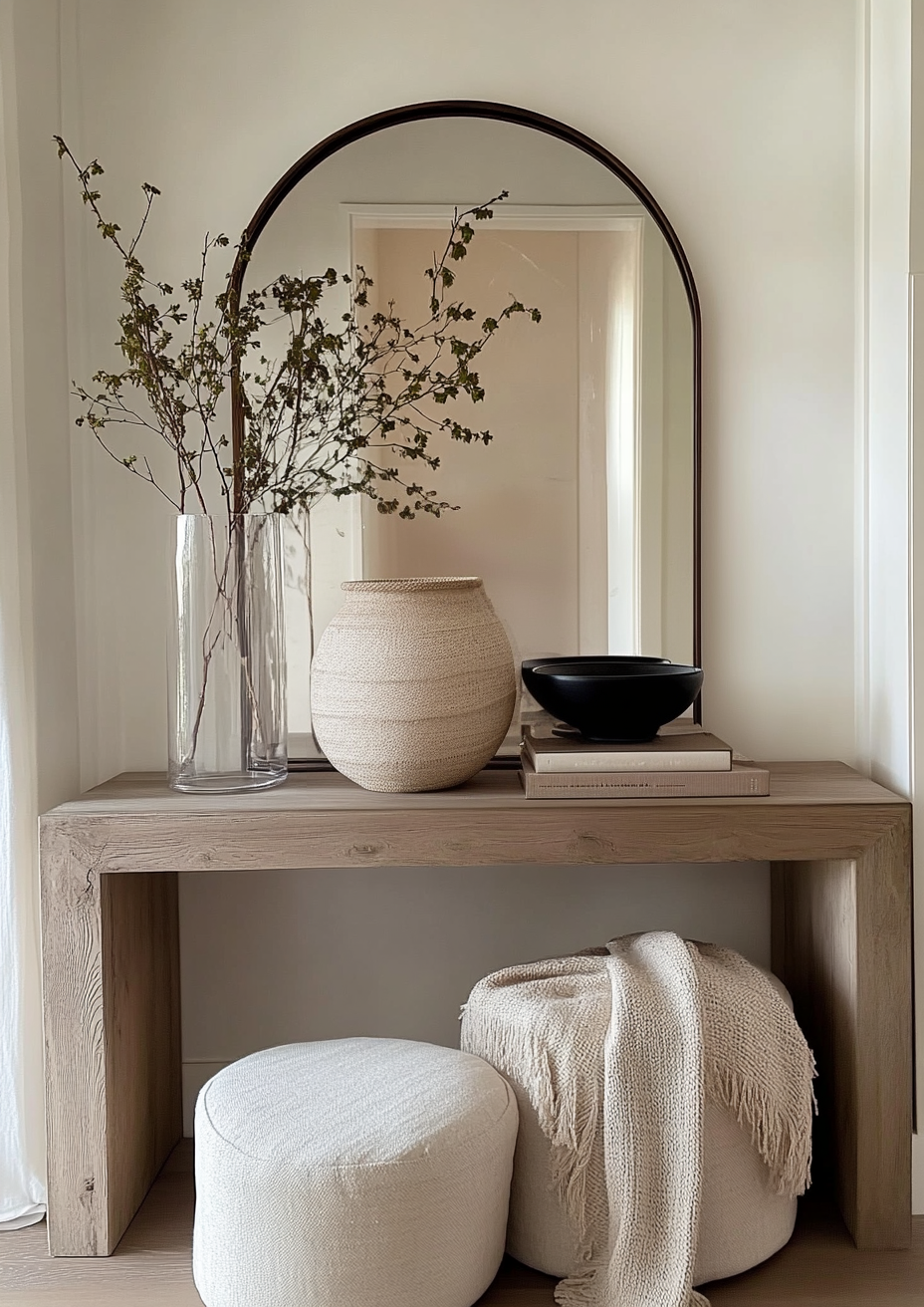
Alabaster is a warm white. Edgecomb Gray is a warm greige. They are different categories of color that serve fundamentally different purposes in a room. For how Alabaster compares to Drift of Mist - a Sherwin-Williams neutral with a similarly complex, shifting undertone but a lower LRV and more gray-green lean - the Drift of Mist vs Alabaster guide explains why Alabaster stays dependable where Drift of Mist can shift with the light.
The 19-point LRV gap is the most immediately visible difference - Alabaster reads as noticeably brighter and lighter, Edgecomb Gray reads as deeper and more grounded. But the character difference is equally consequential. Alabaster rooms feel bright, warm, and open. Edgecomb Gray rooms feel warm, settled, and specifically greige - with a sophistication and depth that Alabaster's lighter, brighter character cannot fully replicate.
The cross-brand trim question is the most practically important aspect of this comparison. Many schemes use Edgecomb Gray on walls and reach for Alabaster SW on trim - the instinct being that Alabaster's warm cream quality will complement Edgecomb Gray's warm beige-greige warmly. The reality is more nuanced. Alabaster is SW and Edgecomb Gray is BM - cross-brand mixing on adjacent surfaces creates undertone conflicts and color matching problems that are difficult to resolve on site. More specifically, Alabaster's cream-yellow undertone can sit uneasily against Edgecomb Gray's taupe-beige direction in certain light conditions, making the trim read as slightly yellowed or creamy rather than warm and considered.
White Dove OC-17 or Simply White OC-117 from the BM system are the correct and most reliable trim choices for Edgecomb Gray walls. They stay within the same paint system, relate naturally to Edgecomb Gray's undertone family, and provide the right balance of warmth and definition. For the full comparison of Edgecomb Gray against Pale Oak - the lighter BM greige it is most often compared to - the Edgecomb Gray vs Pale Oak guide gives the most useful BM greige family context.
Not sure which one works for your room? A color consultation is included in all our design packages - book directly here. |
When to Choose Alabaster

Choose Alabaster when the brief is warm white - bright, open, and broadly reliable. Rooms where the walls need to read as white while contributing genuine warmth. North-facing rooms, south-facing rooms, open-plan spaces with mixed orientations - Alabaster handles all of them consistently. Trim and cabinets throughout any warm-palette home. Any room where Edgecomb Gray's depth and greige presence would feel too committed or too colored for the brief. For how Alabaster compares to Revere Pewter - a Benjamin Moore mid-tone greige that's usually paired with Alabaster rather than substituted for it - the Alabaster vs Revere Pewter guide covers the 26-point LRV gap and the classic wall-and-island pairing between them.
Avoid Alabaster when the brief calls for a neutral with depth and color presence. At LRV 82 it will always read as a warm white backdrop - it will never deliver the settled, grounded greige quality that Edgecomb Gray creates on four walls. For how Alabaster relates to deeper SW warm neutrals in same-brand pairing, the Alabaster vs Agreeable Gray guide covers the wall-and-trim logic for that SW pairing.
When to Choose Edgecomb Gray

Choose Edgecomb Gray when a warm, sophisticated greige with real depth and presence is the brief. Traditional, transitional, and warm contemporary interiors where the walls need to contribute character rather than simply provide a bright backdrop. Open-plan spaces - Edgecomb Gray's consistent, balanced undertone holds well across varied light conditions, making it one of the most reliable BM greiges for multi-orientation schemes. Rooms with warm wood floors, warm stone, and brass or bronze hardware where the beige-greige quality ties naturally into the palette.
Edgecomb Gray is also the right answer when Pale Oak feels too pale and the brief needs just a little more depth and presence without committing to the weight of a full medium-depth neutral. It sits in precisely the most useful position in the BM greige family for that brief. Avoid it only in very small rooms with extremely limited natural light, where the depth can feel heavier than intended.
For the comparison of Edgecomb Gray against BM Chantilly Lace - the crisp near-neutral white 29 LRV points above that is a legitimate trim option for Edgecomb Gray walls in contemporary schemes - the Chantilly Lace vs Edgecomb Gray guide covers the colour category difference and the trim question in full.
How the Pairings Differ

For Edgecomb Gray on walls, White Dove OC-17 on trim is the most natural and most consistently reliable BM pairing - the warm grey-cream undertone of White Dove relates to Edgecomb Gray's beige-greige direction and creates a warm, enveloping, considered result. Simply White OC-117 provides a slightly brighter, crisper boundary. Chantilly Lace OC-65 gives maximum contrast for contemporary schemes. All three stay within the BM system - do not use Alabaster SW on trim adjacent to Edgecomb Gray BM walls.
For Alabaster on walls, Pure White SW 7005 or Extra White SW 7006 on trim provides clean definition. Edgecomb Gray on trim alongside Alabaster walls does not work - the deeper greige trim makes the warm white walls look yellowed by contrast and the scheme reads as heavy and unresolved. For how Alabaster compares to Drift of Mist - a Sherwin-Williams neutral with a similarly complex, shifting undertone but a lower LRV and more gray-green lean - the Drift of Mist vs Alabaster guide explains why Alabaster stays dependable where Drift of Mist can shift with the light.
For flooring, both colors work with warm wood tones. Edgecomb Gray relates particularly well to warm oak, medium walnut, and warm stone - the beige-greige quality shares the same warmth direction as these floor materials. Alabaster is more broadly flexible and handles a wider range of floor finishes including cool stone and contemporary tile without undertone conflict.
For hardware, both colors suit aged brass and warm metals. Edgecomb Gray also works with brushed nickel and matte black in contemporary schemes - the balanced beige-grey undertone handles cool metals comfortably. Alabaster is slightly less comfortable with very cool hardware finishes - the cream-yellow undertone can create a subtle tension with polished chrome.
For the comparison between Edgecomb Gray and Dove Wing - two Benjamin Moore neutrals separated by fourteen LRV points and a significant difference in undertone confidence - the Dove Wing vs Edgecomb Gray guide explains which one to choose depending on how much presence the room actually needs.
Architect's Verdict - Alabaster or Edgecomb Gray?

For trim, cabinets, and any surface where warm white is needed throughout a warm-palette home - Alabaster is the natural first choice within the SW system. For walls where the brief is a bright, open, reliable warm backdrop that works across all conditions - Alabaster again.
Edgecomb Gray is the right choice when a warm, sophisticated greige with genuine depth and color presence is the brief - and when the room has the space and light to support that presence. In a south-facing living room or bedroom with warm wood, warm stone, and warm brass, Edgecomb Gray creates a quality of warmth and sophistication that Alabaster's brighter, lighter character simply cannot deliver. The depth reads as intentional and the beige-greige character gives the room a settled, considered atmosphere.
The test: hold large samples of both in your room in morning light and under your evening artificial lighting. If Edgecomb Gray looks warm and settled in both conditions, choose Edgecomb Gray. If it reads slightly heavy or too committed for the room's brief, Alabaster on walls is your answer.
Frequently Asked Questions
Is Alabaster lighter than Edgecomb Gray?
Yes - by 19 LRV points. Alabaster has an LRV of 82 and Edgecomb Gray has an LRV of approximately 63. The gap is clearly visible on a wall - Alabaster reads as a bright warm white and Edgecomb Gray reads as a medium-light warm greige with real presence and body. They belong to entirely different color categories.
Can I use Alabaster on trim with Edgecomb Gray on walls?
Not recommended as a first choice. Alabaster is SW and Edgecomb Gray is BM - cross-brand mixing on adjacent surfaces creates undertone conflicts and color matching problems. Alabaster's cream-yellow undertone can also sit uneasily against Edgecomb Gray's taupe-beige direction in certain light conditions. The reliable choices are White Dove OC-17 or Simply White OC-117 from the BM system - both stay within the same paint system and relate naturally to Edgecomb Gray's undertone family.
Which is better for an open-plan space?
Both perform well in open-plan spaces - but for different briefs. Alabaster as a warm white reads consistently bright and warm across varied orientations. Edgecomb Gray is one of BM's most consistently balanced open-plan greiges - its taupe-beige undertone holds well across different light conditions without the dramatic shifts that more complex greiges can produce. If the brief is warm white throughout - Alabaster. If the brief is warm greige throughout - Edgecomb Gray.
Which is better for a north-facing room?
Both handle north-facing rooms reliably - this is one comparison where north-facing is not a decisive factor. Alabaster's greige anchor prevents the cream from reading as heavy or obviously yellow in cool indirect light. Edgecomb Gray's balanced beige-grey undertone holds its warmth without shifting cold in north-facing conditions. Either works in north-facing rooms. The choice between them is about color category and brief, not north-facing performance.
What is the LRV of Alabaster vs Edgecomb Gray?
Alabaster SW 7008 has an LRV of 82 and Edgecomb Gray HC-173 has an LRV of approximately 63. The 19-point gap puts them in entirely different brightness categories. Alabaster reads as a bright warm off-white. Edgecomb Gray reads as a medium-light warm greige with real presence on a wall. The LRV difference reinforces why these are different color categories rather than competing alternatives for the same wall.
Final Thought
Alabaster and Edgecomb Gray are both excellent colors for the right brief. The choice between them is not about which is better - it is about which color category your room actually needs.
If the brief is warm white backdrop - Alabaster on walls with Pure White SW on trim. If the brief is warm, sophisticated greige with depth and presence - Edgecomb Gray on walls with White Dove BM on trim. And if you are asking whether to use Alabaster SW on trim alongside Edgecomb Gray BM walls - stay within the BM system and use White Dove or Simply White instead. The cross-brand mix creates undertone problems that the within-system alternatives avoid entirely. Buy sample pots of both, paint large patches in your room, and look at them across a full day. The answer will be clear within 24 hours.
Want a complete color scheme built around Alabaster or Edgecomb Gray? Our design packages cover full palette selection, finish recommendations, and 3D visualizations - see our packages. |
About the Author
Beril Yilmaz is a qualified architect and interior designer based in the UK. She runs BY Design And Viz, a design platform covering paint color reviews, interior design guidance, and residential design projects. Beril has applied both Sherwin Williams Alabaster and Benjamin Moore Edgecomb Gray across residential projects in the UK and internationally.


Comments