


Benjamin Moore Fog Mist OC-31 - An Architect's Honest Review

Benjamin Moore Fog Mist OC-31 is one of the most underspecified and most misunderstood colours in the entire BM Off-White collection - and in my practice, it is also one of the most rewarding when it lands in the right room. The reason it gets overlooked is simple: on a paint chip in a store it looks like a pale, unassuming near-neutral, easy to pass over in favour of the more obviously warm greiges that dominate most shortlists. On a wall in the right room it creates a calm, sophisticated, fresh atmosphere that warm neutrals simply cannot replicate.
Fog Mist is cool. That is the single most important fact to understand before going any further. It does not sit in the warm greige family. It has a cool grey-green undertone that places it in a completely different category from Pale Oak, Edgecomb Gray, or Balboa Mist. Most people searching for a soft BM neutral gravitate toward the warm family by default - and if that is your brief, Fog Mist is not the right answer. But if the brief is calm, cool, restrained, and contemporary, it is one of the most distinctive and most beautiful options in the range.
This review covers everything you need to know about Fog Mist - its undertone, its LRV, how it behaves in different light conditions, what to pair it with, and an honest assessment of exactly who this colour is and is not right for.
Fog Mist OC-31 - The Key Facts
Collection | Benjamin Moore Off-White Collection |
LRV | ~72 (light, airy zone - reads as bright without being high-reflectance white) |
Undertone | Cool grey-green - restrained, misty, calm |
Character | Contemporary, Scandinavian, spa-like, architectural |
Best trim | Chantilly Lace OC-65 or Simply White OC-117 |
Best orientation | South or west-facing - needs warm light to perform at its best |
Main risk | Cool undertone reads cold or flat in north-facing rooms or under cool artificial light |
Fog Mist Undertones - What Is Actually Going On

The undertone of Fog Mist is cool grey-green - and understanding precisely what that means in practice is essential before committing to it. It is not obviously green in the way that October Mist or Aganthus Green would be. It does not read as a green colour on a wall. The grey anchor in the formula is strong enough to prevent that. What it reads as is a cool, calm, misty neutral - a colour that is clearly not warm beige, not obviously grey, and not white, but something more distinctive and more specific than any of those.
The grey in the undertone is what gives Fog Mist its architectural quality - the restraint and precision that makes it feel considered rather than accidental. The green is what gives it freshness and life - it prevents the grey from reading as flat or cold in the way that a pure cool grey can. Together, the grey-green reads as calm, sophisticated, and quietly beautiful in conditions where there is warmth in the room to counterbalance the cool direction.
Where the undertone creates risk is in rooms that are themselves cool - north-facing orientation, cool artificial lighting, predominantly cool or hard materials. In those conditions the grey-green quality has nothing warm to balance it against and the colour can read as cold, flat, or more grey than intended. I have had clients who were thrilled with Fog Mist in the showroom and disappointed on the wall - in every case the room was north-facing with cool LEDs and no warm materials. The colour had not changed - the context had removed everything it needed to perform.
For the cross-brand comparison of Fog Mist against SW Alabaster - the warm off-white at the opposite end of the undertone spectrum - the Alabaster vs Fog Mist guide explains exactly why these two should never share adjacent surfaces and which one your room actually needs.
LRV - What 72 Means in a Real Room
At LRV ~72, Fog Mist sits in the light zone - bright enough to keep a room feeling open and airy, deep enough to read as a colour with genuine identity rather than a near-white backdrop. It is fractionally lighter than Pale Oak (~70) and sits meaningfully lighter than Balboa Mist (~67) or Edgecomb Gray (~63).
In practical terms, LRV 72 means Fog Mist will not make a room feel dark or heavy - even in a smaller space it has enough reflectance to keep things feeling open. What it does not do is flood a room with light the way a true off-white at LRV 84-92 would. It has presence. It reads as a wall colour with a deliberate identity, not a white that happens to have a faint tint.
The LRV matters most in rooms where you are comparing Fog Mist to lighter alternatives - if you are considering Fog Mist versus Chantilly Lace or Simply White for a small north-facing room, the 20-point LRV gap is significant and you will feel it. If you are comparing it to Pale Oak or Balboa Mist in a south-facing room, the 2-point gap is negligible and the undertone direction is the only meaningful difference.
For how Fog Mist compares to BM Edgecomb Gray - the warmer, deeper greige 7 LRV points below where the cool-versus-warm undertone difference creates genuinely different rooms - the Fog Mist vs Edgecomb Gray guide covers which one suits which brief.
How Fog Mist Behaves in Different Light

South-Facing Rooms
South-facing rooms are where Fog Mist is most consistently beautiful and where I specify it with greatest confidence. In warm natural light the grey-green undertone reads as genuinely refined and sophisticated - calm, fresh, and alive. The warmth of south-facing light balances the cool undertone and the colour sits on walls with the kind of considered restraint that warm neutrals rarely achieve. I have specified Fog Mist in south-facing bathrooms and bedrooms with white oak floors and brushed nickel fixtures and the result has consistently been one of the most serene and beautiful neutral effects I can produce. In those conditions it is exceptional.
North-Facing Rooms
North-facing rooms are where Fog Mist requires the most careful judgement - and where I have seen it go wrong most often in my practice. The cool indirect light of a north-facing room has no warmth to counterbalance the grey-green undertone, and in those conditions the colour can shift toward flat, cold, or more obviously grey-green than the chip suggested. This is not a failing of the colour - it is simply the interaction of a cool undertone with cool light.
If you have a north-facing room and are committed to Fog Mist, the minimum specification I would recommend is: 2700K warm-spectrum lighting throughout (I would not use 3000K or above in this combination), warm wood floors or warm wood furniture as the dominant floor material, at least one warm metal element - brass, bronze, or aged gold - and warm linen or natural textiles. With all four of those elements providing warmth, Fog Mist in a north-facing room can hold its quality. Remove any of them and the risk increases significantly.
East and West-Facing Rooms
East-facing rooms receive warm morning light and cool afternoon light - Fog Mist in an east-facing room reads beautifully in the morning and can feel slightly more restrained and cool in the afternoon. For rooms primarily used in the morning - a breakfast room, a home office used before midday - this can be genuinely pleasant. For rooms used across all hours, the shift is worth observing on a large sample before committing.
West-facing rooms are often the most flattering for Fog Mist after south-facing. The warm evening light from the west activates the colour beautifully and the grey-green reads at its most sophisticated and refined in the late afternoon and evening hours. For a sitting room or dining room used primarily in the evening, a west-facing Fog Mist room with warm lighting can be genuinely extraordinary.
Artificial Lighting
Artificial lighting specification is non-negotiable with Fog Mist - this is the lesson I reinforce with every client who chooses it. Under warm-spectrum bulbs at 2700K the grey-green quality reads as calm and sophisticated - the warmth of the light provides the counterbalance that the cool undertone needs. Under cool daylight bulbs at 4000K or above, the grey-green can become more prominent and the colour reads as cooler and flatter than intended. I do not specify Fog Mist in rooms where the client insists on cool or neutral artificial lighting. The two are incompatible.
Thinking about Fog Mist for your home? Book a colour consultation here - bydesignandviz.com/book-online |
Trim Colours and What to Pair With Fog Mist

Trim - Crisp Whites Only
The most important trim rule for Fog Mist is to stay in the crisp white family - not the warm cream family. Chantilly Lace OC-65 is the trim colour I specify most consistently alongside Fog Mist. Its near-neutral crispness creates a clean boundary against the cool wall colour without introducing warmth that fights the undertone direction. The contrast reads as precisely architectural and considered. The full palette logic for Chantilly Lace on trim is in the Chantilly Lace coordinating colors guide.
Simply White OC-117 is a reliable alternative when a slightly warmer trim is needed - it sits just on the warm side of neutral and creates a slightly softer boundary than Chantilly Lace without introducing the obvious creaminess that fights Fog Mist's cool undertone.
Avoid White Dove OC-17 and Alabaster SW 7008 on trim alongside Fog Mist. I have seen this combination in rooms I was called in to review and the result is consistent: the warm cream of the trim makes the cool wall colour look colder and more grey-green by contrast. The undertone conflict is clearly visible and creates a result that reads as unresolved.
Floor Materials
White oak and pale natural wood floors are the most reliable flooring pairing for Fog Mist - the neutral-to-cool quality of white oak relates naturally to the cool grey-green of the walls without creating an undertone conflict. In a south-facing room, white oak floors with Fog Mist walls and Chantilly Lace trim is one of the most quietly beautiful neutral combinations I have produced.
Warm honey oak or orange-toned wood floors create an undertone conflict with Fog Mist - the warm orange of the floor fights the cool grey-green of the walls and neither colour reads well. If you have warm honey oak floors and are committed to Fog Mist, the palette needs significant compensating elements - warm textiles, warm lighting, warm furniture - and even then the floor-wall relationship will require careful management.
Cool stone, large-format warm grey tile, and polished concrete are all strong floor choices alongside Fog Mist - the shared cool-neutral family creates a cohesive, contemporary result that reads as deliberate and considered.
Metal Finishes
Brushed nickel and chrome are the most natural metal companions for Fog Mist - the cool silver quality sits in the same undertone family and the combination reads as cohesive and refined. In a bathroom with Fog Mist walls, brushed nickel fixtures, cool marble, and white oak vanity, the palette creates a genuinely spa-like result.
Warm brass can also work beautifully alongside Fog Mist when used deliberately as contrast - the warm-cool juxtaposition is one of the most satisfying design combinations available and brass alongside Fog Mist creates exactly this tension. The key is committing to the contrast: if there is brass, it should be clearly intentional, not apologetic. A single brass tap fitting in an otherwise cool Fog Mist bathroom can look accidental. Multiple brass elements - tap, towel rail, mirror frame, accessories - read as a deliberate warm accent against the cool walls.
Accent Colours
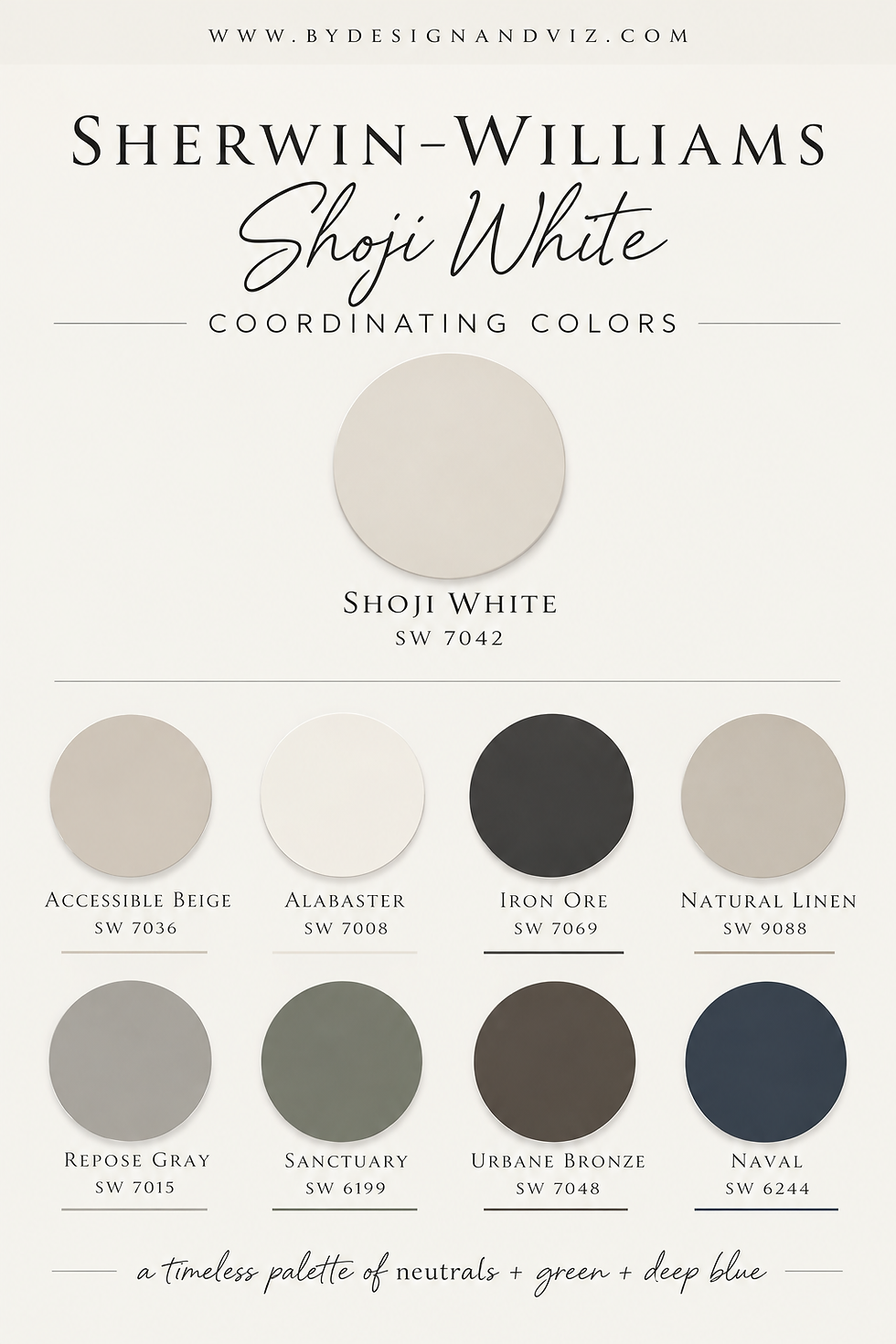
The accent colours that work best alongside Fog Mist are those that either share its cool family or provide deliberate warm contrast. Deep navy - Hale Navy HC-154 or Naval SW 6244 - alongside Fog Mist walls creates a beautiful high-contrast combination in studies, libraries, and living rooms. The shared cool quality means there is no undertone conflict and the navy provides the depth and drama that Fog Mist's light LRV cannot deliver on its own.
Soft sage and muted dusty greens relate naturally to Fog Mist's grey-green undertone and create a restrained, organic palette. Deep charcoal - Kendall Charcoal HC-166 or Wrought Iron 2124-10 - on a feature wall or in joinery alongside Fog Mist walls creates a sophisticated, architectural combination.
Avoid warm terracotta, rust, or orange accents alongside Fog Mist - the warm-orange family fights the cool grey-green in the same way that warm honey oak floors do. The contrast reads as an undertone mistake rather than a considered combination.
Fog Mist Room by Room

Bathrooms
Bathrooms are where Fog Mist performs most reliably and most impressively - and they are the application I recommend most readily to clients who are drawn to this colour. The spa-like, cool, serene quality is precisely what most people want from a bathroom, and Fog Mist delivers it with a sophistication that pure white cannot match. My standard specification for a Fog Mist bathroom is: Fog Mist walls, Chantilly Lace ceiling and trim, white oak or cool stone floor, brushed nickel or chrome fixtures, cool marble or large-format cool stone tiles, and natural linen towels. In a south-facing bathroom this combination is genuinely extraordinary.
Bedrooms
Fog Mist in a bedroom creates a calm, restful atmosphere that suits contemporary and Scandinavian briefs beautifully - the cool grey-green is genuinely conducive to rest and the light LRV prevents it from feeling heavy or oppressive. I have specified it in south and west-facing bedrooms with white oak floors, warm linen bedding, and 2700K bedside lighting to consistently good results. The key specification note: the bedside lighting temperature matters significantly - the 2700K warmth is what prevents the grey-green from reading as cold in the evening hours when the room is primarily used.
In north-facing bedrooms I would think carefully before committing to Fog Mist - the cool orientation combined with a cool undertone requires significant warm material investment to prevent the room reading as cold and flat at night.
Living Rooms
Living rooms are where Fog Mist is most design-brief-specific - it suits contemporary, Scandinavian, and coastal living rooms naturally but requires real commitment. In a south or west-facing living room with white oak floors, natural linen sofas, deep navy accent, and warm brass table lamps, Fog Mist on walls creates a space that reads as genuinely considered and distinctive - the kind of room that people comment on. In a traditional living room with warm wood, warm textiles, and a warm colour scheme, Fog Mist will fight the brief and the colour will not read at its best.
Kitchens
Fog Mist on kitchen walls in a contemporary kitchen is a strong and underused choice - the cool grey-green reads as clean and architectural alongside white or light grey cabinetry, cool stone countertops, and brushed nickel hardware. On kitchen cabinets it is a more specific and more demanding choice - it suits handleless contemporary cabinetry in a south-facing kitchen but requires careful material coordination throughout.
Home Offices and Studies
Fog Mist is one of my most consistent specifications for home offices and studies - the cool, calm quality is genuinely conducive to focused work and the restrained character prevents the room from feeling distracting. Paired with deep navy shelving or a dark feature wall, warm brass desk lamp, and white oak desk, a Fog Mist study creates one of the most satisfying work environments I know how to produce.
Need help deciding if Fog Mist is right for your room? See our design packages here - bydesignandviz.com/#interiordesignpackages |
Who Fog Mist Is Right For - And Who It Is Not

Fog Mist is right for you if:
The interior style is contemporary, Scandinavian, coastal, or spa-like - the cool grey-green quality is precisely the character these briefs require. It reads as architecturally distinctive and considered in these contexts in a way that warm neutrals cannot replicate.
The room is south or west-facing with good warm natural light - this is the condition under which Fog Mist performs at its most beautiful and where its cool undertone is fully balanced by the warmth of the light.
You want a neutral that is genuinely distinctive - most neutral shortlists are dominated by warm beige-greiges. Fog Mist is the cool alternative that reads as a deliberate, considered choice rather than a safe default. If you want your room to feel designed rather than just painted, Fog Mist in the right conditions delivers that.
You are prepared to commit to warm-spectrum artificial lighting throughout - this is non-negotiable. 2700K bulbs minimum in every fitting.
Fog Mist is not right for you if:
The room is north-facing and you do not have the material budget to compensate - without warm wood, warm metals, warm textiles, and warm-spectrum lighting in abundance, Fog Mist in a north-facing room will disappoint.
The brief is warmth and cosiness - Fog Mist does not create warmth. It creates calm and sophistication. If the client or the brief uses the words 'warm', 'cosy', 'traditional', or 'inviting' as the primary drivers, a warm greige is the correct answer. For the full warm greige family, the warm greige paint colors guide covers every option.
The material palette is predominantly warm - warm honey oak floors, warm terracotta, warm brass as the dominant metal - Fog Mist will fight the warmth of those materials rather than sitting comfortably within them.
You are not prepared to sample at large scale in the actual room - Fog Mist is one of the colours that most frequently surprises people between chip and wall. A large sample board observed across morning, midday, and evening light under the actual artificial lighting is not optional for this colour. It is the only way to know whether the conditions of your specific room support it.
How Fog Mist Compares to Similar Colours

vs Pale Oak OC-20 - Pale Oak is the warm-toned alternative at almost the same LRV. In the same room, Pale Oak reads as warm, beige-pink, and inviting; Fog Mist reads as cool, grey-green, and restrained. They suit completely different briefs. The full comparison is in the Fog Mist vs Pale Oak guide.
vs Light Pewter OC-35 - Light Pewter is a close neighbour in the cool neutral family with a similar grey-green direction at LRV ~68. Light Pewter has slightly more body and depth. Both suit the same brief. The choice between them comes down to how much presence you want the wall colour to have. The full comparison is in the Pale Oak vs Light Pewter guide.
vs October Mist 1495 - October Mist is a more obviously green choice with a stronger green identity than Fog Mist's restrained grey-green. October Mist reads as a deliberate green colour; Fog Mist reads as a cool neutral with a green quality. For rooms where a clearly green colour is the brief, October Mist. For rooms where a restrained cool neutral is the brief, Fog Mist. The full October Mist review covers its specific conditions and risks at October Mist Benjamin Moore.
vs Sea Pearl OC-19 - Sea Pearl is a BM Off-White neighbour with a cool green-grey-aqua undertone that is more overtly coloured and more obviously distinctive than Fog Mist. Sea Pearl has a coastal, spa quality that is stronger and more committed than Fog Mist's quieter mist. Sea Pearl is more situation-specific; Fog Mist is more broadly usable as a neutral.
Frequently Asked Questions
Is Fog Mist warm or cool?
Fog Mist is cool. Its grey-green undertone places it clearly on the cool side of neutral. This is the defining characteristic that determines whether it is right for your room - if you want warmth, Fog Mist is not the correct colour. If you want calm, restrained, cool sophistication, it is one of the best options in the BM range.
Does Fog Mist look green on the wall?
In most conditions Fog Mist reads as a cool, misty neutral rather than obviously green. The grey anchor in the formula keeps the green quality subdued. However, in certain conditions - strong direct natural light, alongside warm materials that contrast with the cool undertone, or next to other warm colours - the green quality becomes more visible. Sampling at large scale in the actual room is essential to assess how the green character reads in your specific conditions.
What is the best trim colour for Fog Mist?
Chantilly Lace OC-65 for maximum crispness and contemporary precision. Simply White OC-117 for a marginally softer alternative. Both are in the crisp white family. Avoid warm cream whites - White Dove, Alabaster, Linen White - on trim alongside Fog Mist. The warm cream will fight the cool undertone and create an unresolved contrast.
Can Fog Mist work in a north-facing room?
With significant material investment, yes. Without it, I would not recommend it. The minimum specification for Fog Mist in a north-facing room is 2700K warm-spectrum artificial lighting throughout, warm wood floors or furniture as a dominant element, warm brass or bronze metal, and warm linen or natural textiles. All four are needed. Remove any one and the colour risk increases substantially.
What rooms is Fog Mist best for?
Bathrooms are where Fog Mist performs most consistently and most impressively - the spa-like, cool, serene quality is exactly what most bathroom briefs ask for. South-facing bedrooms, contemporary home offices, and west-facing sitting rooms are all strong applications. It is less reliable in traditional living rooms, north-facing main bedrooms, and any room where warmth is the primary brief.
The Verdict
Benjamin Moore Fog Mist is a genuinely distinctive and genuinely beautiful colour - in the right room. It is not a safe default neutral. It is a considered choice that requires specific conditions to perform: good warm natural light, warm-spectrum artificial lighting, cool or neutral-toned materials, and a brief that values calm and restraint over warmth and cosiness.
In those conditions - and I have seen it in those conditions many times in real rooms - it creates one of the most serene, sophisticated, and quietly impressive neutral effects available from any paint brand. The cool grey-green is not a flaw. It is the entire point. If you want that quality and your room can support it, Fog Mist is worth every bit of consideration it deserves.
Sample it at large scale. Check it under your actual artificial lighting. Observe it across a full day. If it holds its quality in all three conditions, you have found an exceptional colour for your room.
Not sure if Fog Mist is right for your room? Book a colour consultation here - bydesignandviz.com/book-online |
About the Author
Beril Yilmaz is a qualified architect and interior designer based in the UK. She runs BY Design And Viz, a design platform covering paint colour reviews, interior design guidance, and residential design projects.



Comments