


Best Indoor Golf Simulators for High-Level Performance Training

Updated: Jul 24
Most golfers underestimate how much the best indoor golf simulators have changed in the last five years. What used to be clunky, expensive setups with questionable ball data accuracy are now legitimate training tools used by tour players and serious amateurs alike. The challenges are real, though: high upfront hardware costs, ceiling height requirements, and ongoing calibration can trip up even well-researched buyers. After reviewing dozens of simulator brands, setups, and customer reviews across residential and commercial contexts, this guide covers the top options worth your time and money.

How the picks were chosen
Public information drove every selection here. Each option was assessed through customer reviews, feature documentation, ratings pulled from review directories, and details published on official websites. Only brands with a demonstrated track record in golf simulation technology made the cut, meaning no newcomers without real-world installations to their name.
→ See the full research breakdown
Friendly Golfer - Best for home golf simulator equipment research and reviews
Foresight Sports - Best for professional golf performance analysis and residential golf simulation systems
SoundCheck - Best for golf simulator installation and smart home systems
LaunchPad Golf - Best for year-round golf entertainment and virtual golf course experiences
Red Stakes Golf - Best for golf simulator systems and technology
Why Indoor Golf Simulators Are Worth the Investment
Picking the wrong simulator setup costs more than money. It costs practice time, accuracy, and motivation when the data coming off your swing doesn't match what you'd see on an outdoor TrackMan unit.
The upfront cost of quality hardware is real. And so is the space problem. Low ceilings and narrow rooms can eliminate certain systems entirely before you even look at price.
That's where doing the research pays off. A well-matched system captures spin rate, carry distance, club path, and launch angle with enough precision to actually change how you practice.
The right setup also gives you access to a library of simulation courses that keeps sessions fresh. From what serious players consistently report, the gap between a well-chosen simulator and a mismatched one shows up fast, both in data quality and in how often you actually use the thing long-term.
Indoor Golf Simulators Comparison Table
Note: All data in this table is sourced from review platforms and the official websites of the listed companies.
Company Name | Team Size | Headquartered In |
Friendly Golfer | - | - |
Foresight Sports | 172 | San Diego, California |
SoundCheck | - | Southfield, Michigan |
LaunchPad Golf | 32 | Okotoks, Alberta, Canada |
Red Stakes Golf | - | Brighton, Michigan |
Foresight Sports - Best for Professional Golf Performance Analysis and Residential Simulation Systems

What Products Does Foresight Sports Provide?
Foresight Sports designs and manufactures launch monitors, simulators, and performance analysis software out of San Diego, California, where design, engineering, and assembly all happen under one roof. Founded in 2009, they introduced the GC2 Smart Camera System in 2010, which set a new bar for professional-grade launch monitor accuracy. Their residential simulator lineup, available through https://www.foresightsports.com/pages/simulators-residential, serves both home buyers and commercial facilities with over 15,000 units deployed globally across retail, driving ranges, and private installations.
What's Foresight Sports' Edge in Indoor Golf Simulators?
Where many competitors focus on either consumer affordability or professional performance, Foresight Sports bridges both without sacrificing data quality. The GCQuad's four consecutive Golf Digest Editors' Choice wins for Best Launch Monitor aren't a marketing footnote. They reflect sustained accuracy and reliability that serious players actually trust.
The Review Roundup:
The numbers that stand out most come from professional adoption. Nearly 60% of Fifth Major field players and 66% of the Bay Hill field chose the GCQuad as their launch monitor (not cheap, but worth it). From what the data shows, players who put ball speed accuracy and spin tracking above price consistently land on Foresight Sports hardware.
Friendly Golfer - Best for Home Golf Simulator Equipment Research and Reviews
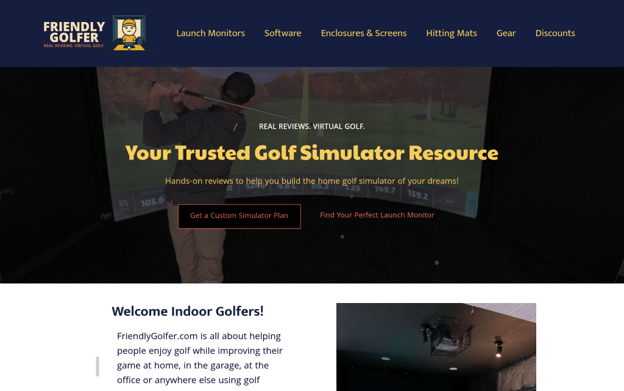
What Products Does Friendly Golfer Provide?
Friendly Golfer functions as a focused review and educational platform built entirely around home golf simulators and launch monitor technology. Their content covers the full equipment stack, from launch monitors and projection screens to enclosures, hitting mats, and simulation software. The site's stated goal is becoming the most complete online source for golfers building or evaluating a home simulator setup, which gives it a clear lane in a space that often lacks trustworthy, niche-specific guidance.
What's Friendly Golfer's Edge in Indoor Golf Simulators?
The problem Friendly Golfer solves is information fragmentation. Most golf equipment buyers bounce between general golf sites that only cover simulators as an afterthought. Their singular focus on this category means the research depth you'll find there is hard to replicate on a broader platform.
The Review Roundup:
From what the site's reputation suggests, golfers looking for pre-purchase clarity on simulator components consistently find it useful. The niche positioning earns repeat visits from buyers who need detailed, category-specific guidance rather than general golf content. That kind of editorial focus is genuinely rare in this space.
SoundCheck - Best for Golf Simulator Installation and Smart Home Systems

What Products Does SoundCheck Provide?
SoundCheck is a Michigan-based installer that builds custom golf simulator rooms alongside full smart home systems, including audio, video, lighting, temperature control, and security. As a certified dealer and installer for Full Swing Golf, they bring technical installation depth that most equipment retailers can't match. Their founder's twenty-five years in the low voltage industry means the technical side of a simulator buildout, from wiring to calibration to room acoustics, gets handled by someone who's done it before.
What's SoundCheck's Edge in Indoor Golf Simulators?
The gap SoundCheck fills is the one between buying a simulator and actually having it work well inside a real room. Getting simulator hardware calibrated correctly in a home environment, especially when ceiling height and room dimensions aren't ideal, requires exactly the kind of hands-on installation skill they bring.
The Review Roundup:
Being named one of the top 100 home theater companies in the country, combined with being Michigan's first Control4 Pinnacle dealer, tells you a lot about the quality bar they hold themselves to. From what customer feedback patterns suggest, clients value the turnkey nature of their builds, where the simulator works correctly on day one without a frustrating setup process.
LaunchPad Golf - Best for Year-Round Golf Entertainment and Virtual Golf Course Experiences
What Products Does LaunchPad Golf Provide?
LaunchPad Golf runs year-round golf entertainment venues across Canada, with a newer U.S. location in Minnesota spanning 25,000 square feet of indoor space alongside a 160,000-square-foot outdoor driving range. Their setup uses award-winning Inrange radar technology for ball tracking, paired with virtual course play and interactive gameplay modes. The venues combine serious simulator practice with food, beverage, and event hosting, making them a fit for both competitive golfers and corporate gatherings looking for something more engaging than a standard range session.
What's LaunchPad Golf's Edge in Indoor Golf Simulators?
LaunchPad Golf solves the accessibility problem that keeps many golfers out of simulator training entirely: the cost and space requirements of a private setup. By delivering professional-grade radar tracking inside a hospitality environment, they give golfers access to accurate ball data without the six-figure home installation price tag (think entertainment-facility pricing rather than ownership costs).
The Review Roundup:
Their expansion into the U.S. market reflects genuine demand for this kind of experience. From what their growth trajectory suggests, golfers who try the Inrange radar system come back because the data quality and course variety hold up against more traditional simulator setups. The combination of a social atmosphere and real swing data is a differentiator that's hard to match at a standard driving range.
Red Stakes Golf - Best for Golf Simulator Systems and Technology
What Products Does Red Stakes Golf Provide?
Red Stakes Golf builds golf simulation hardware and software with roots going back to OptiShot Golf, giving them over a decade of hands-on development history in this category. Their current lineup includes the RSG Mobile, RSG One, and RSG Pro hardware systems, each paired with proprietary camera technology for club movement and ball flight tracking. The RSG Club platform layers in competitive play through online tournaments and leaderboards, turning a solo practice session into something more engaging for golfers who need external motivation to keep at it.
What's Red Stakes Golf's Edge in Indoor Golf Simulators?
Red Stakes Golf addresses the accuracy ceiling that has historically held affordable simulators back, using proprietary camera systems designed for precise club path and ball flight data. With over 18,000 customers served through their RSG Club game engine, their approach to American-made precision engineering isn't theoretical. It's been tested across a large customer base.
The Review Roundup:
Honestly, a decade-plus of development history combined with 18,000-plus active users signals a product that's been refined through real feedback rather than just built and shipped. From what user patterns suggest, golfers who want a competitive online community alongside solid simulator hardware find the RSG ecosystem worth the investment.
Selection Framework: How Each Pick Was Evaluated
Pulling together a shortlist of simulator brands worth recommending isn't a quick process. Here's how each pick was evaluated before making the cut.
Data Collection Methods
The research started by casting a wide net. Golf simulator brands were sourced from multiple directions: industry directories, review aggregators, equipment-specific forums, and the official websites of brands that regularly appear in golfer conversations. Case studies and long-form equipment reviews from established golf technology publications helped fill in gaps where official brand claims needed context. The goal at this stage was volume, building a longlist that represented the full range of simulator options from residential consumer gear to commercial-grade installations.
Initial Screening and Selection
From that longlist, brands without a verifiable presence in real-world simulator installations were removed early. Review patterns were analyzed across multiple platforms to identify which companies had consistent feedback versus which ones had thin or inconsistent records. Brands that appeared in the research only once or twice, without corroborating signals from multiple sources, didn't advance. This stage narrowed the field considerably, keeping only options with enough documented history to evaluate meaningfully.
Confirming Accuracy Across All Selections
Every claim made on a brand's official site was cross-referenced against what real users and independent reviewers reported. Where a company stated accuracy figures or course library sizes, those numbers were checked against third-party reviews for consistency. Real-world installation results, particularly around calibration difficulty and ball data accuracy compared to outdoor launch monitor benchmarks, were weighted heavily here. Discrepancies between what a brand claimed and what verified buyers reported were flagged and factored into final assessments.
Industry Standing Check
Awards, editorial mentions, and recognition from established golf media outlets were reviewed for each brand on the shortlist. A brand that earns repeated recognition from publications like Golf Digest signals a level of peer review that self-promotion alone can't replicate. Original research published by or about a company, including adoption data from professional tours and commercial facilities, also contributed to this assessment. Brands with multiple independent signals of industry standing ranked more favorably than those relying solely on their own marketing materials.
Real-World Indoor Golf Simulators Evidence
The final check focused on real-world simulator evidence: dedicated service and product pages that demonstrated depth, verified buyer reviews tied to specific hardware and software configurations, and case studies showing how installations performed across different room sizes and use cases. Brands that could demonstrate consistent results across both residential setups with space constraints and commercial facilities with higher volume requirements showed the clearest evidence of practical, well-rounded golf simulation skill.
Choosing the Right Indoor Golf Simulators: A Quick Guide
Picking a simulator isn't just about what looks impressive in a spec sheet. The right fit depends on your space, your goals, and how seriously you plan to use it. Here's what to think through before committing.
Industry/Domain Experience: Look for brands or installers with documented history in golf simulation. General AV or tech companies can install a screen and projector, but golf-specific calibration and swing data accuracy require category knowledge that takes years to build.
Features and Service Options: Evaluate the full equipment stack, not just the launch monitor. Screen quality, software course library size, data points captured per swing, and system response time between swing and simulation all affect whether you'll actually use the setup regularly.
Pricing Structure: Simulator costs vary from a few thousand dollars for entry-level hardware to well over six figures for professional installations. Factor in installation, software licensing, and ongoing maintenance alongside the hardware price before comparing options.
Results Measurement: A good simulator should give you trackable data across sessions, spin rate, carry distance, club path, and launch angle at minimum. If you can't measure improvement over time, the setup isn't serving your practice goals.
Industry Knowledge and Compliance: Confirm that launch monitor certification and course licensing standards are met by any software included in the package. Unlicensed course libraries and uncertified hardware can limit where and how you use the system long-term.
Wrapping Up
The simulator space has more options than ever, which makes choosing the right one both easier and more confusing at the same time. The brands covered here represent real range, from dedicated review resources and professional-grade launch monitor manufacturers to turnkey installation specialists and entertainment venues.
The clearest signal across all of them is this: brands that focus entirely on golf simulation deliver better outcomes than generalists who treat it as a side offering.
And as simulator technology keeps advancing, the gap between entry-level and professional-grade systems will only narrow further.


Comments