


Navajo White Sherwin Williams: The Honest Architect's Review

Navajo White SW 6126 is one of those paint colors that divides opinion -- people who use it in the right room love it completely, and people who use it in the wrong room wonder what went wrong. The peachy-cream undertone is the key to everything: it is the color's greatest asset and its main risk. In a south-facing room with warm natural light and warm materials, Navajo White creates one of the most beautiful, glowing warm off-white atmospheres available. In a north-facing room or alongside cool materials, the peachy element can push the color toward a warmth that reads as slightly orange rather than simply warm.
This review covers everything you need to know about Navajo White -- undertone, LRV, light behavior, best rooms, what to pair it with, and a clear honest verdict on who this color is and is not right for.

Navajo White at a Glance
Color name | Navajo White |
Brand | Sherwin Williams |
Color number | SW 6126 |
LRV | 73 |
Undertone | Warm cream with a peachy-cream quality |
Color family | Warm off-white |
Depth | Medium -- deeper than Alabaster, similar to Shoji White |
Best trim | Extra White SW 7006 or Pure White SW 7005 |
Best rooms | South-facing living rooms, bedrooms, traditional interiors |
Finish | Eggshell for walls, Semi-gloss for trim and cabinets |
Pairs with | Warm wood, terracotta, brass, warm stone, olive green |
Undertone and Character
Navajo White's defining characteristic is its warm cream undertone with a distinctly peachy quality -- it reads as clearly and obviously warm in most light conditions, with a richness that most warm off-whites do not deliver. This is not a restrained or ambiguous warm white. Navajo White commits to warmth directly and obviously -- in the right conditions this commitment creates a glowing, rich result that feels genuinely beautiful and considered. In the wrong conditions it creates a warmth that reads as slightly orange or heavy.
At LRV 73, Navajo White has real depth on a wall -- it is noticeably deeper than Alabaster (LRV 82), Greek Villa (LRV 84), and most other popular SW warm whites. This depth gives it genuine body and presence -- it reads as a proper warm off-white rather than a near-white or a bright white. The combination of depth and peachy-cream undertone is what makes Navajo White such a specific and situational color.
How Navajo White Behaves in Different Light
South-Facing Rooms
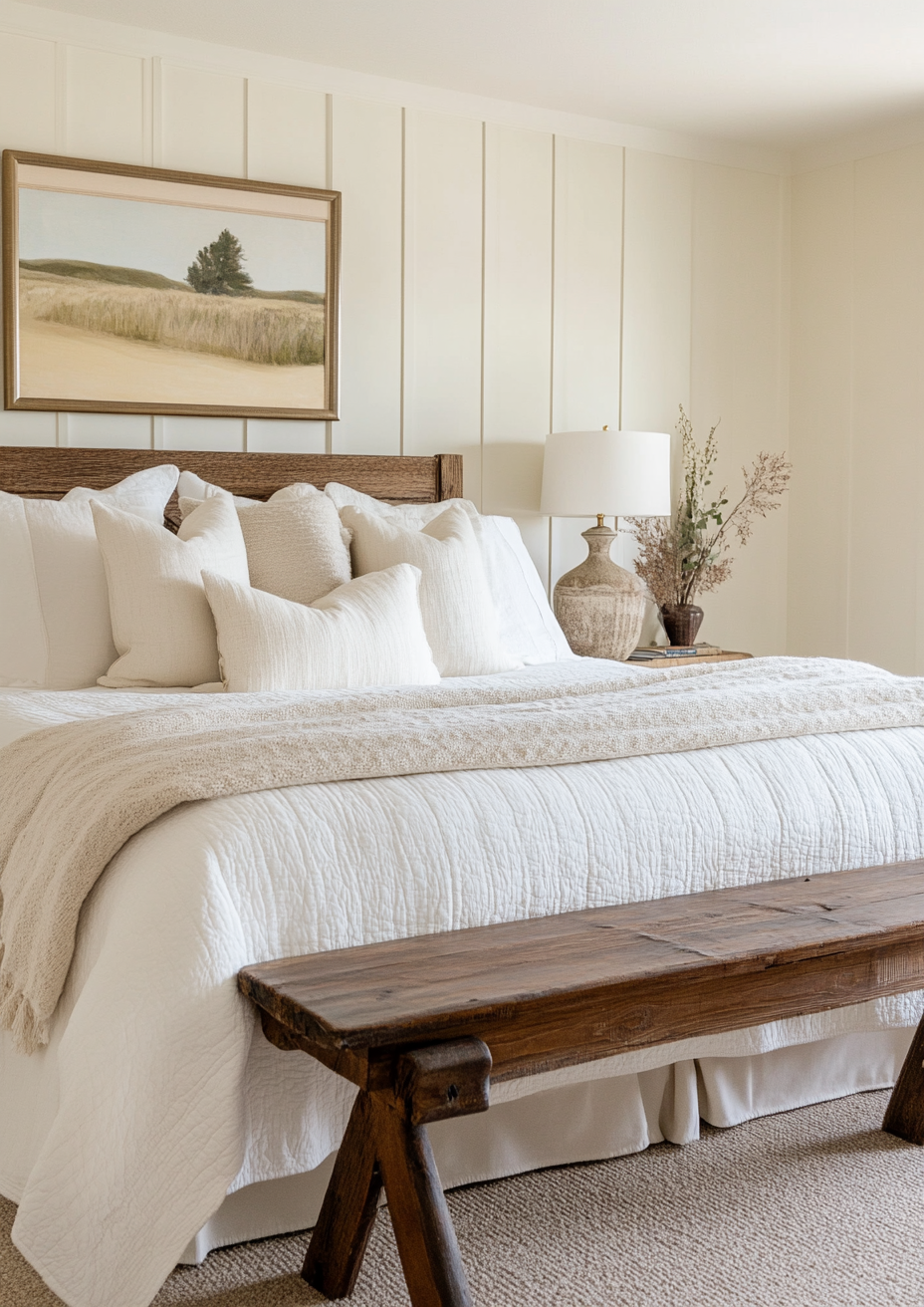
This is where Navajo White performs at its absolute best -- in strong, warm south-facing natural light the peachy-cream depth creates a rich, luminous glow that is genuinely one of the most beautiful warm off-white effects available. The warmth of the light enhances the warmth of the color without pushing the peachy element toward orange. Rooms with terracotta tiles, warm wood floors, and brass fittings in strong south-facing light are the ideal conditions for Navajo White. Sample it in these conditions and it will likely be love at first sight.
North-Facing Rooms
North-facing rooms are Navajo White's most difficult conditions -- in cool, indirect light the peachy element can become more pronounced and push the color toward a warmth that reads as slightly orange or heavy rather than simply warm. The lower LRV of 73 compounds this in north-facing conditions, as the room already has less light to work with. For north-facing rooms, Alabaster or Aesthetic White are significantly more reliable warm white choices. If you want to try Navajo White in a north-facing room, sample at very large scale and look at it across a full day before committing.
Artificial Light
Under warm-toned artificial light (2700K-3000K) Navajo White can look beautiful -- the peachy warmth is enhanced by the warm bulb temperature and the room reads as rich and inviting. Under cooler artificial light (4000K+) the peachy element can read as more orange and less warm. For rooms where artificial light dominates -- basement rooms, windowless studies, evening-use spaces -- warm bulbs are essential alongside Navajo White.
Morning vs Afternoon Light
Navajo White shifts noticeably through the day -- in early morning light it often reads as slightly softer and more cream. As the day progresses and the light warms, the peachy quality becomes richer and more glowing. In late afternoon golden light it can look spectacular. This shifting quality is part of its character -- it is a color that rewards living with and observing across a full day.
Considering Navajo White for your home? Book a color consultation here -- bydesignandviz.com/book-online |
Navajo White Room by Room

Living Rooms
In a south-facing living room with warm materials, Navajo White is a genuinely excellent choice -- the depth and peachy-cream warmth create an enveloping, sophisticated atmosphere that suits traditional, warm-palette transitional, and organic modern styles. In a north-facing living room or a living room with contemporary cool materials, it is a significant risk. The material palette matters enormously -- warm wood floors, terracotta accents, and brass hardware bring out the best in Navajo White. Cool grey sofas and contemporary metal fittings can make it read as slightly orange and out of place.
Bedrooms
Navajo White in a bedroom creates a deeply warm, cocooning atmosphere -- the depth and peachy-cream quality give it a restful, enveloping character that suits a bedroom's purpose in the right conditions. In a south-facing bedroom with warm linen bedding, warm wood furniture, and warm lighting it is a beautiful and considered choice. In a north-facing bedroom or a bedroom with a more contemporary palette it carries the same risks it does in any north-facing room.
Kitchens
Navajo White on kitchen cabinets is a more specific and more demanding choice than Alabaster or Shoji White -- the peachy-cream depth creates a warm, traditional kitchen result that looks beautiful alongside warm stone countertops, unlacquered brass hardware, and warm wood open shelving. It is not broadly versatile in the way Alabaster is -- it needs warm supporting elements to perform at its best. In a contemporary kitchen with cool materials, Navajo White cabinets can feel too committed to warmth.
Exteriors
Navajo White on an exterior is a bold and specific choice -- at exterior scale the peachy-cream depth reads with more warmth and presence than it does inside, and the color needs strong south-facing light to perform at its best. In strong sunlight it can look rich and beautiful on traditional and Mediterranean-style architecture. On a shaded north-facing elevation the peachy element can become heavy and slightly orange. If you are considering Navajo White for an exterior, test it on multiple elevations at different times of day before committing.
What to Pair With Navajo White

Trim: Extra White SW 7006 or Pure White SW 7005 -- a clean, crisp white boundary is essential alongside Navajo White's depth. Avoid creamy or warm whites on the trim as they will blend with the wall color and lose definition.
Floors: Warm wood in honey, oak, walnut, or aged pine tones -- Navajo White's peachy-cream quality relates most naturally to warm organic floor materials. Terracotta tile is one of the most beautiful floor pairings for this color.
Accents: Warm terracotta, deep olive green, warm brass and bronze, cognac leather, warm stone, natural linen.
Avoid: Cool grey sofas, chrome fittings, cool contemporary materials -- these will fight Navajo White's peachy warmth and make it read as orange rather than warm.
Style: Traditional, warm-palette transitional, Mediterranean, farmhouse, warm organic modern. Not recommended for minimalist, contemporary, or Scandinavian interiors.
Navajo White vs Other SW Warm Whites

vs Alabaster SW 7008 -- Alabaster is 9 LRV points brighter and has a broader, more forgiving warm cream-beige undertone. Alabaster suits a far wider range of rooms and conditions. For the full comparison, the Navajo White vs Alabaster guide covers every key difference.
vs Creamy SW 7012 -- Creamy has a similar LRV to Alabaster (approximately 81) and a distinctly yellow-cream undertone. Navajo White is deeper than Creamy and its peachy direction is different from Creamy's yellow-cream direction. For the Creamy vs Alabaster comparison the Creamy vs Alabaster guide is the reference point.
vs Greek Villa SW 7551 -- Greek Villa at LRV 84 is significantly brighter than Navajo White and its yellow-beige undertone is clean and sandy rather than peachy-cream. Greek Villa is far more broadly versatile.
vs Shoji White SW 7042 -- Shoji White has a similar LRV (74) to Navajo White but a very different undertone -- warm beige-greige with a gray-green quality rather than peachy-cream. Shoji White is significantly more adaptable across room types and orientations.
Is Navajo White Right for Your Room?

Navajo White is right for your room if: the room is south-facing with strong warm natural light, the interior style is traditional, warm-palette transitional, or Mediterranean, your floor and material palette is distinctly warm (warm wood, terracotta, warm stone, brass), you want a warm off-white with genuine depth and committed warmth, and you have sampled it at large scale in the actual room in both morning and afternoon light.
Navajo White is not right for your room if: the room is north-facing or has limited natural light, the interior style is contemporary, minimalist, or Scandinavian, your material palette includes cool or neutral elements that could fight the peachy direction, or you are uncertain about the conditions -- Navajo White does not forgive uncertain conditions.
The non-negotiable: sample at large scale before committing. Navajo White is one of the colors where the difference between a small chip and a full wall in real light conditions is most dramatic. Paint at least an A2 sample board and observe it across a full day -- morning light, afternoon light, and evening artificial light -- before deciding.
Frequently Asked Questions
What is the LRV of Navajo White Sherwin Williams?
Navajo White SW 6126 has an LRV of 73 -- placing it in the deeper end of the warm off-white spectrum. It is noticeably deeper than Alabaster (82), Greek Villa (84), and Simply White (89.5). It is comparable in depth to Shoji White (74) and Kestrel White (73).
Does Navajo White look orange?
In the wrong conditions -- north-facing rooms, cool artificial light, or alongside cool materials -- the peachy element in Navajo White's undertone can push toward a warmth that reads as slightly orange. In the right conditions -- south-facing rooms, warm natural light, warm materials -- it reads as a rich, beautiful peachy-cream warm white. Sampling in the actual room is essential.
Is Navajo White warm or cool?
Navajo White is clearly and obviously warm -- its peachy-cream undertone is one of the most directly warm undertones in the Sherwin Williams warm white range. There is no grey or cool component to moderate its warmth direction.
What is the difference between Navajo White and Alabaster?
The 9-point LRV gap and the undertone direction are the two main differences. Alabaster at LRV 82 is significantly brighter and its broad warm cream-beige undertone is far more forgiving across different conditions. Navajo White at LRV 73 is deeper and its peachy-cream undertone is more directional and more demanding of the right conditions. The full comparison is in the Navajo White vs Alabaster guide.
Is Navajo White good for kitchen cabinets?
In the right kitchen, yes -- but it is a more specific and demanding choice than Alabaster. Navajo White cabinets look beautiful in a traditional kitchen with warm stone countertops, brass hardware, and warm wood open shelving. In a contemporary kitchen with cool materials it can feel too committed to its peachy warmth. If you want a broadly versatile warm white for kitchen cabinets, Alabaster is a safer choice.
Final Verdict
Navajo White is a beautiful, specific, and situational color -- it rewards the right room and the right conditions with one of the most genuinely warm and glowing off-white atmospheres available. It does not forgive the wrong conditions. The peachy-cream depth that makes it spectacular in a south-facing room with warm materials is the same quality that makes it risky in a north-facing room or alongside cool materials. Sample it properly, understand its conditions, and if your room qualifies it is a color worth using with confidence.
Need help deciding if Navajo White is right for your home? See our design packages here -- bydesignandviz.com/#interiordesignpackages |
About the Author
Beril Yilmaz is a qualified architect and interior designer based in the UK. She runs BY Design And Viz, a design platform covering paint color reviews, interior design guidance, and residential design projects.


Comments