


Navajo White vs Alabaster: Which Sherwin Williams Warm White Is Right for Your Room?

Updated: Mar 25
Navajo White and Alabaster are both Sherwin Williams warm whites and both appear regularly on designer shortlists for rooms where the brief is warm, inviting, and non-stark. On a paint chip they look like close relatives. On a wall they create significantly different atmospheres -- and the 9-point LRV gap between them is large enough that choosing the wrong one will visibly change the character of your room.
This guide covers exactly how Navajo White and Alabaster differ in LRV, undertone, light behavior, and room application -- with a clear verdict on which one suits which situation.

Quick Reference -- Navajo White vs Alabaster
| Navajo White SW 6126 | Alabaster SW 7008 |
LRV | 73 | 82 |
Undertone | Warm cream-peach, distinctly warm | Warm cream-beige, softer and broader |
Temperature | Clearly warm -- peachy-cream direction | Warm but more restrained and neutral |
Depth | Noticeably deeper -- more body on a wall | Brighter -- lighter, more reflective |
North-facing rooms | Can feel heavy and peachy -- test carefully | More reliable -- holds warmth without going peach |
South-facing rooms | Rich and glowing -- very warm result | Warm and luminous -- more controllable |
Best trim | Extra White SW 7006 or Pure White SW 7005 | Extra White SW 7006 or Pure White SW 7005 |
Cabinets | Very warm -- suits traditional kitchens only | Versatile -- suits most kitchen styles |
Best for | Traditional, warm-palette, south-facing rooms | Contemporary, transitional, most room types |
Verdict | Warmer, deeper, more committed to warmth | Brighter, safer, more broadly versatile |
What Is Navajo White?

Navajo White SW 6126 is a warm, creamy off-white with a distinctly peachy-cream undertone and an LRV of 73. That LRV places it noticeably deeper than most warm whites people consider -- it has genuine body and warmth on a wall in a way that Alabaster, Creamy, and Greek Villa do not. Navajo White is not trying to be a near-white or a bright white. It reads as a proper warm off-white with real depth and a committed warm direction.
Navajo White's undertone is warm cream with a faint peach quality -- it reads as clearly and obviously warm in most light conditions. In south-facing rooms with strong natural light the peachy-cream quality gives it a rich, glowing character that is beautiful alongside warm wood, terracotta, and warm stone. In north-facing rooms or under artificial light the peachy element can become more pronounced and push the color toward a warmth that reads as slightly orange rather than simply warm. It is a color that rewards the right room and the right conditions.
For the full standalone review of Navajo White -- including exactly which rooms it suits, how it behaves in different light conditions, and what to pair it with -- the Navajo White Sherwin Williams review covers everything in detail
What Is Alabaster?

Alabaster SW 7008 is Sherwin Williams' most popular warm white and one of the most widely specified whites in residential design. At LRV 82 it sits 9 points above Navajo White -- significantly brighter, significantly more versatile, and significantly safer in a wider range of rooms and lighting conditions.
Alabaster's undertone is warm cream-beige -- present and clearly warm but broader and more restrained than Navajo White's more directional peachy-cream. This broader undertone is what makes Alabaster so consistently successful -- it reads as warm in almost any room without committing so hard to warmth that it becomes problematic. The full breakdown is in the Alabaster review.
Navajo White vs Alabaster -- The Key Differences

LRV -- The Primary Difference
The 9-point LRV gap between Navajo White (73) and Alabaster (82) is the most significant difference between these two colors -- it is large enough to be clearly and immediately visible on a wall. Navajo White at LRV 73 has real body and depth -- it reads as a proper warm off-white with substance. Alabaster at LRV 82 reads as a warm white that is clearly lighter and brighter -- it fills a room with more reflected light and has a cleaner, more open quality. In a room where you want depth and commitment to warmth, Navajo White. In a room where you want warmth alongside brightness and versatility, Alabaster.
Undertone Character
Navajo White's peachy-cream undertone is more directional and more committed than Alabaster's broader warm cream-beige. Navajo White tells you clearly which direction it is going -- warm, creamy, peachy. Alabaster's warmth is broader and more ambiguous in the best possible way -- it reads as warm without announcing a specific direction. This is why Alabaster suits a far wider range of room types, material palettes, and lighting conditions than Navajo White.

Risk Profile
Navajo White is a higher-risk color than Alabaster -- the peachy-cream undertone can become problematic in cool light, in rooms with cooler materials, or in rooms where the surrounding fixed elements pull in a cool or neutral direction. Alabaster's broader undertone is far more forgiving and rarely creates the unexpected shifts that Navajo White can produce in the wrong conditions. For anyone uncertain about their room's light or material palette, Alabaster is almost always the safer and ultimately more successful choice.
Character on a Wall
Navajo White creates a warmer, richer, more enveloping room than Alabaster -- its depth and committed warmth give it a character that feels genuinely old-world and traditional. It suits rooms with real warmth in the materials and the light -- warm wood, warm stone, warm brass, south-facing sun. Alabaster creates a brighter, fresher, more open room -- its warmth is present but its higher LRV keeps the space feeling light and airy. It suits a far broader range of interior styles from contemporary to traditional.
Not sure which warm white is right for your room? Book a color consultation here -- bydesignandviz.com/book-online |
Navajo White vs Alabaster -- Room by Room
Living Rooms

Alabaster is the stronger living room choice between the two for most situations -- its higher LRV keeps living rooms feeling open and airy while the warm undertone creates the inviting, non-clinical quality that makes a living room feel like a home. Navajo White in a living room with strong south-facing light and warm materials can look rich and beautiful. In a north-facing living room, a living room with cool or contemporary materials, or any living room where the lighting is uncertain, Navajo White is a significant risk. Alabaster handles all of these situations comfortably.
Bedrooms

Navajo White can be a beautiful bedroom color in the right conditions -- south-facing, warm materials, traditional or warm-palette style. The depth and warmth create a settled, enveloping quality that suits a bedroom's purpose. Alabaster is more reliable across all bedroom types -- north-facing, south-facing, contemporary, traditional. For a bedroom where the brief is warm and cocooning, Navajo White rewards the right conditions beautifully. For a bedroom where reliability matters more than depth of character, Alabaster.
Kitchens
Alabaster is the significantly stronger kitchen choice -- on cabinets it is one of the most popular and reliable warm whites in residential design, creating a warm but bright kitchen that suits everything from shaker to slab cabinetry. Navajo White on kitchen cabinets is a more specific and more risky choice -- the peachy-cream depth can read well in a very warm traditional kitchen with warm stone countertops and warm brass hardware, but it is not a broadly versatile kitchen white the way Alabaster is.
Trim and Ceilings

Neither Navajo White nor Alabaster is typically used as a trim color alongside each other -- both are wall colors. For trim alongside Navajo White walls, Extra White SW 7006 or Pure White SW 7005 provide a clean, bright boundary. For trim alongside Alabaster walls, the same applies -- Extra White or Pure White. Both colors work well on ceilings in rooms where a warm ceiling is the brief, though Alabaster's higher LRV makes it more suitable for ceilings in rooms where maximum light reflectance matters.
North-Facing Rooms

Alabaster is the clear choice for north-facing rooms between these two. In cool, indirect light Alabaster's broader undertone holds its warm character reliably -- it reads as a warm white without pulling toward a specific direction. Navajo White in a north-facing room can shift toward a more pronounced peachy quality that reads as slightly orange or warm-heavy rather than simply warm. For north-facing rooms specifically, Alabaster is one of the most reliable warm whites in the SW range.
South-Facing Rooms

South-facing rooms are where Navajo White performs at its best -- in strong warm natural light the peachy-cream depth creates a rich, glowing quality that is genuinely beautiful. Strong south-facing light enhances the warmth without pushing it toward orange, and the depth of LRV 73 gives the room real presence and character. Alabaster in a south-facing room also looks beautiful -- the warmth is enhanced by the strong light and the higher LRV keeps the room feeling open and luminous. Both work well in south-facing rooms; Navajo White simply makes a stronger, more committed statement.
What to Pair With Navajo White
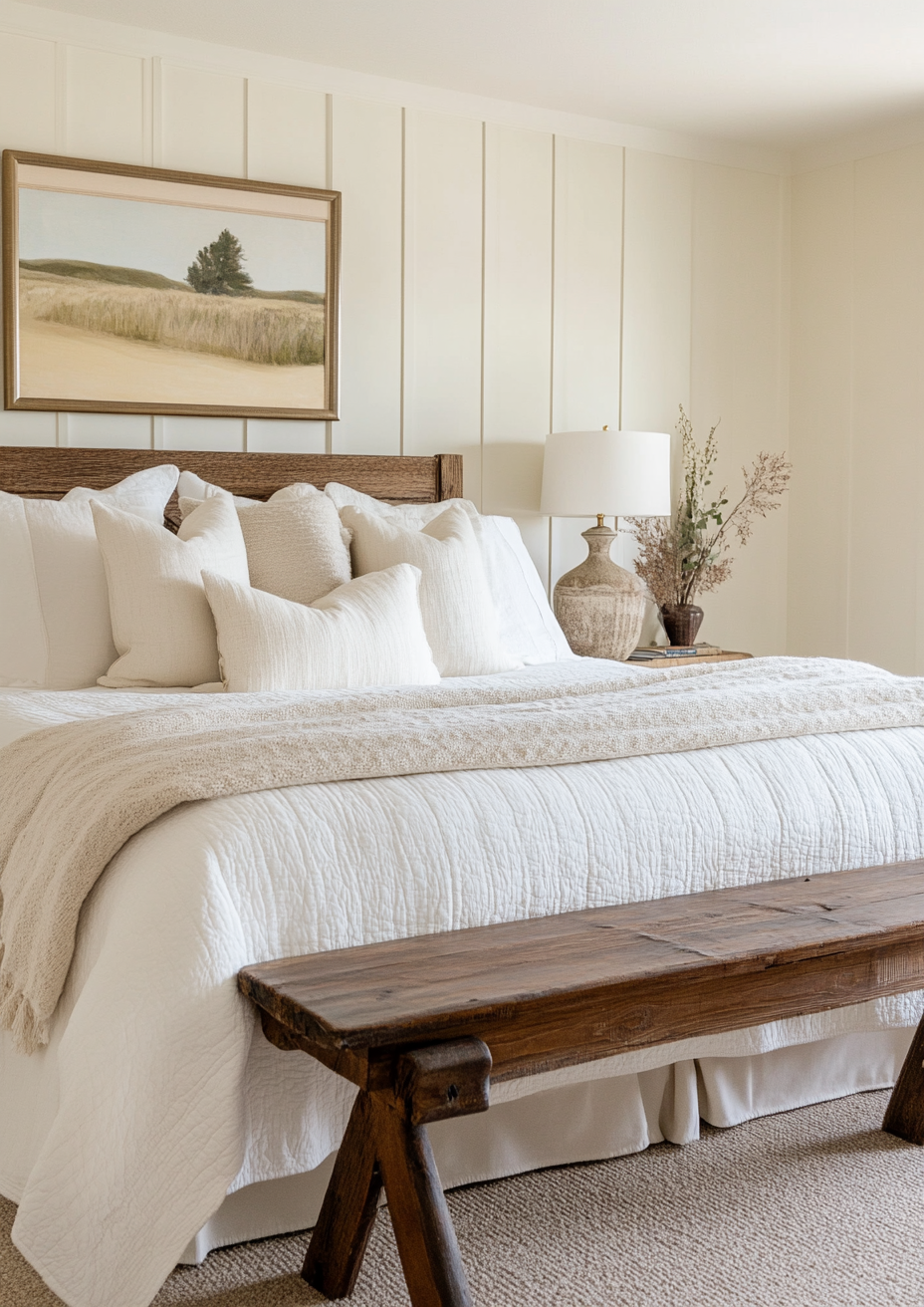
Trim: Extra White SW 7006 or Pure White SW 7005 -- a crisp bright white boundary prevents Navajo White from feeling heavy.
Floors: Warm wood in honey, oak, or walnut tones -- Navajo White's peachy-cream quality relates most naturally to warm organic materials.
Accents: Warm terracotta, deep olive green, warm brass, cognac leather -- colors that share Navajo White's warm, earthy direction.
Style: Traditional, farmhouse, Mediterranean, warm-palette transitional. Not recommended for contemporary or minimalist interiors.
What to Pair With Alabaster

Trim: Extra White SW 7006 or Pure White SW 7005.
Floors: Warm wood, white oak, warm stone, marble -- Alabaster's broader undertone adapts to the widest range of floor materials.
Accents: Warm brass, muted greens, deep navy, natural linen, terracotta -- Alabaster pairs with both warm and cool accent colors without creating undertone conflict.
Style: Contemporary, transitional, organic modern, traditional, farmhouse -- virtually any interior style. This is Alabaster's defining advantage.
For how Alabaster compares to Creamy -- the other major SW warm white with a committed yellow direction -- the Creamy vs Alabaster guide covers that comparison. For how Alabaster compares to Dover White and Shoji White, the Dover White vs Alabaster and Shoji White vs Alabaster guides cover those comparisons directly.
The Verdict

Choose Navajo White if: your room is south-facing with strong warm natural light, the interior style is traditional or warm-palette, your floor and material palette is distinctly warm, you want a warm white with genuine depth and committed warmth, and you have sampled it in the actual room and are confident in the result.
Choose Alabaster if: you want a warm white that works reliably across a broader range of rooms and conditions, the interior style is contemporary or transitional, you are uncertain about the light or material palette, or you want warmth without the risk of the peachy-cream direction that Navajo White can produce.
For most rooms and most people, Alabaster is the correct choice between these two -- its broader undertone, higher LRV, and greater versatility mean it performs well in situations where Navajo White would struggle. Navajo White rewards the right room beautifully but requires more confidence in the conditions. Always sample both at large scale in the actual room before deciding -- the difference at LRV 73 vs 82 is immediately and clearly visible on a wall in a way that a paint chip cannot communicate.
Frequently Asked Questions

Is Navajo White warmer than Alabaster?
Yes -- significantly. Navajo White's peachy-cream undertone and lower LRV (73 vs 82) create a noticeably warmer, deeper result on a wall. Alabaster is warm but its higher LRV keeps it brighter and its broader undertone makes it more restrained in its warmth direction.
Can I use Navajo White in a small room?
With caution. The lower LRV of 73 means Navajo White absorbs more light than Alabaster -- in a small room with limited natural light it can feel heavy and enveloping in a way that reduces the sense of space. In a small south-facing room with good natural light it can work beautifully. In a small north-facing room, Alabaster's higher LRV is a meaningful practical advantage.
Does Navajo White look orange?
In cool light or alongside cool materials, the peachy element in Navajo White's undertone can read as slightly orange -- this is the primary risk with this color. In warm light and alongside warm materials it reads as a rich, glowing cream. Testing at large scale in the actual room under the actual light conditions is essential before committing to Navajo White.
Which is better for cabinets -- Navajo White or Alabaster?
Alabaster is the significantly more versatile and widely recommended cabinet color between the two. On cabinets Alabaster's warmth creates an inviting, timeless result that suits a wide range of kitchen styles and countertop materials. Navajo White on cabinets is a more specific and more risky choice -- it suits warm traditional kitchens with warm stone countertops but is not broadly versatile in the way Alabaster is.
How does Navajo White compare to Creamy?
Both are warmer and deeper than Alabaster but they are different colors. Creamy SW 7012 has an LRV of approximately 81 and a distinctly yellow-cream undertone -- similar depth to Alabaster but more committed to yellow warmth. Navajo White at LRV 73 is significantly deeper than Creamy and its peachy-cream undertone pulls in a slightly different direction. Of the two, Creamy is the more popular and widely used warm white in residential design. For the full comparison between Creamy and Alabaster, the Creamy vs Alabaster guide covers both colors in detail.
Final Thought

Navajo White and Alabaster serve different rooms and different briefs -- Navajo White is for the room where you want genuine depth, committed warmth, and a color with real character; Alabaster is for the room where you want warmth alongside brightness, versatility, and reliability across a wide range of conditions. The 9-point LRV gap between them is large enough to make this choice meaningful. Sample both at large scale in your actual room and look at them across a full day before deciding -- the right choice will be clear.
Need help choosing between Navajo White and Alabaster for your room? See our design packages here -- bydesignandviz.com/#interiordesignpackages |
About the Author
Beril Yilmaz is a qualified architect and interior designer based in the UK. She runs BY Design And Viz, a design platform covering paint color reviews, interior design guidance, and residential design projects.


Comments