


Shoji White vs Alabaster: Which Warm White Works Best for Your Room?

Updated: Jul 3
Choosing a white paint can feel deceptively simple — but when you bring it home, it transforms. Between Shoji White vs Alabaster, many homeowners find themselves unsure which to choose. These two warm whites are loved by designers because they avoid the harshness of pure white while still feeling fresh and luminous.
In this post, I’ll walk you through the nuances of Shoji White vs Alabaster — their undertones, how they behave in different lighting, and which settings each suits best. You’ll also get practical advice on pairing trim, furnishings, and accent colours so your white feels intentional, not accidental.
By the end, you’ll be confident in choosing between these two neutrals — and know how to use them to elevate your room’s mood.
At a Glance
A breakdown of undertones and Light Reflectance Value (LRV) for Shoji White and Alabaster
How Shoji White vs Alabaster behave under different lighting
Matching trim, woodwork, and accent colours
Designer tips for small rooms, open-plan spaces, and feature walls
Comparison summary and decision guidance
1. Shoji White vs Alabaster: Undertones & Technical Basics

When comparing Shoji White vs Alabaster, the first thing to understand is their undertones and light performance. These underpin how they will look in your specific space.
1.1 Undertones and Character
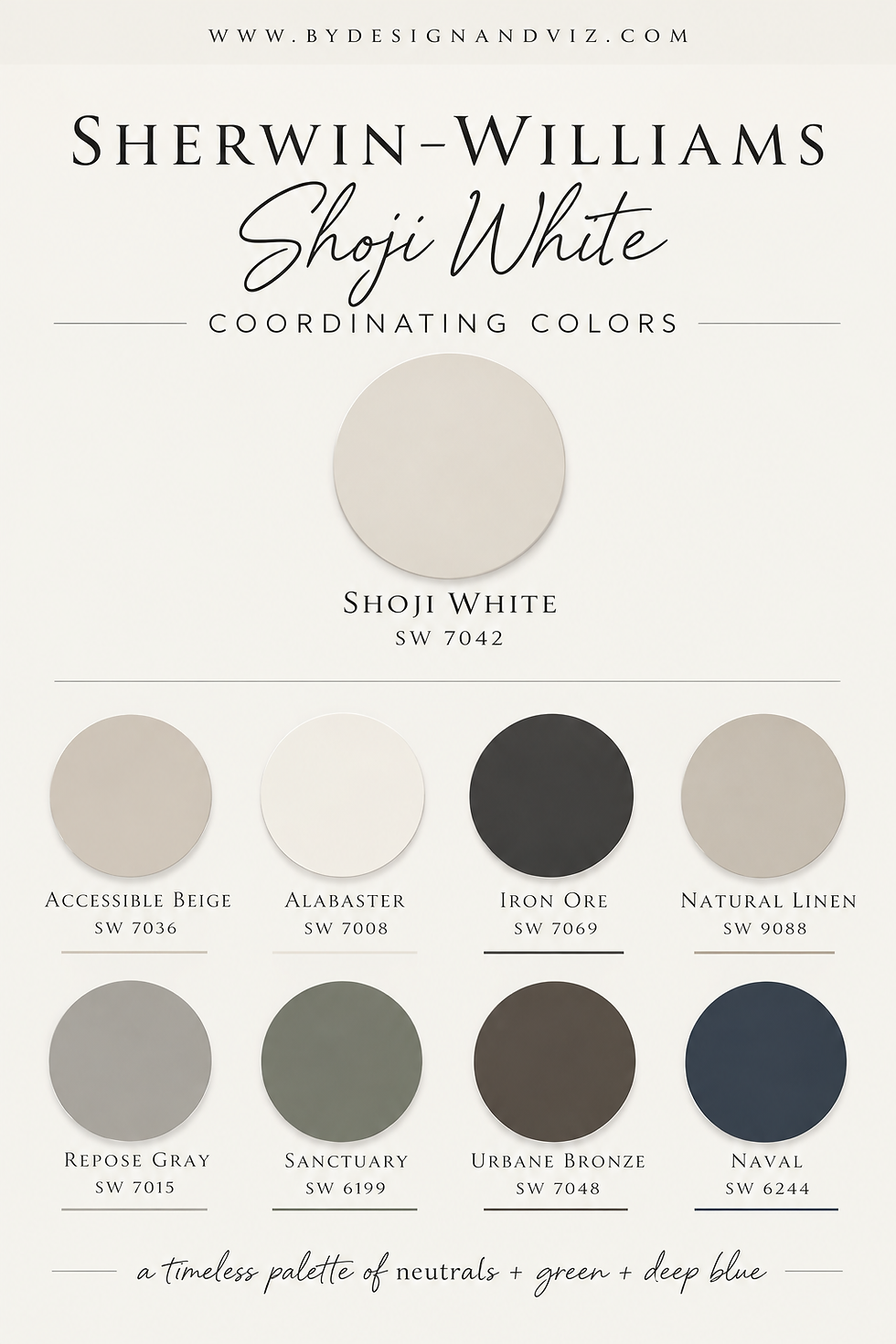
Shoji White (Sherwin-Williams SW 7042) is often described as a warm, creamy white with a soft greige or beige undertone.Depending on light, hints of green or grey may subtly emerge, making it a flexible neutral
Alabaster (Sherwin-Williams SW 7008) is a balanced warm white with gentle yellow undertones, offering a soft, airy effect. Other paint brands’ “Alabaster” may shift slightly in warmth or tone (for instance, Dulux’s Alabaster White leans more yellow).
Designer Tip: Always view real paint samples on your own wall rather than relying on digital swatches. Undertones will shift dramatically based on natural light, furnishing colours, and adjacent finishes.
For the comparison of Shoji White against SW Creamy - the direct buttery cream that sits 7 LRV points above Shoji White and commits fully to yellow warmth where Shoji White holds back - the Shoji White vs Creamy guide explains the undertone difference and which one suits which brief.
1.2 Light Reflectance Value (LRV) & Brightness
Shoji White’s LRV is around 74, meaning it reflects a good amount of light, though not as “pure” as crisp whites.
Alabaster has a somewhat higher reflective quality, making it appear a bit brighter and airier under many conditions.
In rooms with less natural light, Alabaster’s greater reflectance can help avoid a dull look, while Shoji White remains slightly richer and more anchored in warmer interiors.
2. Shoji White vs Alabaster: Light & Room Conditions

One of the most critical differences between Shoji White vs Alabaster shows when you test them across day and evening lighting. Let’s explore how each behaves in different settings.
2.1 North-Facing Rooms
North-facing rooms receive cooler, less direct sunlight. In such spaces:
Shoji White may lean cooler (greige) as its warmth is softened by the cooler natural light.
Alabaster tends to maintain more of its brightness and warm hint, preventing the room from feeling too grey or flat.
Designer Tip: In a north-facing room, sample both paints on large poster boards and observe across a full day before making a decision.
For a same-brand comparison that shows how Shoji White performs against a brighter, more committed Sherwin Williams cream, the Dover White vs Shoji White guide explains why Dover White's stable warmth and Shoji White's adaptable greige rarely work side by side on adjoining walls.
2.2 South- / West-Facing Rooms
Rooms flooded with abundant natural light will push whites to their extremes:
Shoji White may appear more creamy and warm — the undertones soften and it can feel cosy.
Alabaster risks tilting slightly yellow in strong sunlight, particularly if paired with warm wood tones.
For how Alabaster compares to BM Westhighland White - the Westhighland White vs Alabaster guide covers a cleaner, less chalky same-brand alternative that sits four LRV points brighter and explains the trim relationship between the two.
2.3 Artificial Light Scenarios
Under warm artificial lighting (2700-3000K):
Shoji White keeps its softness and avoids looking stark or washed out.
Alabaster can appear more uniformly bright, but may show its yellow tinge more.
Under cooler bulbs (4000K+), both may lose warmth; this emphasises the importance of choosing complementary trims and soft furnishings.
For the full comparison of Alabaster against SW Sanctuary - the quieter, more muted SW off-white at LRV 76 that is frequently compared to both Alabaster and Shoji White - the Sanctuary vs Alabaster guide covers every difference and a clear verdict on which one your room needs.
3. Shoji White vs Alabaster: Pairing Trim, Woodwork & Accent Colours

Selecting the right trim and accent palette is crucial when choosing between Shoji White vs Alabaster. Let’s break down what works best with each.
3.1 Trim, Ceilings & Woodwork
With Shoji White, opt for a “clean white” (no tint) or a slightly warm bright white for trims. This contrast helps Shoji White appear crisp without clashing.
With Alabaster, you can get away with using the same tone for trims (for a tonal look) or a slightly brighter white to delineate edges.
If your wood flooring or furniture has warm oak, honey, or chestnut tones, both paint choices complement them. But Alabaster’s brightness may allow the wood to “pop” more.
3.2 Accent Colours & Complementary Tones
With Shoji White: earthy tones like clay, terracotta, sage, mushroom, and muted blues balance its creamy depth beautifully.
With Alabaster: soft pastels (blush, soft mint), greys with warmth, and pale oak accents work nicely.
Designer Tip: Choose one or two accent colours and echo them via cushions, artwork, or small decorative elements to help the white feel intentional and cohesive.
For how Alabaster compares to SW Natural Linen - the warm light beige that puts genuine colour on the walls where Alabaster only adds light - the Natural Linen vs Alabaster guide covers the category difference and which one to choose when the walls themselves need to carry warmth.
3.3 Feature Walls & Contrast
If you want a feature wall:
Shoji White gives you enough depth to pair with mid-tone greys or soft greens.
Alabaster works nicely with darker charcoal, moody blues, or even soft patterned wallpapers without overwhelming the space.
For the cross-brand comparison of Alabaster against Benjamin Moore Swiss Coffee - two warm off-whites at almost identical LRV with different undertone characters and different brand systems - the Swiss Coffee vs Alabaster guide explains every difference and why brand matters more than LRV in this comparison."
4. Shoji White vs Alabaster: Which Works Best for Your Room?

This section gives practical decision-making guidance — a designer filter to decide between Shoji White vs Alabaster depending on your room and goals.
4.1 For Small Rooms & Low Ceilings
Alabaster is often a safer bet: its higher reflectivity brightens compact spaces, making them seem airier.
Shoji White can still work beautifully, especially if offset with lighter furnishings and careful lighting, but may feel slightly more intimate and snug.
For how Shoji White compares to a true grey-greige with a violet undertone that needs strong direct light to perform - unlike Shoji White's more stable warmth - Balboa Mist vs Shoji White guide explains where each colour is the safer choice by orientation.
4.2 For Open-Plan or Grand Rooms
Shoji White provides a degree of depth and warmth that helps large spaces avoid feeling cold or clinical.
Alabaster can bring a fresher, lighter backdrop — especially effective if combined with darker accent walls or statement furniture to anchor zones.
4.3 Transitional & Heritage Homes
In older homes, with rich joinery or period detail:
Shoji White often harmonises more naturally with warmer woods, natural stone, and period finishes.
Alabaster can accentuate crispness and brightness — good if you're aiming for a more refreshed, clean appearance without losing warmth.
4.4 Best Use Cases Snapshot
Room / Scenario | Preferred Choice | Why |
Small, dim rooms | Alabaster | Brighter, more reflective |
Large open spaces | Shoji White | Depth, warmth, avoids sterility |
Heritage or traditional interiors | Shoji White | Warmer, more sympathetic to period detailing |
Modern minimal schemes | Alabaster | Crisp and airy when paired with modern accents |
Feature wall or contrast scheme | Either (depending on desired contrast) | Use the lighter for walls, darker for accents or vice versa |
Designer Tip: Always paint test patches in multiple spots around the room (corners, mid-wall, opposite window) and revisit them throughout a full day before finalising.
5. Shoji White vs Alabaster: Sample Strategy & Mistakes to Avoid

Testing properly ensures you don’t regret your choice. Let’s go through best practices and common pitfalls when deciding between Shoji White vs Alabaster.
5.1 Sampling Tips
Use large sample pots and paint full wall sections — don’t rely on tiny swatches.
Test in natural daylight and artificial lighting, early morning to evening.
Observe next to your permanent furniture, fabrics, and flooring (these influence how the white looks).
Use neutral masking board around the sample to isolate it visually from existing wall colours.
5.2 Common Mistakes
Viewing swatches only under store lighting — you’ll be surprised how different they read at home.
Displaying multiple white shades side by side — this often makes all seem off.
Ignoring undertones from flooring, textiles, and furnishings.
Forgetting to evaluate after dark (some whites shift considerably under artificial light).
Summary Box: Choosing Between Shoji White vs Alabaster

Decision Factor | Shoji White | Alabaster |
Undertone | Creamy greige | Soft warm yellow |
Brightness | Slightly less reflectance | Brighter, airy feel |
Best in low light | May feel a touch muted | Maintains brightness |
Best in bright light | Warms up nicely | Can show slight yellow cast |
Pairing | Earthy palettes, warm woods | Pastels, crisp contrasts, pale accents |
Ideal for | Open space, heritage, cosy feel | Smaller rooms, modern schemes, airy vibe |
Conclusion
Between Shoji White vs Alabaster, there’s no one-size-fits-all winner — both are excellent warm whites. The choice rests on how they interact with your space: your light, your furnishings, and your design intent.
Shoji White offers depth, softness, and a comforting warmth that suits layered, timeless interiors. Alabaster brings higher reflectivity and a brighter, airier feel — ideal in smaller or lower-light spaces.
By sampling carefully, noting how each shifts in difference light, and pairing with your wood tones and accents, you can confidently choose the white that makes your room feel just right — not stark, not dull, but softly luminous and harmonious.
FAQs
1. Will Shoji White vs Alabaster clash with warm wood tones?Not usually — both work beautifully with warm woods (oak, walnut, chestnut). Shoji White might recede more, allowing wood to stand out; Alabaster can enhance contrast and brightness.
2. Can I use the same white for walls and ceiling?Yes — but with caution. With Shoji White, you might choose a slightly brighter white for ceilings to lift the space. With Alabaster, using the same tone can give a seamless, airy feel. Always test how each option looks in your light.
3. If I already have neutral décor, which should I pick?If your existing palette is soft and muted, Shoji White helps maintain warmth. If your décor includes crisp neutrals and modern lines, Alabaster can reinforce brightness and clarity.
4. Does the “Alabaster” name vary between brands?Yes — the undertones can shift depending on the manufacturer. Always compare samples from the same brand and test them side by side in your space.
If choosing between Shoji White vs Alabaster still feels tricky, I’m here to help. Book a 1:1 Paint Consultation where I’ll review your room photos, lighting, and furnishings — and recommend the perfect warm white for your space. Let’s make confident colour decisions together.



Comments