


Sliding Room Dividers That Fix Open-Plan Homes Without Major Renovation

Updated: Jan 2
Open-plan living promised freedom, light, and flexibility. What it didn’t warn you about was noise travelling everywhere, the constant visibility of mess, or that strange feeling of living in one very large room rather than a home with intention.
This is exactly where sliding room dividers come in. When designed properly, they don’t fight open-plan layouts — they refine them. They givehttps://www.bydesignandviz.com/post/room-divider-ideas you control without permanence, separation without commitment, and structure without rebuilding walls.
In this guide, we’re breaking down how designers actually use sliding room dividers in real homes. Not as an afterthought, not as a trend, but as a strategic design tool that fixes layout problems quietly and effectively.
At A Glance
-Situations where sliding room dividers work better than walls
-How designers decide where dividers should start and stop
-The best divider styles for modern homes
-Common mistakes that make dividers feel awkward
-How sliding room dividers affect light and flow-
What to plan before installing one
1. Sliding Room Dividers: Why Open-Plan Homes Need Them

Open-plan homes often struggle with definition. Cooking, working, relaxing, and entertaining all happen in one visual line, which can feel overwhelming rather than flexible.
Sliding room dividers introduce control. They allow spaces to shift based on time of day or activity, rather than forcing one layout to work for everything.
Designers use them to create temporary rooms within open layouts — a quiet work zone during the day, separation during hosting, or visual calm when the kitchen is in full use.
Designer Tip: If your open-plan space feels chaotic rather than flexible, it’s usually a zoning issue — not a furniture issue.
2. Sliding Room Dividers: When a Wall Is Too Much

Building permanent walls solves problems, but it also creates new ones. Reduced light, blocked views, and rigid layouts are common trade-offs.
Sliding room dividers sit between open and enclosed. They let you divide space only when needed, keeping layouts adaptable as life changes.
This makes them ideal for renters, growing households, or homes where flexibility matters more than fixed structure.
Designer Tip: If you’re hesitating to commit to a wall, that hesitation is usually a sign a sliding solution will suit you better.
3. Sliding Room Dividers: Fixing Privacy Without Killing Flow
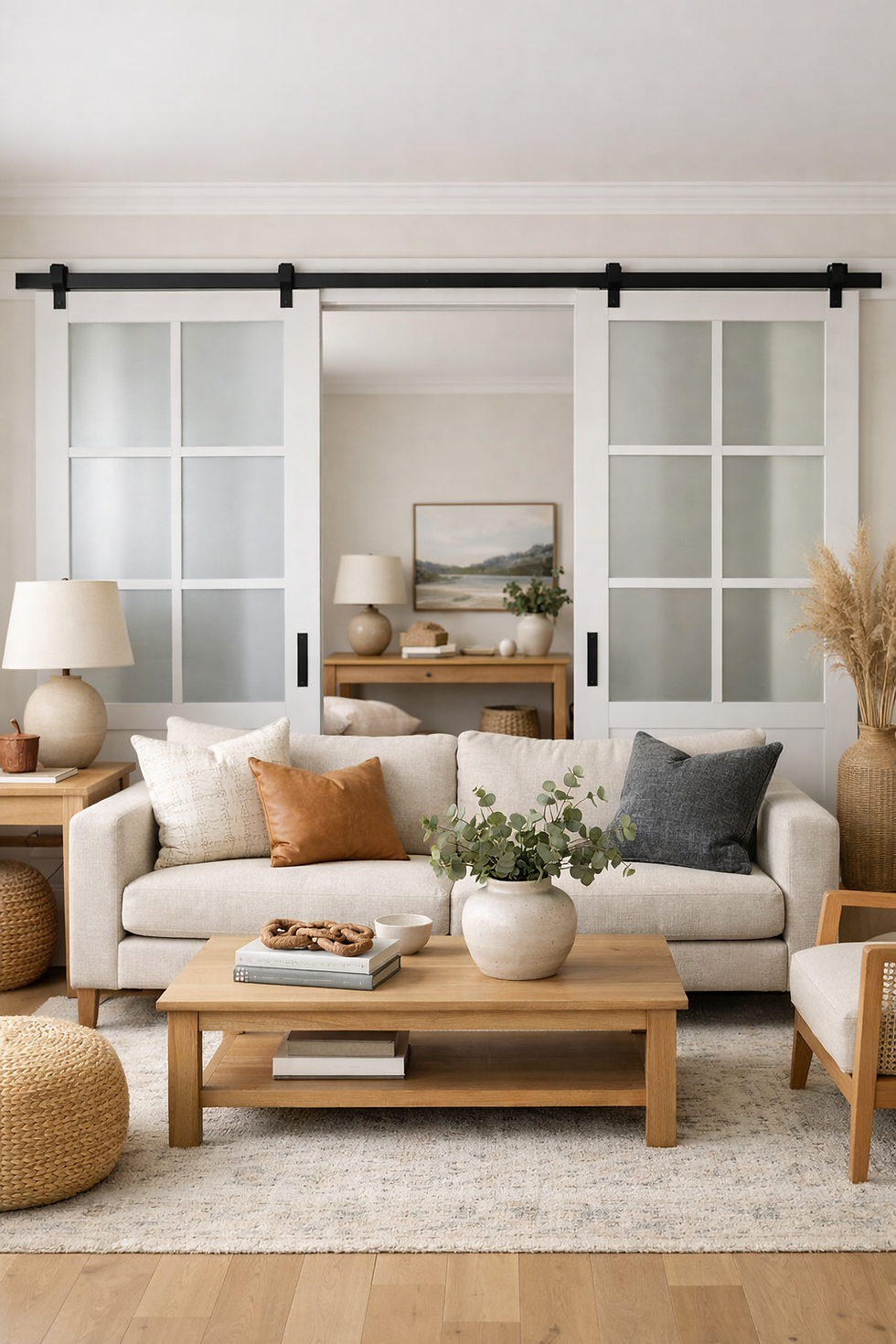
One of the biggest complaints in open-plan homes is lack of privacy. Conversations overlap, screens are always visible, and quiet moments are hard to come by.
Sliding room dividers solve this by offering visual and acoustic separation while preserving circulation paths. Unlike hinged doors, they don’t interrupt furniture placement or walkways.
Designers often place them between kitchens and living areas, or to separate workspaces from social zones.
Designer Tip: Privacy works best when separation is partial and intentional, not absolute.
4. Sliding Room Dividers: Choosing the Right Style for Your Home

Not all sliding room dividers suit every space. The style should respond to architecture, ceiling height, and how the divider will be used daily.
Framed glass works well where light needs to travel. Solid panels create stronger separation. Slatted or reeded designs soften transitions while maintaining visual interest.
Designers avoid choosing dividers based purely on aesthetics. Performance always comes first.
Designer Tip: Choose divider style based on what the space lacks — light, privacy, or structure.
5. Sliding Room Dividers: Ceiling Tracks Matter More Than Panels

Most problems with sliding room dividers come from poor tracking systems. Heavy panels need strong, well-aligned tracks to glide smoothly and sit correctly.
Ceiling-mounted tracks create a cleaner look and avoid floor interruptions, but they require proper structural support. Floor-guided systems are sometimes more practical in retrofits.
Designer Tip: Always plan the track system before finalising the divider material.
Let’s Map Out Your Space Together
If you're planning a makeover and want a designer’s eye on how stick on tiles could work in your home, we’d love to help you visualise the transformation. Book a free 30-minute consultation and let’s sketch out a layout that feels tailored to your space.
6. Sliding Room Dividers: Light Control Is the Hidden Advantage

Beyond privacy, sliding room dividers give you control over light. They allow you to filter, redirect, or block light depending on time and function.
This is especially useful in homes where glare affects screens or where one area receives significantly more daylight than another.
Designers use translucent panels to balance brightness without fully closing spaces off.
Designer Tip: Light control is often the reason clients love their dividers long after installation
7. Sliding Room Dividers: Where Designers Place Them Most Often

Placement determines success. Sliding room dividers work best where activities clash — not where spaces already coexist easily.
Common placements include between kitchens and dining areas, living rooms and home offices, or bedrooms and dressing zones.
Designers avoid placing dividers where they block natural circulation or create pinch points.
Designer Tip: Dividers should follow movement patterns, not fight them.
8. Sliding Room Dividers: Furniture Planning Comes First

A divider can only work if furniture layouts support it. Sofas, tables, and storage must respect opening directions and stacking zones.
Designers always plan divider positions alongside furniture, not after the fact.
Designer Tip: If furniture feels compromised, the divider placement needs rethinking.
Your Renovation, Simplified
If you’re diving into a big home update, our Ultimate Renovation Planner can make the entire process far easier. From material planning to budgeting, it’s designed to keep your project organised while helping you visualise every detail. Explore the planner and plan your makeover with clarity.
9. Sliding Room Dividers: Mistakes Designers See Repeatedly

The most common mistake is installing a divider too late in the design process. This leads to awkward proportions, blocked views, or unused panels.
Another issue is choosing materials that look good but perform poorly over time.
Designer Tip: Sliding room dividers should be planned as architecture, not decor.
10. Sliding Room Dividers: When They Are Not the Right Solution

Despite their flexibility, sliding room dividers aren’t always the answer. In very narrow spaces or where sound insulation is critical, permanent solutions may perform better.
Designers always assess whether the divider solves the root problem or just masks it.
Designer Tip: The best solution is the one that fixes daily frustration, not just visual issues.
Conclusion
Sliding room dividers are one of the most effective tools designers use to refine open-plan homes without heavy construction. When planned properly, they add control, flexibility, and intention to spaces that feel too exposed or undefined.
The key is treating them as part of the architecture, not an accessory. With thoughtful placement, the right system, and clear purpose, sliding room dividers quietly transform how homes function every day.
FAQ: Sliding Room Dividers
Are sliding room dividers better than building walls?
Sliding room dividers offer flexibility that walls cannot. They allow separation without permanently changing layout or light flow.
Do sliding room dividers block sound?
They reduce noise but do not provide full soundproofing. Material choice and track quality affect performance.
Can sliding room dividers be added after renovation?
Yes, but planning is easier when done earlier. Retrofitting requires careful assessment of structure and clearances.
Are sliding room dividers suitable for small spaces?
They can work well if circulation and stacking space are properly planned.
Start Your Dream Home Transformation
Our online design packages were created to make the entire process smoother, clearer, and far more enjoyable — no stress, no second-guessing. Whether you’re refreshing one room or reimagining your whole home, we guide you every step of the way with layouts, visuals, and a fully personalised design plan.
See our interior and exterior design packages to get started.


Comments