


White Dove vs Shoji White - An Architect Explains the Real Difference

Updated: May 12
White Dove OC-17 and Shoji White SW 7042 are two of the most compared warm whites across the Benjamin Moore and Sherwin Williams ranges - and the comparison is genuinely confusing because both are warm, both are broadly popular, and both feel like safe, sophisticated choices. On a chip they can look similar. On a wall they create noticeably different rooms. White Dove is a warm white - it reads as a white with warmth, clean and refined. Shoji White is a warm off-white - it reads as a proper off-white with depth, body, and a subtle grey-green complexity. The 9-point LRV gap between them is clearly visible. The cross-brand difference means they cannot be matched across systems.
I have specified both extensively. White Dove appears on almost every residential project I run as a trim white, and frequently on walls in north-facing rooms where reliable warmth is needed. Shoji White I reach for when the brief calls for a proper off-white with character - something that reads as a deliberate choice rather than a default white. Understanding which brief you have is what makes this decision straightforward.

Side by Side
| White Dove OC-17 | Shoji White SW 7042 |
Brand | Benjamin Moore | Sherwin Williams |
LRV | ~83 | ~74 |
Colour type | Warm white - reads as a warm bright white | Warm off-white - reads as a proper off-white with depth |
Undertone | Warm cream with subtle grey quality - restrained | Warm beige-grey with green quality - complex, shifting |
Character | Clean, warm, settled, broadly versatile | Soft, complex, sophisticated, characterful |
North-facing | Excellent - most reliable warm white in BM range | Good - grey-green can surface but warmth holds with care |
South-facing | Beautiful - warm and clean in good natural light | Beautiful - warm and luminous, grey-green recedes |
Best for | Trim, ceilings, walls in any room type, whole-house | Walls in bedrooms, living rooms, organic modern schemes |
Trim pairing | Works as trim and wall both | Chantilly Lace OC-65 or White Dove OC-17 on trim |
Main risk | Can feel too bright on walls if room is very sunny | Grey-green surfaces in cool light or alongside cool materials |
White Dove OC-17 - What It Actually Is

White Dove OC-17 is Benjamin Moore's most widely specified and most broadly reliable warm white - a colour that appears on practically every residential project I run because it solves so many problems at once. At LRV ~83 it sits firmly in the warm white zone - reflective enough to read as a proper white in any room, warm enough to prevent the clinical coolness that pure whites produce. Its undertone is warm cream with a subtle grey quality - present and clearly warm but restrained enough to work across an enormous range of room types, material palettes, and wall colour directions.
WHICH IS WARMER?
White Dove is more consistently warm. Shoji White has a grey-green component in its undertone that can suppress the warmth in cool light conditions, making it read as a more complex, shifting colour rather than a straightforwardly warm one. White Dove's cream undertone is steady and predictable - it reads as warm in virtually every condition. The warmth of Shoji White is more situation-dependent.
WHICH HAS THE HIGHER LRV?
White Dove, at LRV ~83 vs Shoji White's ~74. That 9-point gap is clearly visible on a wall - White Dove is noticeably brighter and more reflective. In a small room or one with limited natural light, that difference is consequential. In a well-lit room both read as warm and open, but White Dove always delivers more light.
WHICH IS BETTER FOR NORTH-FACING ROOMS?
White Dove - it is one of the most reliable warm whites for north-facing rooms in the entire BM range. The cream undertone counteracts cool indirect light without shifting or introducing risk. Shoji White in a north-facing room can reveal more of its grey-green quality than expected - it remains manageable with warm materials and 2700K lighting, but requires more care. The full White Dove coordinating guidance is in the White Dove coordinating colors guide.
WHICH IS BETTER FOR CABINETS AND TRIM?
White Dove for trim and cabinets - it is one of the most reliable trim whites in the BM range. The LRV and warm undertone create a clean, warm boundary that suits almost any wall colour without undertone conflict. Shoji White is not typically used as a trim colour - its depth and off-white character read as wall colour rather than crisp trim. If trim is the primary application, White Dove is the answer.
MY VERDICT ON WHITE DOVE
White Dove for trim, north-facing rooms, whole-house schemes, and any brief requiring a reliable warm white. It is the most broadly useful white in the BM range. The full picture of what it pairs with across every room type is in the White Dove coordinating colors guide.
For the comparison of Chantilly Lace as a trim option alongside Shoji White walls - and the broader question of Chantilly Lace versus Shoji White as competing wall colors - the Chantilly Lace vs Shoji White guide covers both questions directly.
Shoji White SW 7042 - What It Actually Is

Shoji White SW 7042 is one of Sherwin Williams' most widely loved warm off-whites - a colour with genuine depth, body, and character that White Dove at 9 LRV points brighter simply cannot replicate. At LRV ~74 it sits firmly in the off-white zone - deeper than a warm white, lighter than a proper greige. It reads as a deliberate, considered off-white rather than a default background colour.
Shoji White's defining quality is its undertone complexity - warm beige-grey with a subtle green quality that shifts depending on light conditions. In warm natural light the green recedes and the colour reads as a beautiful, sophisticated warm off-white. In cool north-facing light or under cool artificial lighting the green-grey quality surfaces more visibly and the colour reads as more complex. This shifting behaviour is what makes it so interesting in the right room and what makes it require careful sampling in the wrong one.
WHICH IS WARMER?
White Dove is more consistently warm. Shoji White's warmth is real but conditional - the grey-green undertone means its warmth reading varies across light conditions. In south-facing warm light it glows beautifully. In north-facing or cool conditions the grey-green surfaces and the warmth is less clear. For the full Shoji White undertone story, the Shoji White Sherwin Williams review covers every condition.
WHICH HAS THE HIGHER LRV?
White Dove by 9 points. But Shoji White's lower LRV ~74 is what gives it character and depth on a wall - the 9-point difference means it reads as a proper off-white rather than a near-white. If the brief calls for walls with presence and body, Shoji White's depth is an advantage.
WHICH IS MORE VERSATILE?
White Dove is more broadly versatile across room types, orientations, and applications. Shoji White is more versatile within its specific range - organic modern, transitional, and traditional interiors with warm natural light - but it is more demanding of conditions. White Dove works almost everywhere. Shoji White works beautifully in the right rooms.
MY VERDICT ON SHOJI WHITE
Shoji White for interior walls in south or east-facing rooms with a warm, organic, or transitional brief. It creates a depth and character that White Dove cannot replicate. The full cross-brand comparison between Shoji White and Swiss Coffee - the nearest BM equivalent - is in the Shoji White vs Swiss Coffee guide.
For the cross-brand comparison of Shoji White against BM Simply White - the bright warm white at LRV 89.5 that belongs to a completely different depth category - the Simply White vs Shoji White guide covers the 15-point LRV gap and which one your room actually needs.
The LRV Gap - Why 9 Points Matters
The 9-point LRV gap between White Dove (~83) and Shoji White (~74) is the most practically significant number in this comparison. Nine points is a lot - clearly visible on a wall, clearly felt in a room. White Dove makes rooms feel bright, open, and airy. Shoji White makes rooms feel settled, warm, and considered. In a small or dark room the gap matters enormously. In a well-lit room it creates a different atmosphere rather than a different experience of space.
The gap also determines the trim relationship. White Dove can be wall and trim in the same room - the LRV ~83 is bright enough for trim to read correctly. Shoji White at LRV ~74 needs a proper trim white - White Dove OC-17 or Chantilly Lace OC-65 - to create a clear boundary between wall and trim.
How Each Colour Behaves in Different Light

North-Facing Rooms
White Dove is one of the safest north-facing specifications in the BM range. The cream undertone holds steadily under cool indirect light without shifting. I have specified it in challenging north-facing rooms many times with confidence. Shoji White in a north-facing room requires more care - the grey-green quality surfaces more visibly in cool indirect light and the colour can read as a complex, slightly cooler off-white rather than a warm one. With warm oak floors, 2700K lighting, and warm textiles it manages well. Without those anchors it needs careful testing first.
South-Facing Rooms
Both are beautiful in south-facing rooms. Shoji White is at its most impressive in strong warm natural light - the grey-green recedes completely and the colour reads as a rich, luminous warm off-white that has real character and depth. White Dove in the same conditions is clean, warm, and bright - excellent but less specifically impressive than Shoji White at its best. For south-facing walls where the brief is a warm off-white with genuine character, Shoji White is the more interesting choice.
Artificial Lighting
Both benefit from 2700K warm-spectrum bulbs. Shoji White is the more demanding of the two under artificial light - under cool 4000K bulbs the grey-green quality surfaces and the colour can read as a complex grey-off-white rather than a warm one. White Dove holds its cream warmth more consistently under cool artificial lighting. For rooms where the lighting specification is cool and cannot easily be changed, White Dove is the safer specification.
Not sure which one is right for your room? Book a colour consultation here - bydesignandviz.com/book-online |
The Cross-Brand Consideration

White Dove is Benjamin Moore. Shoji White is Sherwin Williams. These cannot be cross-matched - a SW match of White Dove will not replicate its cream-grey undertone, and a BM match of Shoji White will not replicate its warm beige-grey-green complexity. If the specific undertone character matters - and it does - always buy the original brand. For surfaces that can be seen simultaneously, stay within one brand's system.
The nearest BM equivalent to Shoji White's warm off-white character is Swiss Coffee OC-45 - a warm off-white with cream and green-yellow complexity at a similar depth. It is not an exact match but it occupies a similar position in the BM range. The nearest SW equivalent to White Dove's warm white character is Alabaster SW 7008 - though Alabaster at LRV ~82 is fractionally deeper and more obviously creamy.
White Dove vs Shoji White Room by Room
Bedrooms
Shoji White makes a more atmospheric bedroom choice for south or east-facing rooms - the depth and off-white character create a settled, considered atmosphere that White Dove's brighter quality cannot fully replicate. Under warm evening lighting at 2700K, Shoji White reads as beautifully enveloping. White Dove in a bedroom is the reliable, bright, broadly versatile choice - correct for north-facing rooms, smaller rooms, and any bedroom where maximum lightness is the brief.
Living Rooms

In a south-facing living room with an organic modern or transitional brief, Shoji White is the more distinctive choice - its depth and shifting quality creates a room that feels genuinely considered. In a north-facing living room or a contemporary scheme where brightness is the brief, White Dove is the more reliable specification. Both work in living rooms - the orientation and brief determine which is correct.
Trim and Ceilings

White Dove is the answer for trim and ceilings - Shoji White is a wall colour, not a trim colour. Its LRV ~74 and off-white depth read as a wall colour on skirting, architrave, and window frames - the definition between wall and trim is lost. White Dove on all trim and ceilings creates the bright, warm boundary that Shoji White walls need to read at their best.
Kitchens

White Dove on kitchen cabinets creates a warm, clean, broadly reliable result that suits shaker, slab, and contemporary cabinetry across a range of kitchen styles. It is one of my most consistent kitchen cabinet specifications. Shoji White on kitchen cabinets is a more specific and more characterful choice - it suits organic modern kitchens with warm stone countertops and unlacquered brass hardware beautifully, but its grey-green undertone can read as slightly complex alongside cool stone or stainless appliances.
Open-Plan and Whole-House
White Dove is the stronger whole-house specification. White Dove whole-house is reliable across different room orientations because the cream undertone holds consistently without the grey-green shifting that Shoji White can develop in north-facing sections of a large open-plan space. Shoji White whole-house works in homes with predominantly south or east-facing rooms, warm natural light throughout, and a consistent warm organic brief.
Choose White Dove If

The application is trim, ceilings, or cabinets - White Dove is the most reliable warm trim white in the BM range and the correct choice for any application where a warm white boundary is needed.
The room is north-facing or has limited light - the cream undertone holds reliably in cool indirect conditions where Shoji White's grey-green becomes more noticeable.
The brief is whole-house or open-plan - consistent undertone across varied orientations makes White Dove the safer specification for large or multi-room schemes.
You are working within the Benjamin Moore system - White Dove coordinates naturally with BM neutrals and BM whites. For how it compares to the other main BM whites, the Chantilly Lace vs White Dove guide covers every condition.
Choose Shoji White If
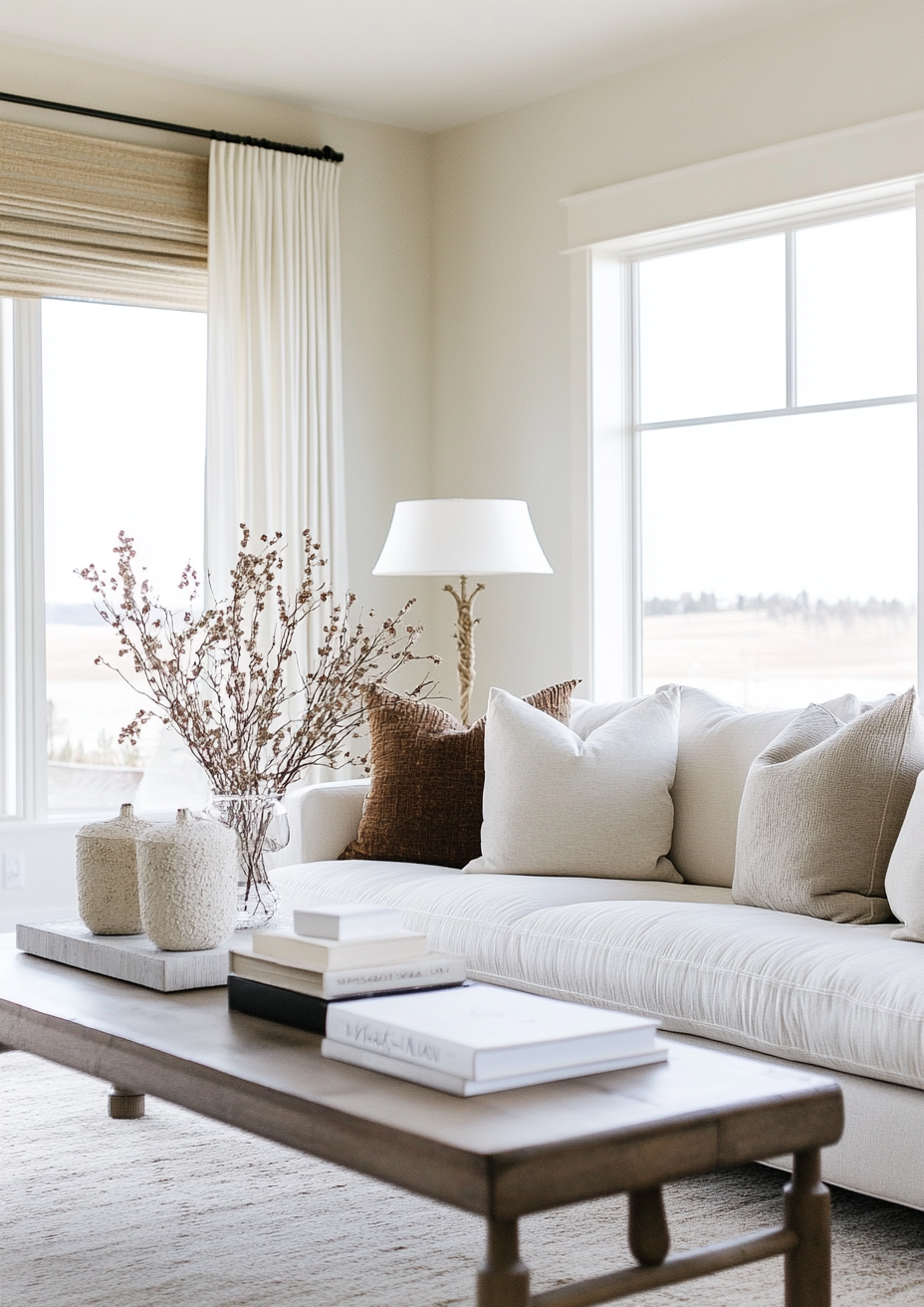
The application is interior walls in a south or east-facing room - Shoji White rewards good warm natural light and reads at its best when that light is present.
The interior style is organic modern, transitional, or traditional - the warm beige-grey complexity relates naturally to these styles and to the warm materials - wood, brass, linen, warm stone - that accompany them.
You want a wall colour with genuine depth and character - Shoji White reads as an intentional, considered off-white rather than a default background. The depth at LRV ~74 gives rooms a settled quality that brighter whites cannot replicate.
You are working within the Sherwin Williams system - Shoji White coordinates naturally with SW neutrals and SW whites. For how it sits within the wider SW off-white family, the Shoji White vs Natural Linen guide covers the nearest SW alternative.
White Dove and Shoji White vs Other Warm Whites

VS SIMPLY WHITE OC-117
Simply White is brighter and more yellow than White Dove. At LRV ~89.5 it reflects more light and its barely-there warm yellow reads as cleaner and more direct than White Dove's cream-grey. For rooms needing maximum brightness and warmth, Simply White is the step up from White Dove. Between Shoji White and Simply White, Simply White is 15+ points brighter and a different type of colour entirely - a bright warm white rather than a warm off-white.
VS ALABASTER SW 7008
Alabaster is deeper and creamier than White Dove, and similar in depth to Shoji White. At LRV ~82 Alabaster sits closer to Shoji White's depth territory than White Dove's, with a warm cream-greige undertone that is more directionally warm than Shoji White's grey-green complexity. For rooms where Shoji White feels too complex and a warmer, more straightforward off-white is needed, Alabaster is often the correct SW alternative.
VS SWISS COFFEE OC-45
Swiss Coffee is the nearest BM equivalent to Shoji White's depth and warmth territory. At LRV ~82 with a warm cream and subtle green-yellow complexity, it occupies a similar position in the BM range to where Shoji White sits in the SW range - a warm off-white with character rather than a bright warm white. The full cross-brand comparison is in the Shoji White vs Swiss Coffee guide.
VS DOVE WING OC-18
Dove Wing is deeper than Shoji White and comparable in LRV. At LRV ~74 Dove Wing sits in the same depth zone as Shoji White but with a warm beige-greige complexity that is different in character from Shoji White's grey-green quality. Both are warm off-whites with real body - the choice between them is undertone direction: Dove Wing is warmer and more beige, Shoji White is more complex with the grey-green shift.
Frequently Asked Questions

Is White Dove warmer than Shoji White?
White Dove is more consistently warm. Shoji White is warm in good light but its grey-green undertone means its warmth varies across conditions. White Dove's cream undertone is steady and predictable across virtually all light conditions. If consistent warmth is the priority, White Dove is the more reliable choice.
Can White Dove and Shoji White be used together?
Yes - Shoji White walls with White Dove trim is one of the most natural combinations. The warm off-white walls and warm white trim sit in the same family and the 9-point LRV contrast creates a clear, considered boundary. I use this combination regularly in organic modern and transitional residential projects. The warmth of both colours creates cohesion while the depth difference provides definition.
Which is better for a warm whole-house neutral?
White Dove for whole-house. The consistent cream undertone works across north and south-facing rooms without the grey-green shift that Shoji White can develop in cooler orientations. For a warm off-white whole-house scheme in a home with predominantly good warm light, Shoji White can work - but White Dove is the safer specification for most UK homes.
Does Shoji White look grey?
In cool north-facing light or under cool artificial lighting, Shoji White can develop a grey-green quality that reads as more complex and less warm than expected. In south-facing warm natural light it reads as a beautiful warm off-white with no obvious grey reading. Sampling at large scale in the actual room is essential. The grey tendency is one of the most reported surprises from clients who chose Shoji White without sampling adequately.
What trim colour goes with Shoji White?
White Dove OC-17 is my first recommendation for trim alongside Shoji White walls. The warmth of White Dove relates naturally to Shoji White's warm off-white character and the 9-point LRV contrast creates a clean, defined boundary. Chantilly Lace OC-65 is a crisper alternative for contemporary schemes where more contrast is the brief.
The Verdict
White Dove and Shoji White are not competing for the same brief. White Dove is the reliable warm white - consistent, broadly versatile, correct for trim, ceilings, north-facing rooms, and whole-house schemes. Shoji White is the characterful warm off-white - deeper, more complex, and more atmospheric in the right conditions, particularly south-facing walls in organic modern and transitional interiors.
The combination of both - Shoji White walls, White Dove trim - is one of the most natural and most beautiful warm white pairings available across the two brands. Sample both at large scale in the actual room. The 9-point LRV difference will be immediately visible. The grey-green tendency of Shoji White will be apparent in cool light if it is going to be a factor in your specific room.
Need help choosing between White Dove and Shoji White? See our design packages here - bydesignandviz.com/#interiordesignpackages |
About the Author
Beril Yilmaz is a qualified architect and interior designer based in the UK. She runs BY Design And Viz, a design platform covering paint colour reviews, interior design guidance, and residential design projects.


Comments