


Chantilly Lace vs Pale Oak: The Comparison That Actually Helps You Decide

Chantilly Lace and Pale Oak are not competing for the same wall. One is the crispest, coolest white in the Benjamin Moore lineup. The other is a warm greige that barely qualifies as white at all. Put them on a comparison chart and the twenty-point LRV gap tells you everything before you even look at undertone.
I have used both across residential projects, and I never treat this as a genuine toss-up. Chantilly Lace does one job — bright, clean, uncompromising white — and Pale Oak does a different one entirely: soft, warm, grounded neutral. The question is rarely which one is better. It is which job your room actually needs done.
Here is how I separate the two and decide which one belongs in a given space.
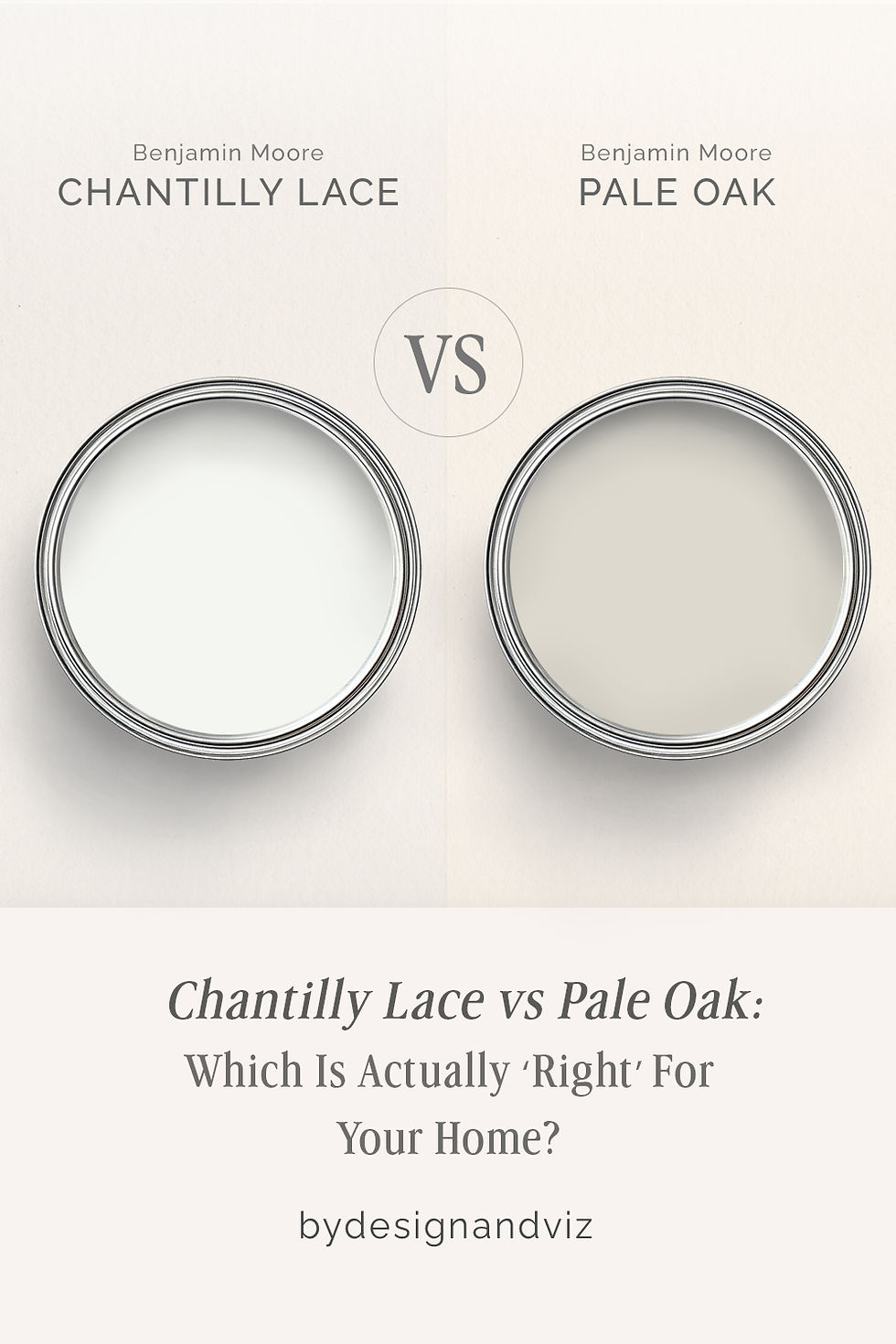
At a Glance
| Chantilly Lace | Pale Oak |
Brand | Benjamin Moore | Benjamin Moore |
LRV | 90.1 - one of the highest LRVs in the BM range | 69.53 - a mid-to-high LRV that behaves like a soft neutral, not a white |
Colour category | True white with a cool, faint blue-violet undertone | Warm greige - part beige, part grey, leaning gently warm |
Undertones | Cool and clean - the closest BM gets to a neutral, undertone-free white | Soft warm-grey with a faint beige base - restrained enough to shift with the light |
Character | Bright, crisp, and architectural; behaves like a spotlight in any room it enters | Quiet and chameleon-like; the definitive Benjamin Moore 'greige' that reads differently in every room |
North-facing | Risky without warmth nearby - can read flat or slightly clinical in low light | Reliable - the warm undertone keeps cool light from reading grey and flat |
South-facing | Excellent - stays bright and true without yellowing or greying | Softens strong daylight without losing warmth or turning beige |
Open-plan | Strong when the goal is a consistent, gallery-like backdrop across zones | Strong - shifts subtly between rooms without ever looking inconsistent |
On walls | Full-brightness white backdrop - reads as intentional and modern from every angle | Soft neutral backdrop that grounds a room without the commitment of a full greige |
On cabinets | The standard choice for crisp modern kitchens and bathrooms with cool or mixed metals | Reliable in kitchens with warm wood floors and mixed metal finishes |
Use together? | Yes - Chantilly Lace on trim against Pale Oak walls is a classic high-contrast pairing | Yes - Pale Oak walls with Chantilly Lace trim is a well-tested, high-contrast combination |
Trim for each | Chantilly Lace on itself for seamless white-on-white, or a deeper white for more definition | Chantilly Lace for a clean, defined edge, or a warmer white for a softer transition |
Style fit | Modern, minimalist, coastal, gallery-style interiors | Transitional, organic modern, warm minimalist interiors |
Architect's pick | When the brief calls for maximum brightness and a true, undertone-free white | When the brief needs warmth and grounding without committing to a visibly beige or grey wall |
Benjamin Moore Chantilly Lace OC-65 - What It Really Looks Like

Chantilly Lace has an LRV of 90.1, which puts it among the brightest whites Benjamin Moore makes. The undertone is cool, with the faintest whisper of blue-violet that only becomes visible next to a warmer white in direct comparison. On its own, it reads as close to a true, neutral white as paint gets.It does not hedge. There is nothing ambiguous about it - it is bright, it is clean, and it stays that way in almost any light. For the comparison against another cool BM contender that's frequently shortlisted alongside it, the Chantilly Lace vs Swiss Coffee guide walks through why one reads warm and the other reads cold in the same north-facing room.
In direct sunlight it can verge on glare if the room already has strong natural light and pale flooring. In dimmer or north-facing spaces, however, it holds its brightness better than most whites - the cool undertone does not warm up or muddy the way a warm white would in flat light. It needs contrast to look considered rather than sterile: dark trim, black hardware, or a strong architectural feature nearby.
Benjamin Moore Pale Oak OC-20 - What It Really Looks Like

Pale Oak has an LRV of 69.53, sitting well below Chantilly Lace and firmly in greige territory rather than white. The undertone is a careful balance of warm beige and cool grey, which is exactly what makes it so difficult to pin down on a swatch. In person it shifts constantly - warmer in morning light, cooler under overcast skies, always soft.It does not commit fully to either warm or cool, and that restraint is its defining trait, not a weakness. For how it performs against another chameleon-like BM neutral in the same LRV range, the Pale Oak vs Light Pewter guide covers which one reads warmer in a mixed-material kitchen.
This is what makes Pale Oak one of the most specified neutrals in the Benjamin Moore range. It grounds a room the way a true grey would, but keeps enough warmth to avoid feeling cold or institutional. Next to warm wood floors it reads beige. Next to white oak or pale stone it reads grey. The room decides, not the paint can.
The Real Difference Between Chantilly Lace and Pale Oak

The simplest way to explain it: Chantilly Lace is a white that behaves like a white. Pale Oak is a neutral that behaves like a room. They are not two shades of the same colour - they are two different tools with a twenty-point LRV gap between them.
Chantilly Lace sits at an LRV of 90.1. Pale Oak sits at 69.53. That gap is the whole story. Chantilly Lace reflects light aggressively and stays consistent regardless of what is around it. Pale Oak absorbs more light and reacts to its surroundings - warmer near wood, cooler near stone, always soft rather than assertive.
The two work together far more often than they work as rivals. Pale Oak on the walls with Chantilly Lace on trim is one of the most reliable pairings in the Benjamin Moore catalogue - the bright trim frames the softer wall colour and keeps the whole scheme from reading muddy. For the comparison of Chantilly Lace against another warm mid-tone neutral it is frequently paired or confused with, the Chantilly Lace vs Repose Gray guide breaks down why a cool white and a cool-leaning grey read so differently against the same warm greige.
Not sure which one works for your room? A colour consultation is included in all our design packages - book directly here. |
When to Choose Chantilly Lace

Choose Chantilly Lace when the brief specifically calls for a bright, true white and the room has enough natural light or contrast to support it. These are the conditions where it is the right answer:
South or east facing rooms with strong daylight, where the cool undertone reads clean rather than cold. Modern and minimalist interiors where the goal is a crisp architectural backdrop. Kitchens and bathrooms with cool-toned stone, chrome, or black fixtures, where a warm white would fight the material palette. Ceilings and trim in almost any scheme, where its brightness creates definition without introducing a competing undertone.
Avoid Chantilly Lace in north-facing rooms with limited daylight and no warm materials to offset it - it can read flat and slightly clinical rather than crisp. Avoid it in traditional or farmhouse interiors where a warm white will sit more comfortably against wood tones and brass.
When to Choose Pale Oak

Choose Pale Oak when the room needs warmth and grounding without reading as an obvious beige or grey wall. These are the situations where it outperforms Chantilly Lace:
North-facing rooms where a true white would look flat or cold, and where the warm undertone in Pale Oak keeps the space feeling inviting. Transitional and organic modern interiors that mix warm wood with cooler metals or stone. Open-plan spaces where the wall colour needs to shift naturally with the light rather than reading as one flat tone all day. Any room where a full greige felt too heavy but a stark white felt too clinical.
Pale Oak is also the more forgiving choice for a first-time neutral - it rarely looks wrong, even in rooms with inconsistent lighting or mixed finishes.
How the Pairings Differ

For Chantilly Lace on walls, keep the room's materials cool or neutral - white oak, chrome, black steel - so the brightness does not fight a warmer palette. Pair with Pale Oak or another warm neutral in adjoining rooms for a considered transition rather than a jarring one.
For Pale Oak on walls, Chantilly Lace on trim and ceilings creates the cleanest definition. A warmer white will soften the contrast further but risks the whole room reading beige rather than balanced.
Both colours work with a wide range of flooring, but for different reasons. Chantilly Lace looks best against pale or mid-tone floors where the white can still assert itself as the brightest element in the room. Pale Oak is more forgiving - it settles comfortably against warm oak, cool-toned engineered wood, and most stone finishes without a fight.
Chantilly Lace pairs naturally with black, chrome, and brushed nickel - cool metals that reinforce its crisp character. Pale Oak is more flexible again, working equally well with brass, matte black, or nickel depending on whether the room is leaning warm or cool that day.
Architect's Verdict - Chantilly Lace or Pale Oak?

For most homes - particularly those where the wall colour needs to do real work grounding a mixed material palette - Pale Oak is the more versatile choice. Its warmth is restrained enough to avoid looking beige, but present enough to keep a room from feeling cold or unfinished.
Chantilly Lace is the right choice when brightness itself is the brief - a modern kitchen, a gallery-style hallway, a room that needs to feel open and architectural rather than warm and grounded. In a south-facing room with strong contrast already built in, it is unmatched for clean, confident white.
Pale Oak is the right choice when the room needs to feel settled rather than sharp - and when the light or the material mix is uncertain. It is the safer bet in a north-facing room, in an open-plan space, or anywhere a stark white would read cold.
The test I always use for this pairing: paint a large sample of Pale Oak on the wall of your dimmest, north-facing room, and hold a Chantilly Lace card against it in both morning and evening light. If Pale Oak still reads warm and settled rather than grey and flat under that worst-case light, it passes. If Chantilly Lace still reads crisp rather than clinical in the same room, it passes too. Whichever one holds up in your hardest room is the one your whole house should follow.
Frequently Asked Questions

Is Chantilly Lace warmer than Pale Oak?
No - it is the opposite. Chantilly Lace is a cool, near-neutral white with a faint blue-violet undertone. Pale Oak is the warmer of the two, with a soft beige-grey base that shifts warmer or cooler depending on the light and materials around it.
Can I use Chantilly Lace and Pale Oak in the same house?
Yes, and it is one of the most reliable pairings in the Benjamin Moore range. Pale Oak on the walls with Chantilly Lace on trim creates clean definition and lets each colour do its job - warmth on the walls, brightness on the joinery.
Which is better for a north-facing room?
Pale Oak, without much competition. Its warm undertone keeps north-facing light from reading grey or flat. Chantilly Lace can look clinical in the same conditions unless the room has strong contrast or warm materials to offset it.
Which is better for kitchen cabinets?
It depends on the metals and countertop. Chantilly Lace is the standard for modern kitchens with cool stone and chrome or black hardware. Pale Oak works better in kitchens with warm wood tones or mixed brass and nickel finishes, where a stark white would feel out of place.
Does Pale Oak read as beige or grey?
Both, depending on the room. That is its defining characteristic - Pale Oak shifts between beige and grey depending on the light, the flooring, and the materials nearby. It rarely commits fully to either, which is exactly why it is so widely specified.
What is the LRV difference between Chantilly Lace and Pale Oak?
Chantilly Lace has an LRV of 90.1 and Pale Oak has an LRV of 69.53 - a gap of roughly twenty points. That is a significant difference in real terms: Chantilly Lace behaves like a true white, while Pale Oak behaves like a soft, light-absorbing neutral.
Final Thought
Chantilly Lace and Pale Oak are not really in competition. One is a bright, true white built for clarity and contrast. The other is a soft, warm-grey neutral built to ground a room without asserting itself. The choice is not about which looks better in the abstract - it is about which job your room needs done.
If your room has strong natural light and needs brightness, Chantilly Lace will deliver a clean, architectural result. If your room needs warmth, softness, or a neutral that adapts to mixed materials, Pale Oak is the more dependable choice. Paint large sample patches of each in your actual room, check them in your dimmest light and your brightest, and the answer will be obvious within a day.
Want a complete colour scheme built around Chantilly Lace or Pale Oak? Our design packages cover full palette selection, finish recommendations, and 3D visualisations - see our packages. |
About the Author
Beril Yilmaz is a qualified architect and interior designer based in the UK. She runs BY Design And Viz, a design platform covering paint colour reviews, interior design guidance, and residential design projects. Beril has specified both Chantilly Lace and Pale Oak across residential projects in the UK and internationally - Chantilly Lace in modern kitchens and gallery-style interiors with cool stone and black hardware, Pale Oak in transitional living spaces with warm wood floors and mixed metal finishes, often specifying both together with Pale Oak on the walls and Chantilly Lace on the trim.



Comments