


Chantilly Lace vs Shoji White: The Comparison That Actually Helps You Decide

Updated: Sep 17
Chantilly Lace and Shoji White appear on the same shortlists more often than their differences would suggest they should. Both are described as timeless, sophisticated, and endlessly versatile. Both have loyal followings among designers and homeowners. One is from Benjamin Moore, one from Sherwin Williams. On a mood board or under artificial lighting they can look like they occupy the same neutral territory. On a wall in a real room the 18-point LRV gap between them is immediately and unmistakably visible - and the undertone difference is even more consequential.
Chantilly Lace is a crisp, near-neutral white. Its undertone sits just on the cool side of neutral - clean, architectural, precise. Shoji White is a warm off-white with genuine depth and body. Its beige-greige undertone delivers warmth with an earthy complexity that no white at Chantilly Lace's LRV can replicate. These two colors serve completely different briefs. But they also have a specific relationship that most comparisons miss entirely: Chantilly Lace is one of the two best trim choices for Shoji White walls, and understanding when to use it in that role versus when to choose it for walls instead is the most practically valuable question this comparison can answer.
This guide covers exactly how Chantilly Lace and Shoji White differ in undertone, LRV, light behavior, and room application - with a clear verdict on which one to choose and when.

At a Glance
| Chantilly Lace OC-65 | Shoji White SW 7042 |
Brand | Benjamin Moore | Sherwin Williams |
LRV | ~92 - one of the brightest whites available | 74 - warm off-white with real depth and body |
Color category | Near-neutral white - reads as architectural white | Warm off-white - reads as a deliberate off-white |
Undertones | Near-neutral with faint cool quality - crisp, precise | Warm beige-greige with subtle grey-green - earthy, complex |
Character | Crisp, clean, bright - reads as genuinely white | Deeper, warmer, more complex - reads as considered off-white |
North-facing | Excellent - near-neutral handles cool light cleanly | With care - grey-green surfaces in cool indirect light |
South-facing | Beautiful - luminous and dazzling | Excellent - earthy depth activates beautifully |
As trim for Shoji White? | Yes - one of the two best trim choices | N/A - Shoji White on walls needs Chantilly Lace or White Dove on trim |
On cabinets | Outstanding - the most specified contemporary cabinet white | Sophisticated, earthy, characterful result |
Trim for each | Chantilly Lace itself on both walls and trim | Chantilly Lace OC-65 or White Dove OC-17 on trim |
Style fit | Contemporary, transitional, traditional - universally versatile | Traditional, transitional, organic modern, Japandi |
Architect's pick | When crisp, clean, architectural white is the brief | When warm, earthy, sophisticated off-white is the brief |
BM Chantilly Lace OC-65 - What It Really Looks Like

Chantilly Lace has an LRV of approximately 92 - one of the highest in the BM range and one of the highest available in residential paint. At that reflectance level it reads as a clean, pure, architectural white in virtually every light condition. The undertone is near-neutral with a very faint cool quality - just enough to prevent it reading cream or ivory, not enough to read as cool or blue in most conditions.
Chantilly Lace reads as white - clean, unambiguous, architectural white. It does not have the warmth of White Dove, the subtle yellow of Simply White, or the earthy off-white character of Shoji White. In rooms and schemes where white needs to read as genuinely white rather than warm off-white, Chantilly Lace delivers that more reliably than any other BM white. For the full range of what coordinates with it and why, the Chantilly Lace coordinating colors guide covers every combination.
On cabinets Chantilly Lace is outstanding - the most widely specified contemporary cabinet white in residential design. Its near-neutral quality works alongside warm stone, cool quartz, and virtually every hardware finish without undertone conflict. It is also the most universally reliable trim white in the BM range - it provides a clean, precise boundary alongside almost any wall color without fighting the undertone. For how it compares to Alabaster in a cross-brand context, the Alabaster vs Chantilly Lace guide covers the warm-versus-crisp white decision in detail.
SW Shoji White SW 7042 - What It Really Looks Like

Shoji White has an LRV of 74 - eighteen points below Chantilly Lace. That gap is large and immediately visible on a wall. Shoji White is not a white with warmth. It is a proper warm off-white with genuine depth, body, and character that reads as a deliberate color decision rather than a background that disappears.
The undertone is warm beige-greige with a subtle grey-green component. That grey-green is what gives Shoji White its distinctive complexity - an earthy, organic quality that straight warm whites cannot replicate. In warm natural light the grey-green recedes and Shoji White reads as a rich, settled warm off-white. In cool conditions - north-facing light or under 4000K bulbs - the grey-green surfaces more visibly and the color reads as a complex greige-green rather than a straightforwardly warm neutral. Always test under your actual artificial lighting before committing.
Shoji White needs proper trim to define it. At LRV 74 the depth means adjacent trim must be clearly brighter to create a clean boundary between wall and trim. Chantilly Lace OC-65 is one of the two most reliable trim choices for Shoji White walls - the 18-point LRV gap creates clear, considered definition and the near-neutral quality of Chantilly Lace does not fight Shoji White's warm undertone. For the full comparison of Shoji White against White Dove - BM's warm white that is the other natural trim choice - the White Dove vs Shoji White guide covers that relationship directly.
The Real Difference Between Chantilly Lace and Shoji White

Chantilly Lace is architectural white. Shoji White is warm off-white. They are not two versions of the same neutral - they are different categories of color that serve different purposes entirely. Trying to build a full palette around Shoji White rather than just choosing between it and Repose Gray? The Shoji White coordinating colors guide covers the best wall, trim, and accent pairings room by room.
Side by side on a wall the 18-point LRV gap is dramatic. Chantilly Lace looks bright, crisp, and clean. Shoji White looks noticeably deeper, warmer, and more obviously off-white. In rooms on their own the character difference is even more consequential: Chantilly Lace rooms feel bright, precise, and architecturally clean. Shoji White rooms feel warm, settled, and characterful.
The trim relationship is the most practically important thing to understand. Shoji White on walls is a deeper, warmer color that needs a clearly brighter trim to create definition. Chantilly Lace as trim alongside Shoji White walls is an excellent pairing - the near-neutral brightness provides clean, precise contrast against the earthy warmth without fighting the undertone. The warmth of the Shoji White walls and the crispness of the Chantilly Lace trim create a considered, sophisticated result.
The reverse - Chantilly Lace on walls with Shoji White on trim - does not work. Shoji White on trim alongside Chantilly Lace walls reads as cream against white - the warmth of the trim makes the walls look cooler and more obviously near-neutral by contrast, and the scheme reads as unresolved. Chantilly Lace on walls needs either Chantilly Lace on trim in a tonal approach or a crisp neutral white - not a warm off-white - to maintain the clean, architectural character of the wall color.
Not sure which one works for your room? A color consultation is included in all our design packages - book directly here. |
When to Choose Chantilly Lace

Choose Chantilly Lace when crisp, clean, architectural white is the brief. Contemporary and transitional interiors where precision and clarity are the design values. Trim, cabinets, and ceilings in virtually any scheme - Chantilly Lace's near-neutral quality means it works alongside almost any wall color without undertone conflict. Any room where a previous warm white has felt too creamy, too yellow, or too obviously off-white for the brief.
Chantilly Lace is also the correct trim choice alongside Shoji White walls when the brief calls for maximum definition and contrast. The 18-point LRV gap creates a clean, precise boundary that makes both colors look more considered. For every other combination and application, the Chantilly Lace coordinating colors guide is the most complete reference.
When to Choose Shoji White
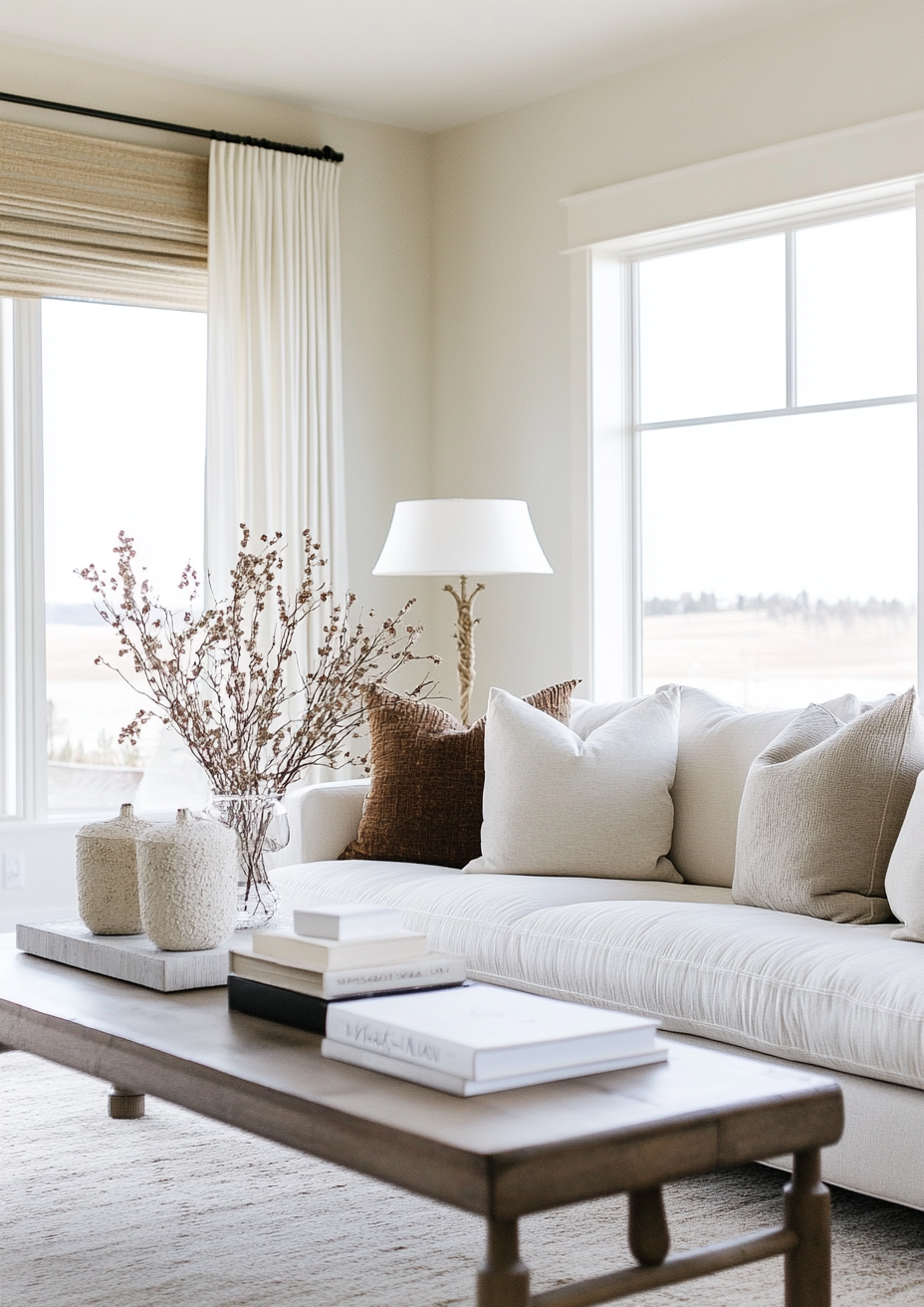
Choose Shoji White when warm, earthy, sophisticated off-white is the brief. Traditional, transitional, and organic modern interiors where the walls need to have presence and character rather than simply provide a bright backdrop. Rooms with warm wood, warm stone, and brass or bronze hardware where the earthy warmth ties naturally into the palette. South-facing rooms where the depth activates beautifully in strong natural light. Any brief where the client specifically wants an off-white that reads as a deliberate color decision.
Avoid Shoji White in rooms with very limited natural light - the grey-green component can dominate and the color can read muddy. Avoid it in north-facing rooms without warm 2700K lighting and warm materials to anchor the warmth. For how Shoji White compares to Pale Oak in the same depth zone, the Shoji White vs Pale Oak guide covers that cross-brand comparison.
How the Pairings Differ

For Shoji White on walls, Chantilly Lace OC-65 on trim is one of the two best choices - the 18-point LRV gap creates clean, precise definition and the near-neutral quality does not fight the warm earthy undertone. White Dove OC-17 on trim creates a softer, more tonal result that suits traditional and farmhouse schemes. Both are BM colors staying within the same paint system.
For Chantilly Lace on walls, Chantilly Lace itself on trim and ceiling creates a monochromatic approach that is extremely bright and clean - effective in contemporary spaces where maximum light reflection is the brief. Do not use Shoji White on trim alongside Chantilly Lace walls - the warm off-white trim reads as cream against the crisp near-neutral walls.
For flooring, the two colors suit different materials. Chantilly Lace handles the full range of floor finishes - warm wood, cool stone, contemporary tile - because its near-neutral undertone creates no conflict with any of them. Shoji White needs warm floors more urgently - its grey-green undertone can conflict with cool grey stone or tile and the combination can read muddy.
For hardware, Chantilly Lace works with everything - brass, nickel, matte black, chrome. The near-neutral undertone creates no conflict with any hardware finish. Shoji White suits aged brass, unlacquered brass, and warm metals most naturally - the grey-green quality can create a subtle tension with very cool hardware finishes.
Architect's Verdict - Chantilly Lace or Shoji White?

For trim, cabinets, and any surface where white needs to read as genuinely white - Chantilly Lace is the more broadly reliable and universally applicable choice. And when used as trim alongside Shoji White walls, it is one of the most considered and effective cross-brand white pairings available.
Shoji White is the right choice when warm, earthy, off-white character is specifically the brief - when the room needs warmth with depth and presence rather than a bright, clean backdrop. In a well-lit organic modern or traditional room with warm materials throughout, Shoji White delivers an atmosphere that Chantilly Lace's crisp brightness simply cannot replicate.
The test: paint large samples of both in your room in morning light, afternoon light, and under your evening artificial lighting. If Shoji White looks warm and settled in all three conditions, choose Shoji White. If it reads grey-green or muddy under your artificial light, Chantilly Lace on walls - with Shoji White saved for a future room with better light - is your answer.
Frequently Asked Questions

Is Chantilly Lace brighter than Shoji White?
Yes - significantly. Chantilly Lace has an LRV of approximately 92 and Shoji White has an LRV of 74. That 18-point gap is one of the largest in any white comparison and is immediately visible on a wall. Chantilly Lace reads as a bright, crisp, near-white. Shoji White reads as a warm, earthy off-white with real depth and body. They belong to entirely different brightness and depth categories.
Can I use Chantilly Lace on trim with Shoji White on walls?
Yes - this is one of the most effective cross-brand pairings available. Chantilly Lace's near-neutral crispness provides clean, precise definition against Shoji White's warm earthy depth. The 18-point LRV gap creates a clear boundary between wall and trim that reads as considered and sophisticated. White Dove OC-17 is the alternative for a softer, more tonal result.
Can I use Shoji White on trim with Chantilly Lace on walls?
No - avoid this combination. Shoji White on trim alongside Chantilly Lace walls reads as cream against white - the warmth of the off-white trim makes the near-neutral walls look cooler by contrast and the scheme reads as unresolved. Chantilly Lace needs a near-neutral or crisp white on trim, not a warm off-white.
Which is better for kitchen cabinets?
Chantilly Lace is the more broadly versatile cabinet choice. Its near-neutral quality works alongside the widest range of countertop and hardware finishes without undertone conflict. Shoji White on cabinets creates a sophisticated, earthy result that is beautiful in traditional and organic modern kitchens with warm stone and brass hardware - but more specific in its requirements.
Which is better for a north-facing room?
Chantilly Lace handles north-facing rooms more reliably. The near-neutral undertone never reads grey-green in cool indirect light. Shoji White in north-facing conditions needs warm 2700K lighting and warm materials to prevent the grey-green component surfacing and the color reading more complex than intended. For north-facing rooms between these two, Chantilly Lace is the more reliable choice.
What is the LRV of Chantilly Lace vs Shoji White?
Chantilly Lace OC-65 has an LRV of approximately 92 and Shoji White SW 7042 has an LRV of 74. The 18-point gap is one of the largest in any white comparison and is immediately visible on a wall. It puts the two colors in entirely different brightness and depth categories - Chantilly Lace reads as architectural white, Shoji White reads as warm off-white.
Final Thought
Chantilly Lace and Shoji White are both excellent colors for the right brief. The choice between them is not about which is better - it is about which category your room needs and which role each color should play in your scheme.
If crisp, clean, architectural white is the brief - Chantilly Lace on walls. If warm, earthy, sophisticated off-white is the brief - Shoji White on walls with Chantilly Lace on trim. And if you are asking which is the right trim for Shoji White walls - Chantilly Lace is one of the two correct answers. Paint large samples in your actual room and look at them across a full day. The answer will be clear within 24 hours.
Want a complete color scheme built around Chantilly Lace or Shoji White? Our design packages cover full palette selection, finish recommendations, and 3D visualizations - see our packages. |
About the Author
Beril Yilmaz is a qualified architect and interior designer based in the UK. She runs BY Design And Viz, a design platform covering paint color reviews, interior design guidance, and residential design projects. Beril has applied both Benjamin Moore Chantilly Lace and Sherwin Williams Shoji White across residential projects in the UK and internationally - often with Chantilly Lace on trim alongside Shoji White walls.


Comments