


Edgecomb Gray vs Revere Pewter: The Comparison That Actually Helps You Decide

Updated: Sep 10
Edgecomb Gray and Revere Pewter are the two most specified greiges in Benjamin Moore's Historical Color Collection, and they are frequently treated as interchangeable - the same warm gray-beige, just one shade apart. They are not interchangeable. Edgecomb Gray sits eight LRV points lighter and reads as a soft, adaptable warm greige that rarely commits to a strong undertone. Revere Pewter sits deeper, carries more visible green, and can shift toward taupe or pewter-gray depending on the light in a way Edgecomb Gray simply does not.
I have specified both across residential projects, often as a pair - Edgecomb Gray in the brighter, more open rooms of a scheme and Revere Pewter where a space needs more visual weight and grounding. The two colors share a family resemblance and a green undertone lineage, but they are not asking the same question of a room. One recedes. One anchors.
This guide covers exactly how Edgecomb Gray and Revere Pewter differ in undertone, LRV, light behaviour, and room application - including which rooms genuinely need Revere Pewter's depth and which ones will look heavy and closed-in under it when Edgecomb Gray would have worked instead.

At a Glance
| Edgecomb Gray HC-173 | Revere Pewter HC-172 |
Brand | Benjamin Moore | Benjamin Moore |
LRV | 63 - light warm greige, reflects well | 55 - medium-depth warm greige, noticeably deeper than Edgecomb Gray |
Colour category | Balanced warm greige - reads as adaptable, not committed to gray or beige | Committed warm greige with real visual weight - reads as gray in some light, taupe in others |
Undertones | Warm beige-tan primary, with a faint cool green-gray that only surfaces in poor light | Warm taupe base with a persistent green cast that can read pewter-gray in cool or north light |
Character | Soft, settled, and quiet - the neutral that does not compete with anything else in the room | Grounded, earthy, and mutable - the color genuinely looks different morning to evening |
North-facing | Very good - stays warm and settled, does not turn flat or cold | Fair - the green can step forward and read faintly olive without warm supporting light |
South-facing | Excellent - warms slightly without tipping into beige | Excellent - the taupe dominates and the color reads rich, warm, and sophisticated |
Open-plan | Excellent - holds its balance across different exposures in the same footprint | Good - most reliable in the warmest-lit zone of the plan; can look inconsistent across mixed exposures |
On walls | Light, airy greige backdrop that opens a room up without reading as pale or washed out | Deeper, more enveloping greige backdrop - adds real presence and slightly lowers a room's perceived ceiling height |
On cabinets | One of BM's most widely specified cabinet greiges - pairs cleanly with warm and cool countertops alike | A traditional, grounded cabinet choice - best with warm stone and brass rather than cool stone and nickel |
Use together? | Yes - Edgecomb Gray on adjoining walls or an open-plan zone next to a Revere Pewter feature wall creates a deliberate light-to-dark greige gradient | Revere Pewter on trim alongside Edgecomb Gray walls does not work - the deeper color reads muddy and undefined against the lighter greige |
Trim for each | White Dove OC-17 or Chantilly Lace OC-65 for crisp definition | White Dove OC-17 or Simply White OC-117; avoid stark cool whites, which expose the green undertone |
Style fit | Transitional, organic modern, farmhouse, contemporary - broadly style-agnostic | Traditional, transitional, industrial, rustic - most at home in rooms with real architectural character |
Architect's pick | When the brief needs a whole-house greige that never overwhelms a room | When the brief needs depth, grounding, and a color that reads deliberately warm and gray at once |
BM Edgecomb Gray HC-173 - What It Really Looks Like

Edgecomb Gray has an LRV of 63 - light enough to open a room up and bounce daylight around, but with enough pigment to stop it reading as a washed-out off-white. The undertone is a warm beige-tan primary, with a faint cool green-gray sitting underneath that only becomes visible in poor or north-facing light. That secondary undertone is diluted enough at this LRV that most rooms never notice it at all.
Edgecomb Gray does not commit. That is its defining trait, not a weakness. It is neither warm beige nor cool gray - it sits in the balanced middle of the greige family, which is exactly why it works alongside almost any flooring, hardware finish, or adjoining wall color without creating undertone conflict. On cabinets it is one of the most widely specified greiges in the Benjamin Moore range for precisely this reason.For the closest lighter step in the same family, the Edgecomb Gray vs Pale Oak guide covers how much further Pale Oak recedes and when that extra lightness is actually the better call.
BM Revere Pewter HC-172 - What It Really Looks Like

Revere Pewter has an LRV of 55 - eight points below Edgecomb Gray, and enough to change how the pigment behaves rather than simply making it darker. The dominant note is a warm taupe base, but underneath sits a persistent green cast, the byproduct of the warm-gray mixing process. At this depth that green does not stay diluted the way it does in Edgecomb Gray - it steps forward whenever the light turns flat or cool.
Revere Pewter genuinely looks different at different times of day. In warm, well-lit rooms the taupe dominates and the color reads rich and sophisticated. In flat or north light the green can surface and the same wall reads faintly olive or pewter-gray. That mutability is exactly why the color has stayed one of Benjamin Moore's most-specified grays for over a decade, and exactly why it disappoints anyone who samples it once, in one light, and expects consistency.For how Revere Pewter reads next to a lighter greige neighbour rather than head-to-head with white trim, the Fog Mist vs Revere Pewter guide covers that pairing in detail.
The Real Difference Between Edgecomb Gray and Revere Pewter

Edgecomb Gray is a light, adaptable greige. Revere Pewter is a deeper, more assertive one. The eight-point LRV gap is only part of the story - the real difference is how confidently each undertone commits. For the comparison between Edgecomb Gray and Sanctuary - two warm neutrals separated by a genuine LRV gap rather than a marginal one - the Sanctuary vs Edgecomb Gray guide explains why this pairing is a layering decision rather than a straight either/or choice.
Edgecomb Gray's LRV of 63 keeps its green-gray undertone diluted enough that most rooms never notice it. Revere Pewter's LRV of 55 concentrates the same green pigment into something you can see move across a wall through the day - gray at nine in the morning, taupe by evening. That shift is exactly what makes Revere Pewter beloved by some and frustrating for anyone who samples it once, in one light, and expects consistency.
The two rarely work as trim for one another. Revere Pewter on trim against Edgecomb Gray walls reads as a mismatched darker greige rather than a considered contrast - there is not enough separation in undertone character to make the pairing look deliberate. What does work is using the two together as a light-to-dark wall gradient in adjoining spaces, an approach covered in more depth in the Balboa Mist vs Revere Pewter guide, which walks through pairing Revere Pewter with a lighter greige neighbour rather than a matching trim white.
Not sure which one works for your room? A colour consultation is included in all our design packages - book directly here. |
When to Choose Edgecomb Gray

Choose Edgecomb Gray when the brief is a dependable, whole-house warm greige. Open-plan spaces with mixed exposures where the color needs to hold steady from the north-facing kitchen to the south-facing living zone. North-facing rooms where a deeper greige risks reading flat or cold. Kitchen cabinets where a wide range of countertop and hardware finishes need to sit comfortably alongside the color.
Edgecomb Gray is also the right call when Revere Pewter has been tested and found too heavy or too unpredictable for the room. It delivers the same warm-gray family character at a lighter, steadier depth - the safer choice when the light in a space cannot be guaranteed to stay warm all day.
When to Choose Revere Pewter

Choose Revere Pewter when the brief calls for genuine depth and character, not just a darker neutral. South and west-facing rooms with strong, warm natural light, where the taupe base stays firmly in charge of the green undertone. Traditional and transitional interiors with real architectural detail - millwork, exposed beams, stone - that can carry a deeper, more grounded color. Kitchens with warm stone and brass hardware, where the taupe and the green both read as intentional rather than accidental.
Avoid Revere Pewter in rooms with limited or inconsistent natural light. Without warm light to anchor the taupe, the green undertone can dominate and the room reads flat rather than rich. In that scenario, Edgecomb Gray delivers the same family character with far more consistency. For a deeper, more committed medium greige in the same warm-taupe family - Pashmina AF-100 - the Benjamin Moore Pashmina review covers its undertone, light behaviour by orientation, and an honest verdict on when it works.
How the Pairings Differ
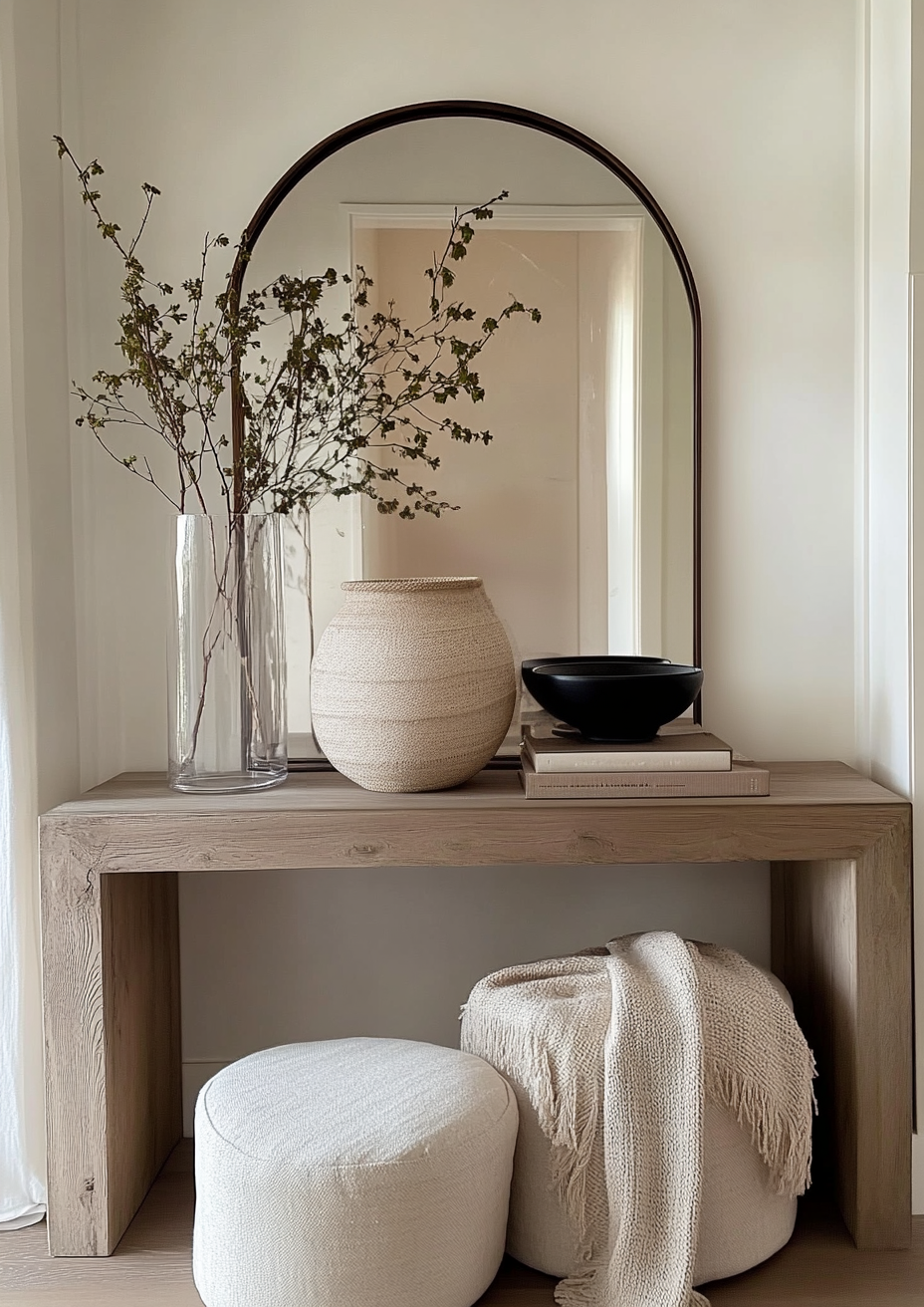
For Edgecomb Gray on walls, White Dove OC-17 or Chantilly Lace OC-65 on trim gives clean, reliable definition without exposing the faint green undertone. Simply White OC-117 is a good middle-ground alternative for a slightly softer contrast.
For Revere Pewter on walls, stick to White Dove or Simply White on trim - both are warm enough not to fight the taupe base, and neither is cool enough to make the green undertone read as obviously olive. Avoid bright cool whites, which flatten Revere Pewter's warmth by comparison.
For flooring, Edgecomb Gray is genuinely flexible - warm wood, cool stone, and pale limestone all read comfortably against it. Revere Pewter wants warm wood and warm stone specifically; cool grey tile or bleached floors alongside it tend to pull the green undertone forward.
For hardware, Edgecomb Gray handles brushed nickel, matte black, and aged brass equally well. Revere Pewter is strongest with warm metals - aged brass and bronze - which anchor its taupe base; cool contemporary hardware can make the greige read colder and greener than intended.
Architect's Verdict - Edgecomb Gray or Revere Pewter?

These two are not competing for the same brief, even though they are constantly shortlisted together.
If the brief is a whole-house greige that needs to work across multiple rooms and exposures without ever feeling heavy, Edgecomb Gray is the answer. It is the more forgiving, more consistent of the two.
If the brief calls for a deeper, more grounded greige with genuine character - a color willing to shift and surprise you through the day - Revere Pewter is the answer, provided the room gets enough warm light to keep the taupe in charge of the green.
Revere Pewter's worst-case condition is a north-facing room in flat winter light: paint a large sample directly beside a window on that wall and check it at midday. A pass looks warm and taupe-leaning even in that cool light; a fail looks flatly olive or gray with no warmth at all. If it fails that test, Edgecomb Gray is the safer, lighter alternative in the same room.
Frequently Asked Questions

Is Edgecomb Gray lighter than Revere Pewter?
Yes - by eight LRV points. Edgecomb Gray has an LRV of 63 and Revere Pewter has an LRV of 55. Edgecomb Gray reads as a light, airy warm greige. Revere Pewter reads as a medium-depth greige with real visual weight. The gap is clearly visible on adjoining walls.
Can I use Revere Pewter as trim on Edgecomb Gray walls?
No - this combination generally does not work. Revere Pewter is too close in undertone and too dark to read as a considered trim choice against Edgecomb Gray walls; it looks like an unfinished darker version of the wall colour rather than deliberate contrast. A crisp white like White Dove or Chantilly Lace is the more reliable trim choice for Edgecomb Gray walls.
Why does Revere Pewter look different in different rooms?
Because its undertone is genuinely unstable across light conditions. The warm taupe base and the underlying green pigment trade dominance depending on the strength and warmth of the light hitting the wall - warm southern light lets the taupe lead, while flat or cool light lets the green step forward. Edgecomb Gray's lighter, more diluted pigment load does not shift nearly as dramatically.
Which is better for a north-facing room?
Edgecomb Gray handles north-facing rooms more reliably. Its lighter LRV and more diluted undertone keep it reading as a settled warm greige even without direct sun. Revere Pewter in the same room risks reading flat, gray, or faintly olive - it needs warm supporting light or warm materials nearby to hold its intended character.
What is the LRV of Edgecomb Gray vs Revere Pewter?
Edgecomb Gray HC-173 has an LRV of approximately 63 and Revere Pewter HC-172 has an LRV of approximately 55. The eight-point gap places them in noticeably different depth categories despite sharing a Historical Color Collection lineage and a green-based undertone family.
Final Thought
Edgecomb Gray and Revere Pewter share a lineage but not a purpose. One is Benjamin Moore's most dependable light greige - a color built to disappear into a room and let everything else lead. The other is a deeper, more opinionated greige that rewards the right light and punishes the wrong one.
For an adaptable, whole-house warm greige, Edgecomb Gray is the safer and more consistent choice. For a room with genuine warmth and architectural character that can carry more depth, Revere Pewter delivers a richness Edgecomb Gray cannot match. Sample both at large scale, in your actual room, across a full day before deciding.
Want a complete colour scheme built around Edgecomb Gray or Revere Pewter? Our design packages cover full palette selection, finish recommendations, and 3D visualisations - see our packages. |
About the Author
Beril Yilmaz is a qualified architect and interior designer based in the UK. She runs BY Design And Viz, a design platform covering paint colour reviews, interior design guidance, and residential design projects. Beril has specified both Benjamin Moore Edgecomb Gray and Revere Pewter across residential projects in the UK and internationally - Edgecomb Gray in open-plan and multi-exposure spaces where a consistent light greige was the brief, Revere Pewter in more traditional, architecturally detailed rooms where added depth and warmth were called for, often using the two together as a light-to-dark greige gradient between adjoining spaces.


Comments