


Entryway Organization Ideas That Actually Work

The entryway is the most used space in a home and the most consistently neglected in terms of design thinking. It gets the coats dumped on it, the shoes piled beneath it, the bags dropped in front of it, and the post stacked across it — and then people wonder why arriving home never feels quite right. An entryway that functions well changes the whole rhythm of a household. One that doesn't creates low-level friction every single day.
These entryway organization ideas are drawn from real residential projects — the storage decisions, layout approaches, and styling choices that make entryways work in homes that are actually lived in, not staged for photography.
The Organizing Principles of a Functional Entryway

Every successful entryway organization solution starts with understanding the three categories of things an entryway needs to handle: items that are taken out of the house every day (coats, bags, keys, shoes), items that arrive in the house and need a temporary home (post, deliveries, shopping), and items that belong near the door but are used infrequently (umbrellas, seasonal items, sports equipment).
Most entryway organization fails because all three categories get treated the same way — everything ends up in a pile near the door because there is no designated place for any of it. The solution is not more storage — it is the right type of storage for each category, placed where the natural deposit point already is rather than where it looks best on a plan.
Coat and Bag Storage
Dedicated Hooks at the Right Height

Hooks are the single most important element in an entryway organization system — they determine whether coats and bags get hung up or dropped on the floor. The height matters more than most people realise: adult coat hooks should sit at 150-160cm from the floor, with a secondary lower row at 100-110cm for children or frequently accessed bags. A single row at adult height means bags never get hung because they require more effort than dropping.
The number of hooks matters too — one hook per household member as an absolute minimum, two per person as a practical target. A family of four with four hooks will have a perpetually overloaded entryway. Eight hooks gives everyone two spaces and still works when guests arrive.
Built-In versus Freestanding Storage

Built-in coat storage alongside the door — a run of floor-to-ceiling cupboards with internal hooks, shelving, and a pull-out shoe rack — is the most efficient use of entryway space available. It removes visual clutter entirely, handles every category of item, and makes the entryway feel like a considered room rather than a transit zone. In new builds and major renovations it should be the default rather than the exception.
In rentals or homes where built-in storage is not possible, a freestanding hall unit with hooks above, a shelf at mid-height, and a bench with understorage below is the closest functional equivalent. The bench serves double duty as seating for shoe removal and as a visual anchor that gives the entryway a defined, considered quality.
The Bench Rule

Every entryway that has floor space for it should have a bench — not primarily for sitting on (though that is useful) but because a bench defines the entryway as a room rather than a corridor. It creates a deposit surface at a height that prevents things ending up on the floor, and it signals to everyone entering that this is a space with a function and a logic. Without a bench, things go on the floor. It is that simple.
Shoe Storage

Shoes are the most persistent entryway organization problem in households with children — they multiply, they get left at the door, and conventional shoe storage either holds too few pairs or requires too much effort to use consistently. The solutions that actually work in real households are the ones that reduce the effort of putting shoes away to near-zero.
Open Shoe Shelving
Open shoe shelving — a simple angled rack or a run of low open shelves — is the most consistently used shoe storage because it requires no opening, closing, or searching. Shoes go in, shoes come out, the effort is minimal. The visual downside is that shoes are visible, but in a well-organised entryway with consistent use, open shelving reads as considered rather than untidy.
Limit open shelving to current-season shoes only — one or two pairs per household member maximum. Off-season and rarely worn shoes belong in bedroom storage, not the entryway. The entryway shoe storage should hold only what is genuinely needed near the door.
Bench with Understorage

A bench with basket storage underneath — either open baskets or pull-out drawers — combines the bench function with shoe storage in the same footprint. One basket per person makes the system intuitive: everyone knows which basket is theirs and where their shoes belong. This approach works particularly well for children because the lower height makes it accessible without adult help.
Hidden Shoe Cupboards

A floor-to-ceiling shoe cupboard alongside the door handles high shoe volumes in a small footprint — the key is ensuring the internal shelving is adjustable and set at the right spacing for your actual shoes rather than the standard shelf spacing that cupboards come with. Standard spacing wastes vertical space. Custom-height shelves increase the capacity of the same cupboard by 30-40%.
Key and Small Item Organisation

Keys are the item most commonly lost in an entryway and the easiest to solve — a dedicated key hook or key bowl at eye level immediately inside the door, used consistently, eliminates the problem entirely. The reason key organisation fails in most homes is not the absence of a solution but the inconsistency of use — the key hook needs to be at the exact point where keys naturally leave the hand, not where it looks best.
The same principle applies to wallets, sunglasses, and small daily-use items — a shallow tray or small bowl on a console table or shelf at adult eye level is more consistently used than a drawer because it requires zero effort and the items remain visible. Drawers create a decision barrier that leads to surfaces being used instead.
Post and Incoming Items

Post and incoming items — deliveries, things that need to be dealt with, items that belong to other rooms — are the category most likely to create entryway clutter because they have no natural deposit point. The solution is a designated tray or basket at a consistent location that acts as the inbox for the house. Everything that comes in and needs dealing with goes in the tray. The tray gets emptied regularly — weekly at minimum.
The tray needs to be visible enough that things actually get deposited in it and small enough that it gets emptied before it overflows — a tray that is too large becomes a repository for things that are never dealt with. A small tray forces regular processing.
Want a functional entryway designed for your specific space? See our design packages here |
Entryway Organization by Space Size
Small Entryway Organization Ideas

Small entryways — a narrow corridor or a front door that opens directly into a living space — require vertical thinking. Every organisation solution needs to use wall height rather than floor area. A run of hooks from dado height to ceiling, a slim console table with a shelf above, and a narrow bench that folds against the wall when not in use are the three elements that make a small entryway function.
The most important rule in a small entryway: ruthlessly limit what the entryway is asked to store. A small entryway cannot hold everything — it should hold only today's coats, today's shoes, and keys. Everything else belongs in bedroom storage or a dedicated storage cupboard elsewhere in the house. Asking a small entryway to store six months of coats and every pair of shoes in the household creates a problem that no organisation system can solve.
For entryway lighting in a small space, the right fixture makes the area feel larger — the full breakdown of what works is in the entryway lighting ideas guide.
Large Entryway Organization Ideas

In a large entryway there is space for a console table with drawers for small items, a full-height mirror, and proper entryway wall decor that makes the space feel like a room rather than a functional corridor. The entryway wall decor ideas guide covers the styling decisions that complete a large entryway scheme.
Entryway Organization by Style
Organic Modern Entryway Organization

Organic modern entryways use natural materials — rattan baskets, raw wood shelving, linen-lined storage — to make the organization system feel like part of the design rather than a functional add-on. Hooks in raw brass or aged bronze, a bench in pale oak or white oak, and woven baskets for shoes and miscellaneous storage create an entryway that is fully functional and visually considered.
The full styling breakdown for this approach is in the organic modern entryway ideas guide.
Modern Cottage Entryway Organization

Modern cottage entryways lean into painted cabinetry, shaker-style hooks, and a warmer palette — the organization system uses the same materials as the wider interior so it feels continuous rather than tacked on. A run of painted hooks above a painted bench, with wicker baskets below and a narrow painted cupboard for shoes alongside, is the classic modern cottage entryway combination.
The full approach for this style is in the modern cottage entryway ideas guide.
The Most Common Entryway Organization Mistakes

The mistakes that undermine entryway organization are almost always about placement and habit rather than the quality of the storage solution. The full breakdown is in the entryway design mistakes guide — but the three most consistent problems are:
• Hooks placed too high — adult-height hooks that children and bags cannot reach easily, resulting in floors being used instead
• Storage placed away from the natural deposit point — a shoe rack on the opposite side of the entryway from the door, a key bowl in the kitchen, a coat cupboard around the corner
• Too much asked of too little space — entryways that are expected to store every coat in the household, every pair of shoes, sports equipment, and seasonal items simultaneously
Entryway Organization Products Worth Using
What to Look For in Entryway Hooks

Weight rating matters more than aesthetics when choosing entryway hooks — a coat hook needs to hold a heavy winter coat, a bag, and potentially a backpack simultaneously. Look for hooks rated to at least 5kg per hook, fixed with screws into wall studs or with appropriate wall anchors rather than adhesive. Adhesive hooks will fail under the weight and frequency of real daily use.
Double hooks — a main hook with a smaller secondary hook below — are more useful than single hooks in entryways because they allow a coat and a bag to hang from the same position without competing for the same hook.
What to Look For in Entryway Benches
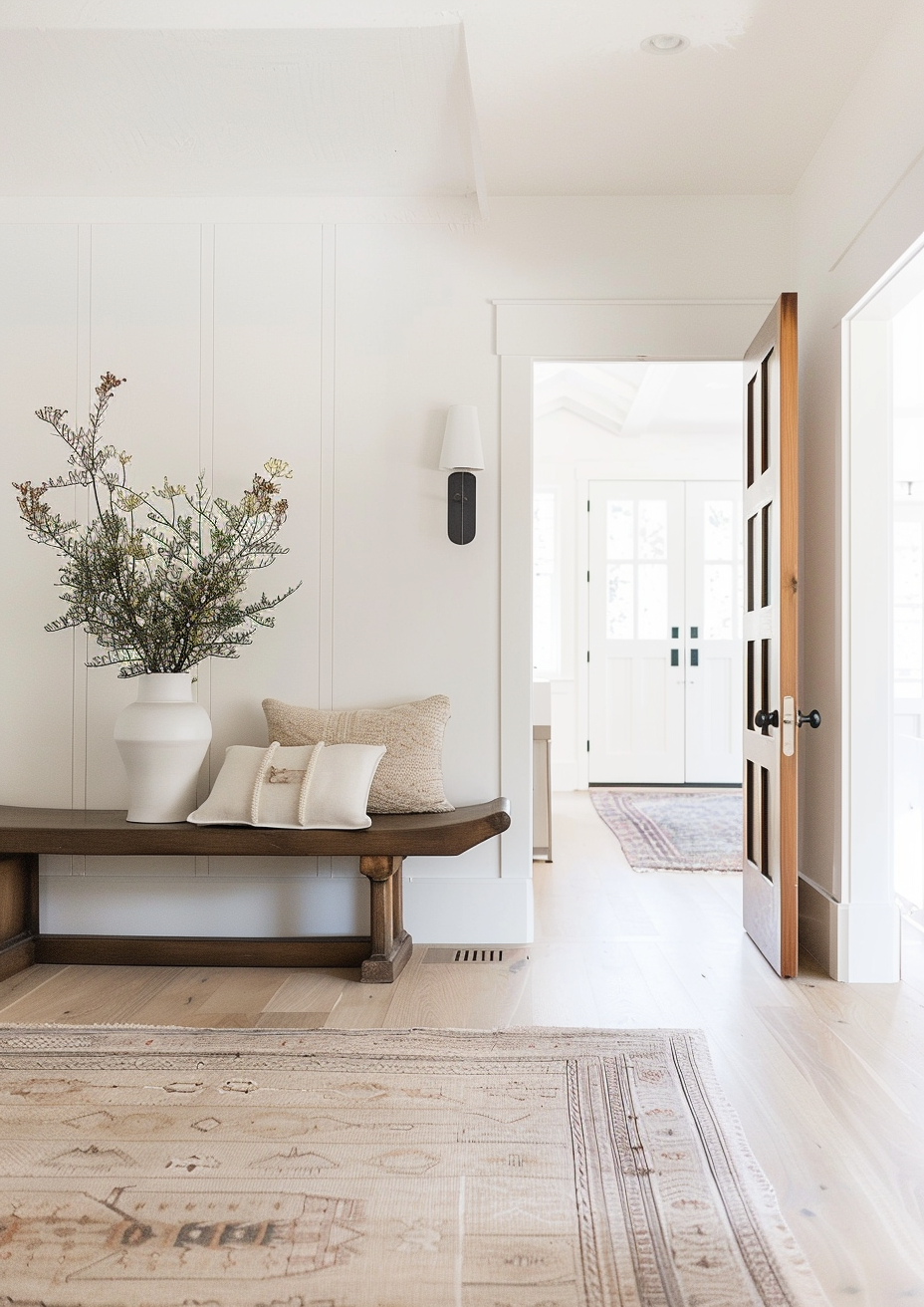
Seat height of 45-48cm is the standard for comfortable shoe removal — the same as a standard dining chair. Benches lower than this require more effort to stand from and become less consistently used over time. The seat surface should be robust enough to take daily use — upholstered seats in light fabrics will show wear quickly in a high-traffic entryway; wood, painted wood, or performance fabric are more practical.
What to Look For in Storage Baskets

Baskets that are used in entryways need to be robust enough to be pulled in and out of understorage daily — wicker and rattan baskets that look beautiful on a shelf are often not built for the friction of daily use in an understorage position. Look for baskets with a solid base and reinforced sides, or use fabric storage bins with a rigid internal structure for understorage positions.
Frequently Asked Questions
How do I organize a small entryway with no space?
Use vertical wall space rather than floor area — a run of hooks from dado height to ceiling takes no floor space and handles the full coat and bag storage requirement. Add a narrow fold-down bench for shoe removal and a small key bowl at eye level. Keep the entryway storage limited to daily-use items only — off-season coats and rarely worn shoes belong in bedroom storage, not the entryway.
What is the most important piece of entryway furniture?
A bench with understorage is the single most functional piece of entryway furniture — it handles shoe storage, provides seating for shoe removal, and creates a visual anchor that gives the entryway a defined, considered quality. If the space only allows for one piece of furniture, a bench is the right choice.
How do I keep my entryway tidy?
Entryway tidiness is a systems problem, not a willpower problem — if things end up on the floor it is because the storage is in the wrong place or requires too much effort to use. Every item that regularly ends up on the floor needs a dedicated storage solution at the point where it naturally gets dropped. Hooks need to be at the right height, shoe storage needs to be immediately inside the door, and the key bowl needs to be at exactly the point where keys leave the hand.
What should every entryway have?
A functional entryway needs: hooks at the right height for every household member, shoe storage immediately inside the door, a key and small items solution at eye level, and a bench or seating surface for shoe removal. Everything beyond those four elements is a styling decision rather than a functional one.
How do I make my entryway look organized and stylish?
Organization and style in an entryway come from the same source — a system where everything has a place and the storage itself is considered as part of the design. Matching hooks, a consistent basket or bin style, and a single mirror are the three styling elements that elevate a functional entryway to a considered one. The full breakdown of styling approaches is in the entryway wall decor ideas guide.
Final Thought
Entryway organization is one of the highest-return design investments in a home — the friction it removes is felt every single day, multiple times a day, by every person in the household. The solutions are not complicated or expensive. They are almost always about placement, habit formation, and giving every category of item a dedicated home at the exact point where it naturally gets deposited.
Get the hooks at the right height, put the shoe storage at the door, give keys a fixed home, and add a bench. Those four decisions solve the majority of entryway organization problems in any size of space.
Want your entryway designed properly from the start? Book a consultation here |
About the Author
Beril Yilmaz is a qualified architect and interior designer based in the UK. She runs BY Design And Viz, a design platform covering paint color reviews, interior design guidance, and residential design projects. Beril has designed entryway storage and organization solutions for residential projects across the UK.


Comments