


Natural Linen vs Edgecomb Gray: The Comparison That Actually Helps You Decide

Natural Linen and Edgecomb Gray sit only three LRV points apart, and on a fan deck that gap looks meaningless. On a wall, it is not the LRV that decides the outcome - it is the undertone. Natural Linen commits fully to warm beige, while Edgecomb Gray hedges toward gray, and that single difference changes which rooms each one belongs in.
I have specified both across residential projects, and I do not treat them as interchangeable warm neutrals. They solve different problems.
This guide covers the undertone behaviour of each, where they perform and where they fail, and how to choose between them with confidence rather than guesswork.

At a Glance
| Natural Linen | Edgecomb Gray |
Brand | Sherwin-Williams | Benjamin Moore |
LRV | 66 - light-medium, reflects well without reading as a white | 63 - light-medium, marginally deeper than Natural Linen |
Colour category | Committed warm beige - straightforward, no gray hedge in the undertone | Balanced greige - warm beige-tan surface with a faint cool green-gray note underneath |
Undertones | Warm beige-yellow with an orange base - direct and unambiguous, no cool component | Soft beige-tan dominant, with a diluted cool green-gray undertone that only surfaces in low or north light |
Character | Organic and linen-like; reads as natural, undyed fabric rather than a designed neutral | Composed and adaptable; reads as neutral rather than as a specific material reference |
North-facing | Workable - the warmth holds up, though it can flatten without some texture or wood tone nearby | Reliable - the faint green-gray note keeps it from looking dingy the way a straight beige can |
South-facing | Excellent - the warm beige glows and reads as intentional, not muddy | Warm and settled - the beige-tan surface dominates and the color reads clean, not gray |
Open-plan | Moderate - consistent enough across zones, but needs warm materials throughout to avoid feeling one-note | Strong - the balanced undertone reads consistently across zones with mixed light and material temperatures |
On walls | Full warm-beige backdrop - unmistakably warm, best against wood tones and natural texture | Composed greige backdrop that shifts subtly through the day without ever looking unresolved |
On cabinets | Strong in traditional and organic-modern kitchens with oak or warm wood; can look flat against stainless and cool stone | The more practical choice across mixed kitchens - handles cool stone, stainless, and warm wood without conflict |
Use together? | Yes - Natural Linen on walls with Edgecomb Gray on adjacent trim or millwork softens the beige without fighting it | Yes - Edgecomb Gray on trim alongside Natural Linen walls is the more tested direction; the reverse needs testing first |
Trim for each | White Dove or Alabaster for a clean lift, or Edgecomb Gray for a quieter, more tonal step down | White Dove or Chantilly Lace for a soft, considered lift without stark contrast |
Style fit | Organic modern, traditional, warm minimalist interiors built around natural materials | Transitional, coastal-neutral, and mixed-material interiors that need one adaptable neutral to hold the whole scheme together |
Architect's pick | When the brief calls for warmth with no gray hedge and the room has wood, linen, or stone to match it | When the room mixes warm and cool materials and needs one neutral that will not pick a side |
Sherwin-Williams Natural Linen SW 9109 - What It Really Looks Like

Natural Linen has an LRV of 66, which puts it in the light-medium range - bright enough to open a room up, deep enough to still read as a colour rather than an off-white.The undertone is warm beige-yellow with an orange base, and it does not hedge toward gray at any point in the day. Natural Linen vs Alabaster guide covers exactly how that beige-yellow behaves next to a true warm white, which is useful context before deciding whether Natural Linen or something lighter suits your room.
In warm natural light Natural Linen reads like unbleached linen or raw plaster - genuinely organic rather than manufactured. There is nothing muddy about it. It commits to its warmth and stays there through the day, which is exactly what makes it useful in rooms built around wood tones and natural texture.
The trade-off is versatility. Because the undertone never hedges toward gray, Natural Linen needs warm company - wood floors, linen textiles, warm stone - to avoid looking flat against anything cooler. It does not adapt the way a greige does.
Benjamin Moore Edgecomb Gray HC-173 - What It Really Looks Like

Edgecomb Gray has an LRV of 63, just three points below Natural Linen on paper - but the undertone tells an entirely different story.The dominant note is a soft beige-tan, with a faint cool green-gray undertone sitting underneath it that only becomes visible in dim or north-facing light. Alabaster vs Edgecomb Gray guide is worth reading alongside this one if you are also weighing Edgecomb Gray against a true warm white, since it maps the same undertone behaviour against a much higher-LRV neighbour.
In good light Edgecomb Gray reads as a settled, warm-leaning neutral. It never fully commits to beige or to gray. That balance is precisely what makes it hold its composure across a room with mixed materials, where a more decisive warm beige would start to clash.
The green-gray undertone is subtle enough that most people never consciously register it - they simply notice that the colour looks calm and unresolved in a way that is hard to name. That is the undertone doing its job quietly.
The Real Difference Between Natural Linen and Edgecomb Gray

The simplest way to put it: Natural Linen is a warm beige that commits. Edgecomb Gray is a greige that hedges. The three-point LRV gap between them is close to irrelevant - the undertone is the entire comparison.
Natural Linen's undertone is warm beige-yellow with an orange base and no gray component at any point in the day. Edgecomb Gray's undertone is a soft beige-tan surface with a faint cool green-gray note that surfaces in weaker light. Side by side, Natural Linen reads warmer and more textural; Edgecomb Gray reads calmer and more composed.
The clearest test of the difference is how each behaves as the light changes - Natural Linen stays warm from morning to evening, while Edgecomb Gray visibly settles toward gray as the light dims. For a full breakdown of that light-shift behaviour against a lighter warm white in the same family, the Natural Linen vs Alabaster guide is a useful companion read, since it covers how Natural Linen holds its warmth against a much cooler, greener neighbour under the same conditions.
Not sure which one works for your room? A colour consultation is included in all our design packages - book directly here. |
When to Choose Natural Linen

Choose Natural Linen when the brief is straightforward warmth with no gray hedge and the room's materials support it. These are the conditions where it wins outright.
South or west-facing rooms with warm wood floors and natural texture throughout. Organic-modern or traditional interiors where the goal is a lived-in, textural warmth rather than a crisp, engineered neutral. Living rooms and bedrooms where linen, rattan, and raw wood are already doing the talking and the wall colour needs to support that palette rather than compete with it.
Avoid it in rooms with cool stone, stainless steel, or minimal-contemporary detailing - the undertone will read flat and slightly dated against those materials. Avoid it too in rooms with limited natural light and no warm accent materials, where it can feel heavy rather than cozy.
When to Choose Edgecomb Gray
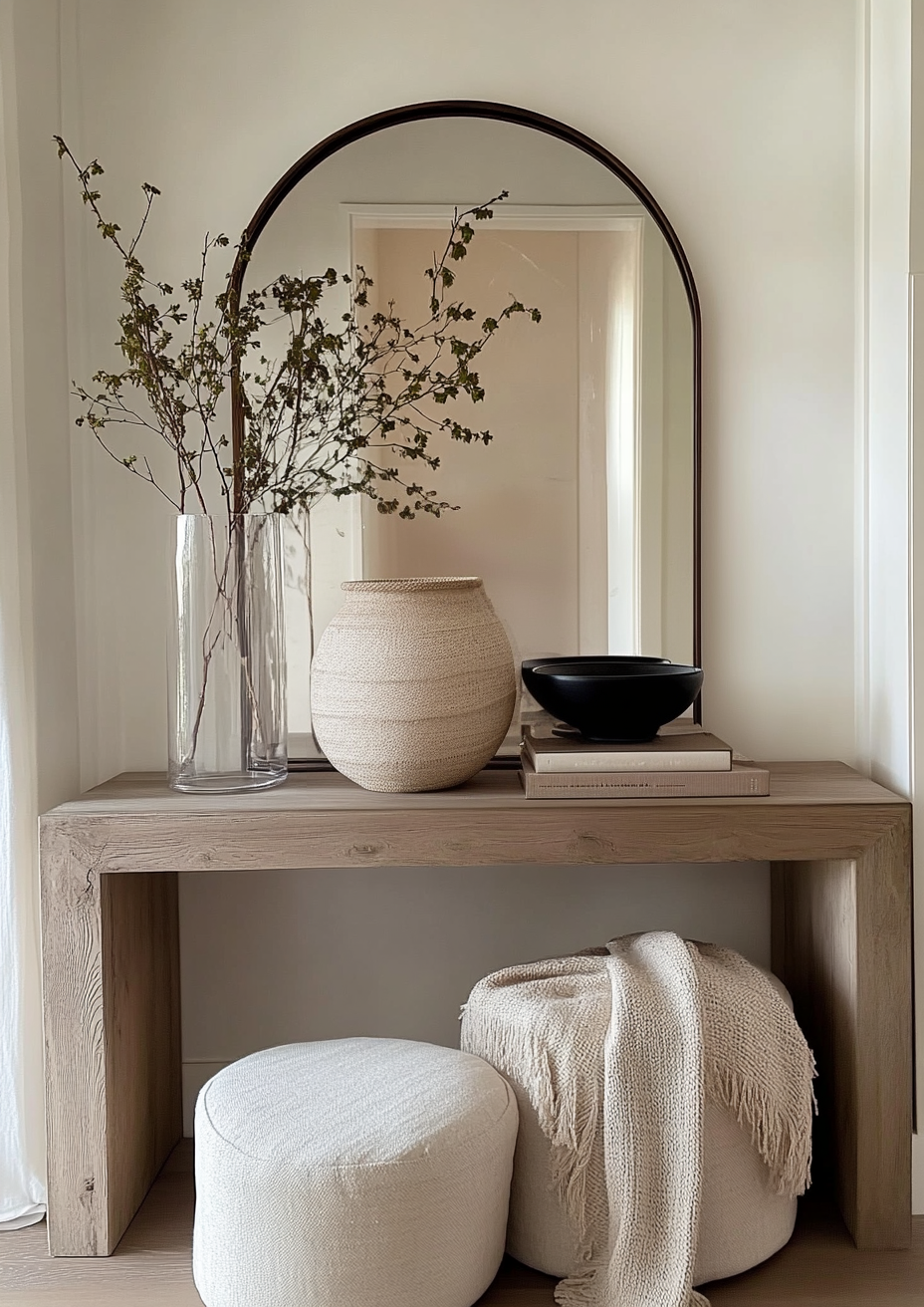
Choose Edgecomb Gray when the room mixes warm and cool materials and needs a neutral that will not tip either way. These are the situations where it outperforms Natural Linen.
Open-plan spaces where light and material temperature shift across the day. Kitchens with a mix of warm wood and cool stone or stainless. Transitional interiors that need one wall colour to hold a scheme together without picking a side. North-facing rooms where a straight warm beige risks looking dingy rather than cozy.
It is also the safer trim partner in most schemes - its restraint reads as considered rather than competing, which is why it shows up so often on millwork and built-ins alongside a bolder wall colour.
How the Pairings Differ

For Natural Linen on walls, White Dove or Alabaster on trim gives a clean, warm lift without stark contrast. Edgecomb Gray also works as a quieter, more tonal trim option where the goal is a softer step rather than a bright one.
For Edgecomb Gray on walls, White Dove or Chantilly Lace on trim keeps the definition soft and considered. Avoid a bright, cool white trim, which will pull out the green-gray undertone more than intended.
Both colours work with warm wood flooring, but Natural Linen needs it more urgently - cool grey flooring alongside Natural Linen creates an undertone conflict that is hard to resolve. Edgecomb Gray is more forgiving and handles both warm wood and cooler stone without clashing.
Natural Linen suits aged brass and warm wood tones best; it is less comfortable against cool chrome. Edgecomb Gray is the more flexible of the two, working with brushed nickel, matte black, and warm brass alike.
Architect's Verdict - Natural Linen or Edgecomb Gray?

For most mixed-material or open-plan homes, Edgecomb Gray is the more reliable choice. Its balanced undertone does the quiet work of holding a room together without picking a side.
Natural Linen is the right choice when warmth is the explicit brief and the room's materials - wood, linen, natural stone - are already pulling in that direction. In a south-facing room built around organic texture, Natural Linen has more presence and character than Edgecomb Gray will ever offer.
Edgecomb Gray is the safer bet when the room's materials are mixed or the light is uncertain. It will not look dingy in a north-facing room the way a committed beige can, and it holds its composure across zones with different light and material temperatures.
The test I always use here: paint large sample boards of each and view them in your dimmest, north-facing corner and in your brightest window light. If Natural Linen still looks warm and inviting in the dim corner, it passes - go with it. If it starts to look flat or heavy in that same corner, Edgecomb Gray is the safer choice. That worst-case light is the one that actually decides this comparison.
Frequently Asked Questions

Is Natural Linen warmer than Edgecomb Gray?
Yes - Natural Linen has a committed warm beige-yellow undertone with no gray component, while Edgecomb Gray's undertone is more balanced, with a faint cool green-gray note that surfaces in weaker light. Natural Linen reads warmer and more textural side by side.
Can I use Natural Linen and Edgecomb Gray in the same house?
Yes, and it works well. Natural Linen on walls with Edgecomb Gray on adjacent trim or millwork softens the beige without introducing a jarring contrast. Using Edgecomb Gray on walls with Natural Linen elsewhere needs a bit more testing, since the reverse pairing can read slightly muddled.
Which is better for an open-plan space?
Edgecomb Gray is the more reliable choice for open-plan layouts. Its balanced undertone reads consistently across zones with mixed light and material temperatures, whereas Natural Linen's committed warmth can feel one-note once the room's materials start to vary.
Does Edgecomb Gray look gray or beige on the wall?
Both, depending on the light. In strong, warm light it reads as a soft beige-tan. In dim or north-facing light, the underlying green-gray note becomes more visible and it settles toward gray. That shift is part of its character, not a flaw.
Which is better for a north-facing room?
Edgecomb Gray handles north-facing rooms more reliably. Its cooler undertone note keeps it from looking dingy the way a committed warm beige can in the absence of direct light. Natural Linen can still work in a north-facing room, but it needs warm materials nearby to avoid feeling flat.
What is the LRV of Natural Linen vs Edgecomb Gray?
Natural Linen has an LRV of approximately 66 and Edgecomb Gray has an LRV of approximately 63. The three-point gap is minor in practice - the real difference between the two colours is in the undertone, not the reflectance.
Final Thought
Natural Linen and Edgecomb Gray are both excellent light neutrals, but they are not interchangeable. The choice comes down to whether your room's materials and light can support a committed warm beige, or whether they need a neutral that hedges.
If your materials are warm and consistent, Natural Linen will reward you with genuine texture and character. If your materials or light are mixed or uncertain, Edgecomb Gray is the more forgiving and dependable choice. Buy sample pots of both, paint large patches side by side, and check them in your dimmest corner and your brightest window. The answer will be clear within a day.
Want a complete colour scheme built around Natural Linen or Edgecomb Gray? Our design packages cover full palette selection, finish recommendations, and 3D visualisations - see our packages. |
About the Author
Beril Yilmaz is a qualified architect and interior designer based in the UK. She runs BY Design And Viz, a design platform covering paint colour reviews, interior design guidance, and residential design projects. Beril has specified both Natural Linen and Edgecomb Gray across residential projects in the UK and internationally - Natural Linen in organic-modern and traditional interiors built around warm wood and natural texture, Edgecomb Gray in open-plan and transitional spaces where material temperature varies across the day, often specifying Edgecomb Gray on trim alongside Natural Linen walls in the same scheme.


Comments