


Chantilly Lace vs Pure White: The Comparison That Actually Helps You Decide

Updated: 5 days ago
Chantilly Lace and Pure White are the two most compared crisp whites across the Benjamin Moore and Sherwin Williams ranges. Both appear on trim and cabinet shortlists for the same brief — a clean, architectural white with minimal warmth — and both are frequently described as the safest, most versatile white in their respective brands. On a paint chip they look strikingly close: two bright, clean, near-neutral whites sitting near the top of the LRV scale. On a wall in a real room, the 8-point LRV gap and the faint cool-leaning versus faint warm-leaning undertone distinction create two different rooms in character, brightness, and cross-palette compatibility.
Chantilly Lace OC-65 reads as the crispest, brightest white in the Benjamin Moore range. At LRV 92 it is Benjamin Moore's most reflective white — near-neutral with a barely perceptible cool quality that reads as pure, architectural, unambiguously white in most conditions. Pure White SW 7005 reads as the most versatile white in the Sherwin Williams range. At LRV 84 it sits 8 points lower — still a proper bright white, but with noticeably more body, a subtly warmer near-neutral undertone, and a broader compatibility with warm wall colours and mixed material palettes.
This guide covers exactly how Chantilly Lace and Pure White differ in LRV, undertone, character, light behaviour, and room application — with a clear verdict on which one to choose and when.

At a Glance
| Chantilly Lace OC-65 | Pure White SW 7005 |
Brand | Benjamin Moore | Sherwin Williams |
LRV | 92 - the brightest white in the BM range; near-maximum reflectivity | 84 - bright white with body; 8 points lower than Chantilly Lace; most versatile SW white |
Colour category | Crisp near-neutral white - faint cool quality, maximum brightness, architectural precision | Near-neutral bright white - faint warm quality, more body than Chantilly Lace, maximum cross-palette versatility |
Undertones | Near-neutral with the faintest cool quality - sits just on the cool side of neutral; no yellow, no pink, no grey | Near-neutral with the faintest warm quality - sits just on the warm side of neutral; compatible with warm and cool equally |
Character | Crisp, brilliant, architectural white; the purest white in BM range; reads as unambiguously white in almost all conditions | Clean, considered, near-neutral bright white; slightly warmer and calmer than Chantilly Lace; performs consistently across every brief |
North-facing | Outstanding - near-neutral undertone reads consistently in cool indirect light without going cold or blue | Excellent - near-neutral with faint warmth holds cleanly in cool indirect light; never reads cold |
South-facing | Very good - remains crisp and clean; does not tip warm in strong natural light the way yellow-undertone whites do | Very good - reads as a clean bright white; does not tip creamy in warm light |
Open-plan | Excellent - the most consistent BM white across mixed exposures; near-neutral holds in all orientations | Outstanding - the defining whole-home SW white; consistent and versatile across all zones and orientations |
On walls | Crisp, brilliant white; reads as the cleanest, most architectural white available; can feel cool in cool rooms | Clean near-neutral bright white with more presence than Chantilly Lace; calm, considered, and broadly compatible |
On cabinets | Outstanding - the most specified BM cabinet white in contemporary and minimalist schemes; crisp and timeless | Outstanding - the most universally specified SW cabinet white; suits contemporary, transitional, and warm-palette kitchens |
Use together? | Not on adjacent surfaces - 8-point LRV gap and opposite undertone leanings create a visible mismatch | Not on adjacent surfaces - 8-point LRV gap and opposite undertone leanings create a visible mismatch |
Trim for each | Works as both wall and trim; Simply White OC-117 for slightly warmer trim contrast; itself for seamless tonal scheme | The most versatile SW trim white; works alongside warm and cool wall colours from both brands equally reliably |
Style fit | Contemporary, minimalist, transitional, modern farmhouse, Scandinavian - crisp near-neutral palette | Contemporary, transitional, modern farmhouse, whole-home neutral - the near-universal SW white |
Architect's pick | When the brief is the crispest, most architectural BM white with maximum brightness and near-neutral precision | When the brief is reliable, consistent near-neutral bright white that works with any palette, light condition, or material |
BM Chantilly Lace OC-65 - What It Really Looks Like

Chantilly Lace OC-65 has an LRV of 92 — the highest of any widely specified Benjamin Moore white and 8 points above Pure White. At that reflectivity it reads as a genuinely brilliant, maximum-brightness white on a wall. The near-neutral undertone with its faint cool quality is the defining characteristic: there is no yellow, no pink, no cream, no grey. It reads as white — clean, precise, architectural white — in almost any condition. In rooms with warm materials the cool quality prevents it from reading as cream or warm, which is precisely why it is the most specified BM white for contemporary and minimalist schemes where a true white result is essential. In rooms with very cool materials or cool north-facing light the faint cool quality can become marginally more perceptible, but even in challenging conditions Chantilly Lace reads as crisp rather than cold.
Chantilly Lace is Benjamin Moore's most specified white for trim, cabinets, and ceilings in contemporary and transitional design — and the white that reads as most unambiguously, precisely white in the entire BM range. For how it compares to Simply White — the warmer, slightly less bright BM white it is most frequently shortlisted against — the Chantilly Lace vs Simply White guide covers that within-brand white distinction in full.
SW Pure White SW 7005 - What It Really Looks Like
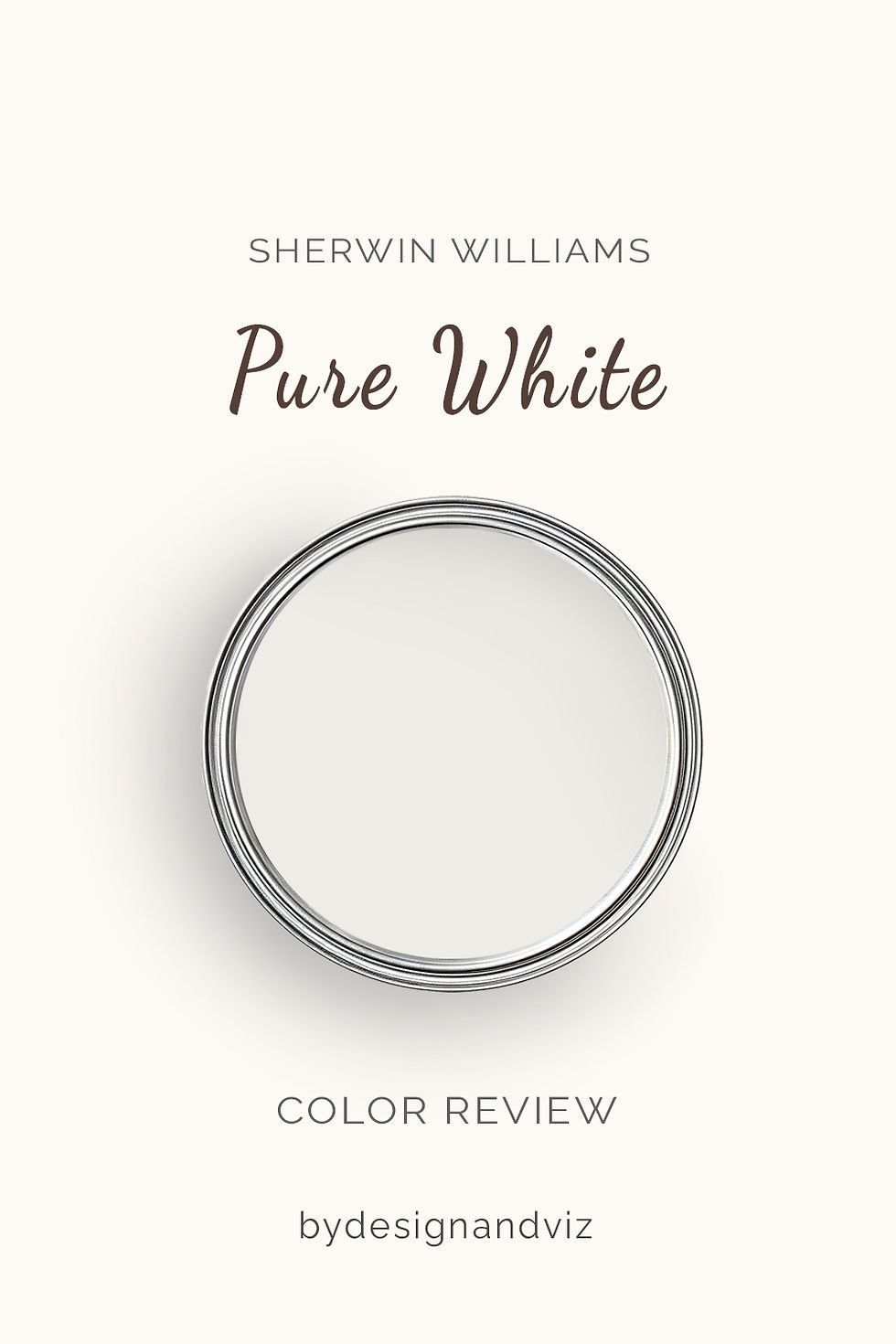
Pure White SW 7005 has an LRV of 84 — 8 points lower than Chantilly Lace and noticeably calmer on a wall as a result. The near-neutral undertone with its faint warm quality is the key characteristic: there is no committed yellow, no cream, no cool blue — just the barest suggestion of warmth that prevents it reading cold or clinical. Where Chantilly Lace's near-neutral sits just cool of neutral, Pure White's near-neutral sits just warm of neutral. That distinction is subtle in isolation but becomes visible when the two are placed side by side: Chantilly Lace reads as slightly crisper and cooler, Pure White reads as slightly softer and warmer. In most light conditions both simply read as clean, bright white — but the 8-point LRV gap gives Pure White noticeably more body, more presence, and more of a considered weight that Chantilly Lace's maximum brightness does not deliver.
Pure White is the SW white that bridges warm and cool palettes more naturally than any other — its near-neutral with faint warmth means it does not conflict with warm wall colours the way Chantilly Lace's cool lean can. For the full comparison of Pure White against Alabaster — the warm SW off-white it is most often used alongside as a wall-and-trim combination — the Alabaster vs Pure White guide covers that within-SW relationship in full.
The Real Difference Between Chantilly Lace and Pure White

Chantilly Lace is the crispest, most brilliant white in the BM range — near-neutral with a faint cool quality that reads as architecturally precise and unambiguously white. Pure White is the most versatile white in the SW range — near-neutral with a faint warm quality that reads as clean and considered, and bridges warm and cool palettes without committing to either.
The 8-point LRV gap is substantial for a white-versus-white comparison. Chantilly Lace at LRV 92 is one of the most reflective whites available in any brand — it reads as brilliantly, maximally bright, and in rooms with good natural light it can almost disappear into pure reflectivity. Pure White at LRV 84 has real body and presence by comparison — it reads as a considered bright white rather than a maximum-brightness one, and that extra body creates a subtly more settled, more substantial result. Chantilly Lace rooms feel brilliant and precise. Pure White rooms feel clean and resolved.
The undertone direction is the more practically significant difference for most real-world specifications. Chantilly Lace's faint cool lean means it reads as crisply neutral alongside any wall colour that carries warmth — the cool quality creates a clean, architectural separation between the warm wall and the trim. Alongside cool or neutral wall colours the same cool lean can make the overall scheme feel slightly austere if not balanced with warm materials. Pure White's faint warm lean means it bridges warm and cool wall colours without tension in either direction — it never reads cold alongside warm walls and never reads creamy alongside cool ones. This is why Pure White is specified more broadly across different interior styles and conditions. For the full picture of how Pure White compares to White Dove — the warm BM white it is most often used alongside in cross-brand schemes — the Pure White vs White Dove guide covers that cross-brand trim pairing in detail.
Not sure which one works for your room? A colour consultation is included in all our design packages - book directly here. |
When to Choose Chantilly Lace

Choose Chantilly Lace when the brief is the crispest, most architectural white available — a white that reads as unambiguously white rather than warm, cream, or off-white. Contemporary and minimalist interiors where the white needs to read as a deliberate design statement of precision and clarity. Trim and cabinets in any scheme where a cool-neutral or saturated wall colour needs a white boundary that does not add warmth or compete with the wall's undertone. Rooms with cool or neutral materials — grey stone, marble, white oak, polished concrete — where Chantilly Lace's near-neutral crispness reads as architecturally cohesive and precisely intentional.
Chantilly Lace is the trim white to reach for when the wall colour carries warmth and you want the trim to provide clean, sharp definition rather than relate warmly. Alongside cool-toned or deeply saturated wall colours it is the most reliable BM white — the near-neutral quality never fights the wall's undertone direction. The one condition to test: very warm, cream-heavy material palettes where the faint cool quality of Chantilly Lace can make warm materials look slightly more yellow by contrast. In those rooms Simply White or White Dove on trim is the more harmonious choice.
For how Chantilly Lace compares to White Heron - the cooler, more tempered Benjamin Moore white that sits 3.4 LRV points lower - the Chantilly Lace vs White Heron guide covers the undertone difference, the wall-and-trim pairing, and which one suits cabinets.
When to Choose Pure White

Choose Pure White when the brief is a clean, near-neutral bright white that performs reliably alongside warm wall colours, mixed material palettes, and varied light conditions. Transitional and whole-home interiors where trim, cabinets, and walls across multiple rooms and orientations all need to share the same consistent white. Rooms with warm wall colours — Alabaster, Accessible Beige, greige neutrals — where the faint warm quality of Pure White relates more naturally than Chantilly Lace's cool lean. Cross-brand schemes where the white needs to work alongside Benjamin Moore wall colours without undertone conflict — Pure White's near-neutral character bridges BM and SW palettes more gracefully than any other SW white. For how Pure White compares to Snowbound - the neutral soft white that suits readers who find warmer whites too yellow in strong light - the Snowbound vs Pure White guide shows which one wins on cabinets, walls and trim, and where each one struggles.
Pure White is the lower-risk specification across most residential trim and cabinet briefs. Its near-neutral faint warmth means it never reads cold against warm wall colours, never reads creamy against cool materials, and never creates the undertone tension that Chantilly Lace's cool lean can introduce in very warm-palette rooms. For any project where the brief is simply 'a clean white that works everywhere', Pure White delivers that more consistently than Chantilly Lace.
How the Pairings Differ

For Chantilly Lace on walls, Chantilly Lace itself on trim is the cleanest, most seamless choice — no visible trim line, the whole room reads as one unified white. Simply White OC-117 on trim creates a subtle warm contrast at the boundary — the slightly warmer, slightly less bright Simply White reads as a quiet separation from Chantilly Lace walls. Avoid warm cream whites like White Dove or Alabaster on trim alongside Chantilly Lace walls — the warmth of the trim will make the wall read as cold by comparison.
For Pure White on walls, Extra White SW 7006 on trim gives the crispest, most contemporary wall-to-trim definition. Pure White itself on both walls and trim is a seamless, clean whole-room approach. White Dove OC-17 BM on trim creates a slightly warmer cross-brand trim result alongside Pure White walls. Avoid Chantilly Lace BM on trim adjacent to Pure White SW walls — the 8-point LRV gap and the opposing undertone leanings will create a visible mismatch on adjacent surfaces.
For flooring, Chantilly Lace works most naturally with cool-to-neutral materials — white oak, light limestone, grey stone, contemporary porcelain tile — where the near-neutral cool quality reads as architecturally cohesive. Above warm honey oak or traditional hardwood floors the cool lean can create a subtle undertone contrast. Pure White handles the full range — warm wood, cool stone, marble, white oak, and traditional hardwood — without undertone conflict. Its near-neutral faint warmth means it sits comfortably above warm and cool floor materials equally.
For hardware, Chantilly Lace works cleanly with all metal finishes — polished chrome, brushed nickel, matte black, and brass all read as deliberately combined with the near-neutral crispness. Warm brass alongside Chantilly Lace reads as a warm accent against a cool-neutral backdrop, which is a classic contemporary combination. Pure White handles all metal finishes with the same ease — its near-neutral faint warmth means no metal creates undertone tension. Both whites are equally versatile for hardware; the floor and wall colour pairings are where the practical distinction lies.
Trying to build a full palette around Pure White rather than just choosing between it and Dover White? The Pure White coordinating colors guide covers the best wall colors to pair it with, room by room.
Architect's Verdict - Chantilly Lace or Pure White?

Both are excellent crisp whites for the right brief. The choice comes down to whether the brief calls for maximum brightness and architectural precision or broader cross-palette versatility with more body.
If the brief is the crispest, most brilliant, most architecturally precise white available — for a contemporary or minimalist scheme, for cabinets alongside cool or neutral wall colours, or for any application where white must read as unambiguously, purely white — Chantilly Lace is the answer. It is the best BM white for that brief and one of the best whites available across either brand.
If the brief is a clean, considered, near-neutral bright white that performs reliably alongside any wall colour, any material palette, and in any light condition — for whole-home trim, cross-brand schemes, warm-palette rooms, or any brief where versatility and consistency matter more than maximum crispness — Pure White is the answer. It will not disappoint in any condition.
The test: paint large samples of both in your room alongside your actual wall colour. Does Chantilly Lace read as crisply white and precisely defined, or does the cool lean make it feel slightly austere against your wall colour? Does Pure White read as clean and considered with good body, or does the lower LRV feel less crisp than you need? The relationship with your specific wall colour will make the right answer immediately clear.
Frequently Asked Questions

Is Chantilly Lace brighter than Pure White?
Yes - by 8 LRV points. Chantilly Lace OC-65 has an LRV of 92 and Pure White SW 7005 has an LRV of 84. The gap is clearly visible on a wall — Chantilly Lace is one of the most reflective whites available in any brand, while Pure White has noticeably more body and a calmer, more settled presence. In rooms where maximum brightness is the priority, Chantilly Lace is the stronger choice. In rooms where a considered, consistent white with more presence is the priority, Pure White is more appropriate.
Which is warmer - Chantilly Lace or Pure White?
Pure White is marginally warmer. Its near-neutral undertone sits just on the warm side of neutral — the faintest suggestion of warmth that prevents it reading cold but is not visible as yellow or cream in most conditions. Chantilly Lace's near-neutral sits just on the cool side of neutral — no warmth, no yellow, a barely perceptible crispness. In most rooms both simply read as clean bright white. The undertone distinction becomes visible when the two are placed side by side or when challenging light conditions push Chantilly Lace's cool lean into more noticeable territory.
Can Chantilly Lace and Pure White be used together?
Not on directly adjacent surfaces. The 8-point LRV gap creates a clearly visible step between them, and the opposing undertone leanings — Chantilly Lace's faint cool versus Pure White's faint warm — create an undertone conflict on adjacent surfaces that reads as a mismatched white rather than a deliberate contrast. Both can appear in the same home in separate rooms with clear visual separation, but adjacent walls, or a wall-and-trim combination using both colours, should be avoided.
Which is better for trim and cabinets?
It depends on the wall colour and interior style. Chantilly Lace is the stronger trim choice alongside cool or neutral wall colours and in contemporary or minimalist schemes where maximum crispness and architectural precision are the brief. Pure White is the stronger trim choice alongside warm wall colours and in transitional or whole-home schemes where broad compatibility and cross-palette reliability are the priority. When in doubt, Pure White is the lower-risk default — its near-neutral faint warmth means it does not conflict with warm wall colours the way Chantilly Lace's cool lean can.
What is the LRV of Chantilly Lace vs Pure White?
Chantilly Lace OC-65 has an LRV of 92 and Pure White SW 7005 has an LRV of 84. The 8-point gap makes this one of the most significant LRV differences in any popular crisp-white comparison. Chantilly Lace is the brighter of the two by a clearly visible margin — it reads as maximum-brightness near-pure white. Pure White has real body and a more settled presence on a wall. The LRV difference is the most immediately practical distinguishing factor between them in everyday use.
Final Thought
Chantilly Lace and Pure White are both outstanding crisp whites — but they serve meaningfully different briefs. The 8-point LRV gap and the faint cool-leaning versus faint warm-leaning undertone make the choice between them clearer than it first appears on a paint chip.
Crisp, brilliant, architecturally precise — Chantilly Lace for contemporary and minimalist schemes, cool-palette rooms, and any brief where white must read as purely, unambiguously white. Clean, considered, broadly compatible — Pure White for warm-palette rooms, whole-home trim, cross-brand schemes, and any brief where consistent performance across every condition matters most. Never on adjacent surfaces. Sample both alongside your actual wall colour in your real room. The relationship with your specific palette will make the right choice immediately clear.
Want a complete colour scheme built around Chantilly Lace or Pure White? Our design packages cover full palette selection, finish recommendations, and 3D visualisations - see our packages. |
About the Author
Beril Yilmaz is a qualified architect and interior designer based in the UK. She runs BY Design And Viz, a design platform covering paint colour reviews, interior design guidance, and residential design projects. Beril has specified both Chantilly Lace and Pure White across residential projects in the UK and internationally — Chantilly Lace in contemporary and minimalist BM schemes where maximum crispness and architectural precision are the brief, Pure White in transitional and whole-home SW schemes where consistent near-neutral performance across all palettes and conditions is the priority.


Comments