


Simply White vs Pure White: The Comparison That Actually Helps You Decide

Simply White and Pure White appear together on trim and cabinet shortlists more often than almost any other cross-brand white pairing. One is Benjamin Moore's brightest warm white, the other is Sherwin Williams' most universally specified near-neutral white — and both are described as clean, versatile, and broadly reliable. On a chip in a paint store they can look close enough to substitute. On a wall in a real room the 7-point LRV difference and the yellow-warm versus near-neutral undertone distinction create two rooms that feel meaningfully different in brightness, warmth character, and material compatibility.
Simply White OC-117 reads as a bright, warm white with a clean yellow undertone. At LRV 91.7 it is one of the brightest whites in the Benjamin Moore range — reflecting substantially more light than most warm whites, warm enough to feel inviting in good light, and committed enough to its yellow quality that it can read as visibly creamy in north-facing rooms or under warm artificial bulbs. Pure White SW 7005 reads as a clean, near-neutral bright white with a subtle warmth. At LRV 84 it sits 7 points lower — still a proper bright white, but with noticeably more body and a balanced near-neutral undertone that performs consistently across a wider range of conditions and material palettes.
This guide covers exactly how Simply White and Pure White differ in LRV, undertone, light behaviour, and application — with a clear verdict on which one to choose and when.

At a Glance
| Simply White OC-117 | Pure White SW 7005 |
Brand | Benjamin Moore | Sherwin Williams |
LRV | 91.7 - very bright; one of the highest LRVs in the BM white range | 84 - bright white with body; 7 points lower than Simply White; most versatile SW white |
Colour category | Bright warm white - clean yellow undertone, high reflectivity, BM 2016 Colour of the Year | Near-neutral bright white - minimal undertone, maximum versatility, performs consistently across conditions |
Undertones | Clean yellow-warm with no grey or pink component - committed warmth, clearly yellow in demanding conditions | Near-neutral with a very subtle warm-grey quality - no committed yellow, no pink, no cool blue; broadly compatible |
Character | Bright, warm, luminous white; clean rather than creamy; yellow undertone surfaces under warm light and in cool rooms | Clean, balanced, near-neutral bright white; the most universally reliable SW white; consistent across light and material conditions |
North-facing | Caution - yellow undertone can surface and read as visibly creamy or off-white in cool indirect light | Excellent - near-neutral undertone holds cleanly in cool indirect light without going cold or yellow |
South-facing | Excellent - bright and warm without tipping into cream; luminous and inviting at high LRV | Very good - reads as a clean bright white; does not tip into cream in warm light the way Simply White can |
Open-plan | Good in warm-light environments; yellow undertone can read inconsistently across zones with mixed light | Outstanding - the defining whole-home SW white; performs consistently across all zones and orientations |
On walls | Bright warm white; reads as clean and fresh in good light; can read yellow in cool or north-facing conditions | Clean near-neutral bright white; more body than Simply White; reads as considered rather than stark |
On cabinets | Classic warm white cabinets - traditional and transitional kitchens with warm wood and warm stone | Outstanding - the most universally specified SW cabinet white; suits contemporary, transitional, and modern kitchens |
Use together? | Not on adjacent surfaces - LRV gap and undertone difference make adjacency visually mismatched | Not on adjacent surfaces - LRV gap and undertone difference create a visible mismatch |
Trim for each | Works as trim alongside warm wall colours; use Pure White or Chantilly Lace if a contrasting trim white is needed | The most versatile SW trim white; suits warm and cool wall colours equally; a reliable whole-home trim choice |
Style fit | Traditional, transitional, farmhouse, warm contemporary - clean warm-white palette | Contemporary, transitional, modern farmhouse, whole-home neutral - the near-universal SW white |
Architect's pick | When the brief is the brightest, cleanest BM warm white with a committed yellow warmth | When reliable, consistent, near-neutral bright white that works with any palette and any light condition is the brief |
BM Simply White OC-117 - What It Really Looks Like

Simply White OC-117 has an LRV of 91.7 — one of the highest LRVs in the entire Benjamin Moore range and 7 points brighter than Pure White. At that reflectivity it reads as a genuinely luminous, high-brightness white in most rooms. The yellow undertone is clean and warm rather than creamy or buttery — it does not read as Alabaster or a cream white, but as a bright white with warmth. In south-facing rooms with strong natural light the brightness and warmth work together beautifully and Simply White is one of the freshest, most inviting whites available. In north-facing rooms or under warm incandescent or low-Kelvin LED bulbs the yellow undertone can surface more visibly and the colour can read as noticeably warm, off-white, or slightly creamy rather than the clean bright white it reads in good light. This is the single most important thing to test before committing Simply White to a north-facing room or a room with warm artificial lighting.
Simply White is Benjamin Moore's 2016 Colour of the Year and one of the most widely specified BM whites for trim, cabinets, and walls in traditional and transitional schemes. For how it sits alongside White Dove — the other BM white it is most frequently compared to and most frequently confused with — the Simply White vs White Dove guide explains that within-brand white distinction in full.
SW Pure White SW 7005 - What It Really Looks Like
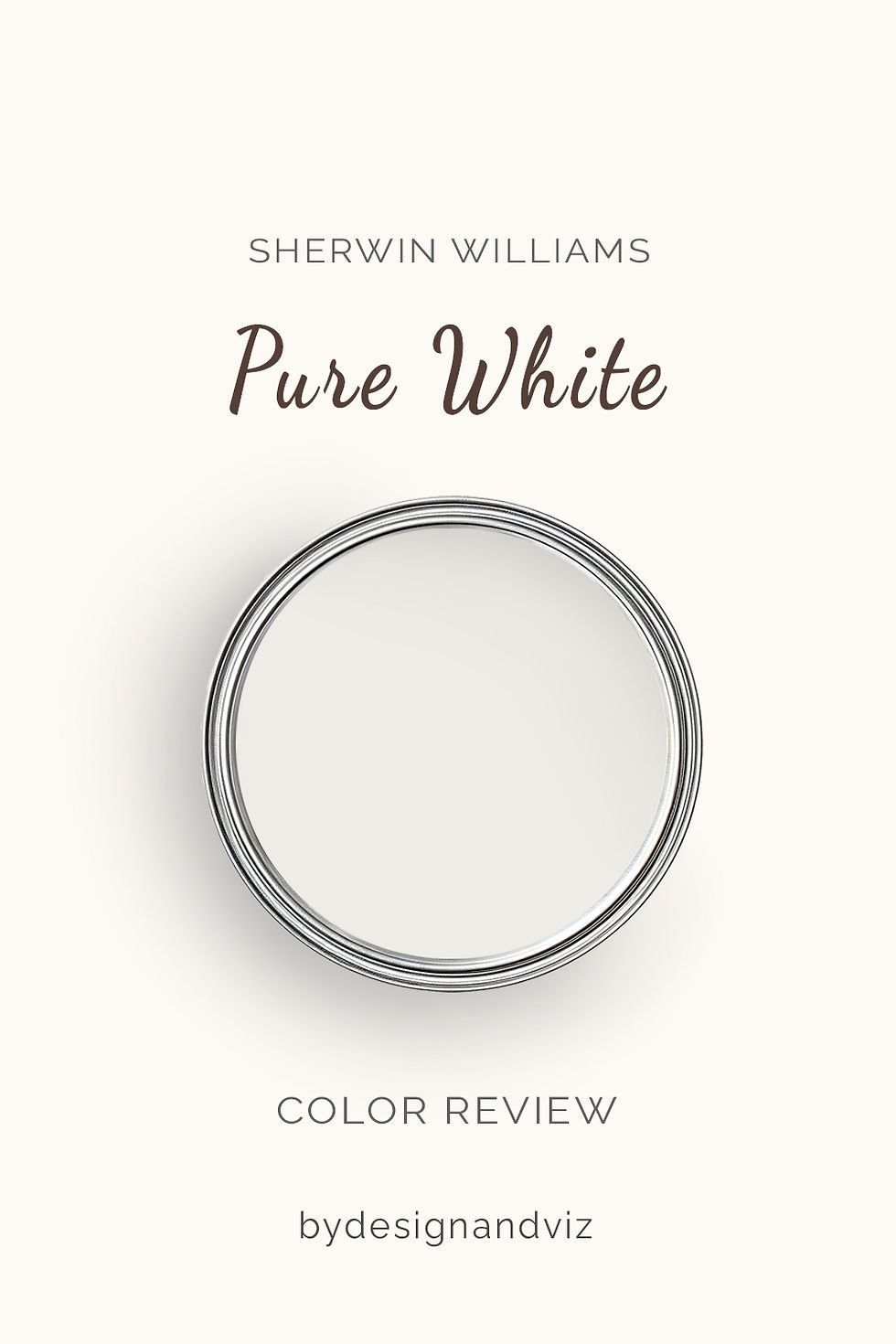
Pure White SW 7005 has an LRV of 84 — 7 points lower than Simply White and noticeably calmer on a wall as a result. The near-neutral undertone with its very subtle warm-grey quality is the defining characteristic: there is no committed yellow, no pink, no cool blue. It reads as a clean, balanced white that does not announce a warmth direction or a cool direction — it simply reads as white with a soft, considered quality. This near-neutrality is what makes it the most broadly compatible white in the SW range. It works alongside warm wall colours, cool wall colours, warm wood floors, cool stone, brass hardware, and polished nickel. It does not clash because it does not commit. In good natural light Pure White is a very clean, bright, polished white. In challenging north-facing or low-light conditions it holds its character without going cold, flat, or yellow.
Pure White is the SW white that appears most consistently across the widest range of interior conditions — it is the specification default when any other white carries a risk the room cannot absorb. For how it sits within the full SW white and off-white range, the Sherwin Williams white paint colors guide covers where Pure White sits relative to Alabaster, Extra White, and the rest of the SW white family.
The Real Difference Between Simply White and Pure White

Simply White is a bright, committed warm white with a clean yellow undertone that is luminous in good light and visibly warm in challenging conditions. Pure White is a near-neutral bright white with a subtle warm-grey quality that reads consistently across most light conditions and the broadest possible range of material palettes.
The 7-point LRV gap is the most significant practical difference between these two whites. Simply White at LRV 91.7 reflects substantially more light — rooms painted in Simply White feel noticeably brighter, more expansive, and more luminous than rooms in Pure White. Pure White at LRV 84 has more body, more presence, and more of what designers call 'considered weight' — it reads as a proper bright white that makes a subtle statement rather than disappearing into maximum reflectivity. Simply White rooms feel bright and warm. Pure White rooms feel clean and considered.
The trim and cabinet question is where the choice between these two is most commonly made — and most commonly got wrong. Simply White on trim works beautifully alongside warm wall colours in the BM range — Pale Oak, Edgecomb Gray, Revere Pewter — where the yellow warmth in the trim relates naturally to the warmth in the wall colour. It struggles alongside cool wall colours or cool materials where the yellow undertone creates an undertone conflict rather than harmony. Pure White on trim works alongside almost any wall colour from either brand — its near-neutral quality creates clean definition without undertone tension. This is why Pure White is one of the most specified trim whites in contemporary residential design. For the full breakdown of how Simply White fits within the BM white family alongside Chantilly Lace and White Dove, the Alabaster vs Simply White guide covers where Simply White sits in the BM warm-white spectrum.
Not sure which one works for your room? A colour consultation is included in all our design packages - book directly here. |
When to Choose Simply White

Choose Simply White when the brief is the brightest, cleanest BM warm white — maximum light reflection with a clean warm quality rather than a creamy one. Traditional and transitional kitchens where white cabinets need to feel bright and fresh rather than cream. Trim and millwork in warm-palette rooms where the yellow warmth relates naturally to the overall scheme. South-facing rooms or rooms with good balanced natural light where the high LRV creates a luminous, expansive quality that lower-LRV whites cannot replicate.
Test Simply White under your artificial lighting before committing — this is non-negotiable. The yellow undertone is clean in daylight but can surface visibly under warm bulbs (2700K-3000K), making the colour read as creamy or off-white in rooms that rely on artificial light in evenings. If the room uses 4000K+ cool bulbs the yellow undertone is suppressed and Simply White reads cleanly, but under warm residential bulbs the shift is real. Sample at large scale on your actual walls at the time of day and under the lighting conditions the room is used most.
When to Choose Pure White

Choose Pure White when the brief is a clean, near-neutral bright white that performs reliably across any light condition, any material palette, and any interior style. Contemporary, transitional, and whole-home interiors where trim, cabinets, and walls across multiple rooms and orientations all need to read as the same consistent white. Rooms with a mixed material palette — warm wood alongside cool stone, brass alongside brushed nickel — where a committed yellow or warm undertone would sit awkwardly against the cooler elements. Any room where the light conditions are uncertain or variable and a consistent result is the priority over maximum warmth or maximum brightness.
Pure White is the lower-risk specification of the two across most residential briefs. Its near-neutral undertone means it does not shift noticeably across light conditions in the way Simply White's yellow undertone can. For projects where multiple rooms, orientations, and lighting environments need to share the same white, Pure White delivers consistency that Simply White — with its higher LRV and more committed yellow warmth — cannot guarantee across every condition.
How the Pairings Differ

For Simply White on walls, White Dove OC-17 on trim creates a visible but warm contrast — the greyer, slightly deeper White Dove recedes while Simply White walls read as luminously bright. Chantilly Lace OC-65 on trim creates a cleaner, near-neutral contrast. Avoid Pure White SW on trim adjacent to Simply White BM walls — the cross-brand pairing with a 7-point LRV gap will read as an unintentional mismatch rather than a deliberate contrast.
For Pure White on walls, Extra White SW 7006 on trim gives the crispest, most contemporary result with maximum wall-to-trim definition. Pure White on both walls and trim is a clean, seamless whole-room approach that works well in any space. Avoid Simply White BM on trim adjacent to Pure White SW walls — the cross-brand combination creates both a visible LRV mismatch and an undertone conflict between the yellow BM base and the near-neutral SW base.
For flooring, Simply White works best above warm wood tones — honey oak, walnut, warm hardwood — where the yellow undertone relates naturally and creates warmth-on-warmth cohesion. Cool grey stone or porcelain tile alongside Simply White can make the yellow undertone read as more obviously warm by contrast. Pure White handles the full range — warm wood, cool stone, marble, porcelain tile, and white oak — without undertone conflict. Its near-neutral character means it does not create tension with any floor finish.
For hardware, Simply White is most natural with warm metals — aged brass, unlacquered brass, warm bronze — where the yellow warmth creates cohesion. Polished chrome or brushed nickel alongside Simply White can make the yellow undertone more visible by contrast. Pure White handles all metal finishes including polished chrome, brushed nickel, matte black, and warm brass without undertone tension — its near-neutral character is compatible with everything.
Architect's Verdict - Simply White or Pure White?

Both are excellent whites for the right brief. The choice comes down almost entirely to whether the brief needs maximum warmth and brightness or maximum versatility and consistency.
If the brief is the brightest, most luminous BM warm white with a clean yellow quality — for a traditional kitchen with warm wood, a south-facing living room that needs warmth and brightness together, or trim and millwork in a warm-palette BM scheme — Simply White is the answer. Test it under your artificial lighting before committing.
If the brief is a clean, near-neutral bright white that works with any palette, any orientation, any material, and any lighting condition without undertone risk — for whole-home trim, contemporary cabinets, open-plan spaces with mixed light, or any cross-brand scheme — Pure White is the answer. It will not disappoint.
The test: paint large samples of both on your actual wall in the most challenging light condition your room produces — north-facing morning, or under warm evening artificial lighting. Does Simply White read as the clean bright warm white it is in good light, or does the yellow undertone make it read as cream? Does Pure White read as clean and considered, or does the lower LRV feel flat in your specific conditions? That single test will make the right choice immediately clear.
Frequently Asked Questions

Is Simply White brighter than Pure White?
Yes - by 7 LRV points. Simply White OC-117 has an LRV of 91.7 and Pure White SW 7005 has an LRV of 84. The gap is clearly visible on a wall — Simply White is one of the brightest warm whites available in either brand, while Pure White has noticeably more body and a more settled presence. In rooms where maximum light reflection is the priority, Simply White wins. In rooms where a considered, consistent bright white is the priority, Pure White is the stronger choice.
Which is warmer - Simply White or Pure White?
Simply White is warmer. Its clean yellow undertone gives it a committed warmth direction that Pure White's near-neutral undertone does not carry. In most conditions Simply White reads as a warm white and Pure White reads as a near-neutral white. The distinction becomes most visible in north-facing rooms or under warm artificial bulbs, where Simply White's yellow undertone surfaces more visibly and Pure White holds its near-neutral character.
Can Simply White and Pure White be used together?
Not on adjacent surfaces. The 7-point LRV gap creates a clearly visible step between them, and the cross-brand combination — BM yellow-warm versus SW near-neutral — creates an undertone conflict on adjacent surfaces. Both can exist in the same home in separate rooms or zones, but using Simply White on walls and Pure White on trim (or vice versa) in the same room will read as a mismatch rather than a considered contrast.
Which is better for trim and cabinets?
Pure White is the more universally reliable trim and cabinet choice. Its near-neutral undertone means it works alongside warm and cool wall colours equally. Simply White is an excellent trim choice specifically alongside warm BM wall colours where the yellow warmth creates cohesion — but it can read as slightly creamy or off alongside cool wall colours or cool materials. For whole-home trim that needs to perform consistently across every room and orientation, Pure White is the more reliable specification.
What is the LRV of Simply White vs Pure White?
Simply White OC-117 has an LRV of 91.7 and Pure White SW 7005 has an LRV of 84. The 7-point gap makes Simply White one of the brightest warm whites in the BM range and places Pure White in a different brightness category — still a proper bright white, but with noticeably more body and presence on a wall. The LRV difference is the most practical distinguishing factor between these two whites in everyday use.
Final Thought
Simply White and Pure White are both excellent whites — but they serve meaningfully different briefs. The 7-point LRV gap and the yellow-warm versus near-neutral undertone distinction make the choice between them clearer than most cross-brand white comparisons.
Bright, luminous, clean yellow-warm — Simply White for warm BM schemes, traditional kitchens, and south-facing rooms where brightness and warmth work together. Clean, consistent, near-neutral bright white — Pure White for whole-home trim, contemporary spaces, mixed-light open plans, and any brief where reliability across conditions matters more than committed warmth. Never on adjacent surfaces. Sample both under your actual lighting conditions — especially evening artificial light. The LRV difference will be immediately visible and the undertone question will be answered within the first day.
Want a complete colour scheme built around Simply White or Pure White? Our design packages cover full palette selection, finish recommendations, and 3D visualisations - see our packages. |
About the Author
Beril Yilmaz is a qualified architect and interior designer based in the UK. She runs BY Design And Viz, a design platform covering paint colour reviews, interior design guidance, and residential design projects. Beril has specified both Simply White and Pure White across residential projects in the UK and internationally — Simply White in traditional and transitional BM schemes where warm-palette trim and cabinets call for the brightest BM warm white, Pure White in contemporary and whole-home SW schemes where consistent near-neutral performance across all rooms and conditions is the priority.


Comments