


Shoji White vs White Duck: The Comparison That Actually Helps You Decide
- Beril Yilmaz

- 1 day ago
- 10 min read
Shoji White and White Duck sit at the exact same LRV of 74, which is precisely why they get lumped together and precisely why that comparison is useless. Shoji White carries a whisper of green-gray taupe that gives it real depth on a wall. White Duck refuses to commit to green, gray, or cream at all. One has an opinion. The other doesn't - and that single distinction decides which rooms each one actually belongs in.
I have specified both across UK renovation projects, and the substitution mistake happens constantly. A client falls for Shoji White's grounded, organic warmth in a showroom sample, then paints their own north-facing hallway and ends up with something heavier and greener than they expected. White Duck was usually the color they actually wanted.
Here is exactly how the two behave differently once they're on your walls, not just on the fan deck.

At a Glance
| Shoji White | White Duck |
Brand | Sherwin-Williams | Sherwin-Williams |
LRV | 74 - identical to White Duck on paper, but the greige-taupe undertone gives it far more visual depth | 74 - identical LRV to Shoji White, but the hybrid undertone reads lighter and far less committed |
Colour category | Grounded warm greige - a genuine off-white with a taupe backbone, not a near-white | Ambiguous warm neutral - a cream-beige-gray hybrid that refuses to commit to one direction |
Undertones | Beige and gray with a distinct whisper of green - the undertone announces itself on a full wall | A low-chroma blend of cream, tan, and gray - no single undertone dominates, which is the point |
Character | Organic and grounded; reads as an intentional greige with real color presence, not an accident of light | Quiet and shape-shifting; borrows warmth or coolness from whatever surrounds it rather than asserting its own |
North-facing | Risky - the green-gray cast can turn heavier and slightly murky without warm light to lift it | Reliable - its lack of a dominant undertone keeps it from tipping obviously warm or cool in flat light |
South-facing | Excellent - the taupe warms and the green cast softens into a rich, grounded neutral | Clean - it warms gently without the depth or drama Shoji White shows in the same light |
Open-plan | Moderate - reads consistently but announces itself as a color rather than receding into a backdrop | Strong - its ambiguity is an asset across zones with mixed light and material temperatures |
On walls | Full-depth warm greige backdrop - unmistakably a color from every angle, in every room | Soft, low-commitment neutral backdrop that recedes rather than announces itself |
On cabinets | Best in organic modern and transitional kitchens with white oak, warm quartz, and matte black hardware | The safer, more universal choice across a wider range of stone, hardware, and appliance finishes |
Use together? | Yes - Shoji White on lower cabinetry with White Duck on the walls above is an easy, well-balanced pairing | Yes, with care - White Duck on trim against Shoji White walls needs testing first, since both sit close enough in value that the contrast can go flat |
Trim for each | Pure White SW 7005 for a crisp lift, or White Duck itself for a softer, closer step up | Pure White SW 7005 for crisp definition; avoid a high-LRV bright white, which will make White Duck look dull by comparison |
Style fit | Organic modern, transitional, earthy-contemporary interiors | Modern farmhouse, transitional, coastal - the more universally adaptable of the two |
Architect's pick | When the brief wants a greige with real presence and the room's light can actually support it | When the brief needs a neutral that will not fight the room's existing floors, fixtures, or furnishings |
Sherwin-Williams Shoji White SW 7042 - What It Really Looks Like

Shoji White has an LRV of 74, which puts it firmly in the light-but-not-bright range. The name promises white. The wall delivers something closer to a pale, considered greige with a warm beige base and a faint green-gray cast that surfaces most clearly in cooler or artificial light.
It does not read as a near-white the way an 82-plus LRV color does. There is genuine pigment here, and it shows. In strong natural light the greige settles down and reads warm and clean. In flat or north-facing light, the green undertone can pull forward and the color turns noticeably heavier than the swatch suggested.
Shoji White commits to being a color, not a backdrop. It needs the room built around it - warm floors, natural materials, and enough daylight to keep the green-gray cast in check. Get those conditions right and it looks intentional and grounded. Get them wrong and it looks muddy. For a fuller sense of how this same taupe-greige base performs against a much brighter Sherwin-Williams white, the Shoji White vs Cloud White guide lays out exactly how far apart 74 and a high-80s LRV actually feel on the wall.
Sherwin-Williams White Duck SW 7010 - What It Really Looks Like

White Duck has an LRV of 74, matching Shoji White number for number - but the resemblance ends at the LRV. The undertone is a genuinely low-chroma hybrid of cream, tan, and gray, and no single one of those wins out. It is not a cream in the way a yellow-leaning color would be, not a tan, and not a true greige.
That ambiguity is deliberate, and it is the entire appeal. In bright, south-facing light White Duck warms gently toward cream. In cooler or north-facing light it settles into a soft, muted beige-gray. It does not swing hard in either direction. It simply adjusts.
White Duck does not hedge because it has strong opinions. It hedges because it has almost none. That makes it the color to reach for when a room's existing materials are already mixed and nothing else needs to be resolved before the walls go on. Against Shoji White's greige-with-presence, that restraint matters most in rooms with several competing warm neutrals already in play - the Shoji White vs Swiss Coffee guide covers a similar restraint-versus-presence decision from a different angle, and is worth reading alongside this one.
The Real Difference Between Shoji White and White Duck

The simplest way to explain it: Shoji White is a warm neutral that knows exactly what it is. White Duck is a warm neutral that deliberately doesn't decide.
Both sit at an LRV of 74, so brightness is not the story here at all - the story is entirely in how committed each undertone is. Shoji White's beige-taupe base carries a genuine green-gray cast that shows up on a full wall, especially in cooler light. White Duck's undertone is a low-chroma blend of cream, tan, and gray with no single note dominant, which is exactly why it reads as more flexible in mixed-material rooms.
In practice this means Shoji White works best when the brief wants a neutral with real character - a room where the greige is allowed to be seen and felt, not hidden. White Duck works best when the brief wants the opposite: a neutral that disappears into the background and lets the floors, furniture, and fixtures do the talking. For how this same undertone-versus-restraint decision plays out against a warmer, more linen-leaning neutral, the Shoji White vs Natural Linen guide walks through a comparison where the LRV gap is real rather than nonexistent, and shows how that changes the framing entirely.
Not sure which one works for your room? A colour consultation is included in all our design packages - book directly here. |
When to Choose Shoji White
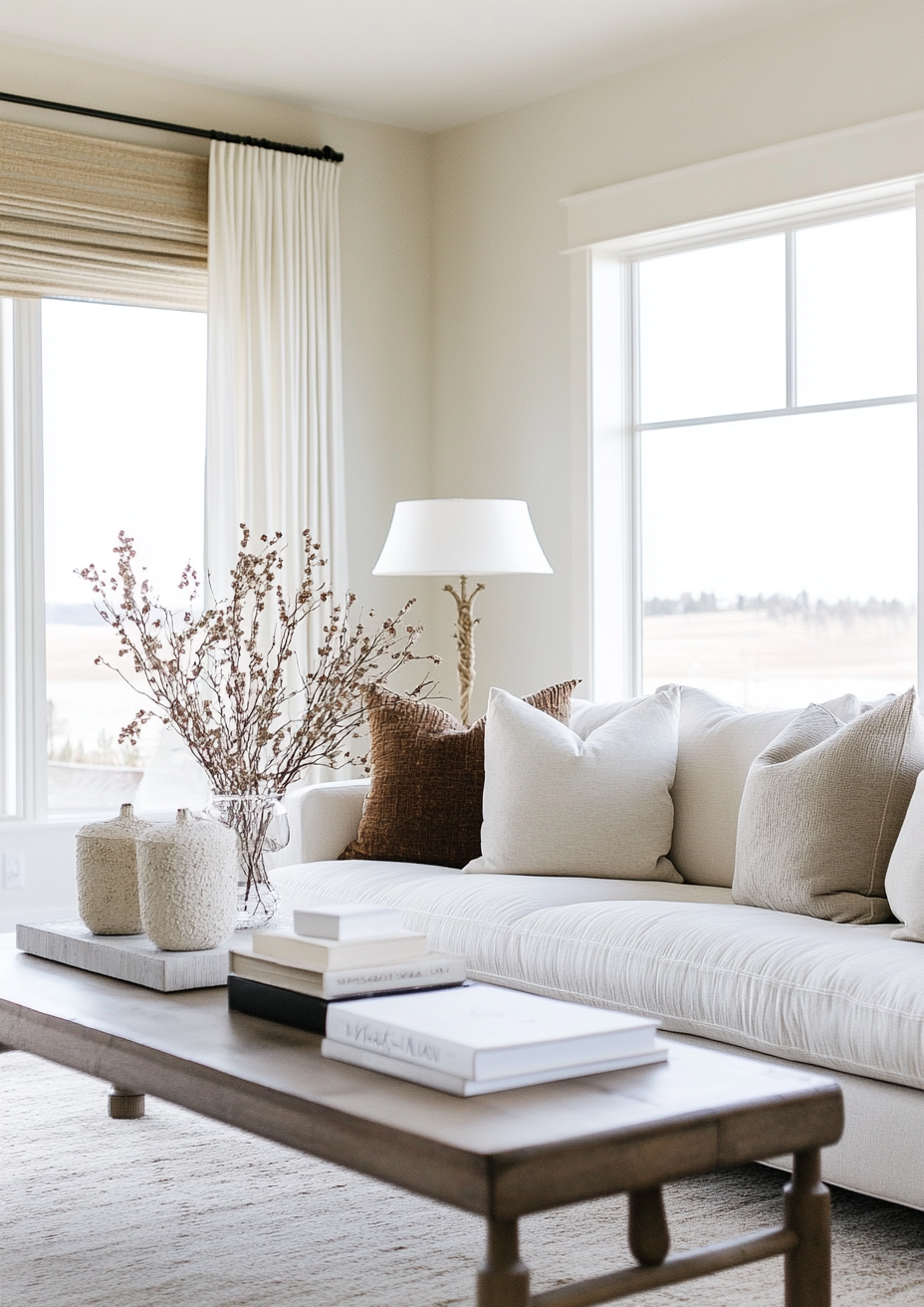
Choose Shoji White when you want a warm neutral with genuine depth and presence, not a near-white. These are the conditions where it performs.
South or west-facing rooms with strong natural light, where the taupe settles rather than turns green. Organic modern and transitional interiors built around white oak, linen, and natural stone. Kitchens and living rooms where the brief specifically wants a greige with weight, not a soft, receding white. Rooms where the surrounding materials are warm enough to hold the undertone in check throughout the day.
Avoid it in north-facing rooms with limited daylight, where the green-gray cast is most likely to dominate. Avoid it in small, low-light spaces where you need a neutral that recedes rather than adds visual weight. And avoid pairing it with cool-toned stone or steel-gray finishes - the green undertone will fight rather than complement them.
When to Choose White Duck

Choose White Duck when the room's materials are mixed and the brief calls for a neutral that will not pick a side. These are the situations where it outperforms Shoji White.
Open-plan spaces where the color needs to work across zones with different light and material temperatures. Modern farmhouse and transitional interiors mixing warm wood with cooler stone or metal finishes. Any room where you've tested Shoji White and found the green-gray cast too pronounced. North-facing rooms where a color with a strong single undertone risks tipping too far in one direction.
White Duck is also the better choice for anyone renovating in stages, since it will not clash with finishes chosen before or after the paint goes on. It is the low-risk, high-flexibility option of the two.
How the Pairings Differ

For Shoji White on walls, Pure White on trim gives the cleanest, most defined contrast without fighting the greige undertone. White Duck also works as a softer, closer-value trim option in rooms where a hard contrast feels too stark.
For White Duck on walls, Pure White on trim is the safer, more universal choice - it keeps the low-chroma neutral from reading dull. Avoid pairing White Duck with a very warm cream trim, which can make the wall color look accidentally gray by comparison.
Both colors suit warm wood tones, but they need different support. Shoji White wants genuinely warm floors - pale or honey-toned oak - to keep the green cast in check. White Duck is more forgiving and can sit comfortably against warmer or cooler wood tones without an undertone conflict emerging.
Both colors pair well with brushed brass and matte black. Shoji White is less comfortable with cool, high-shine chrome, where the green undertone can look slightly at odds with the metal. White Duck handles brushed nickel and chrome without issue, which is part of why it performs better in contemporary kitchens.
Architect's Verdict - Shoji White or White Duck?

For most homes - particularly those with mixed material temperatures, phased renovations, or genuine uncertainty about how a north-facing room will behave - White Duck is the more reliable choice. Its refusal to commit to a single undertone is not a weakness. It is the entire reason it works across such a wide range of conditions without creating problems.
Shoji White is the right choice when the brief specifically wants a greige with real depth and character - and when the room's light and materials can support it. In a south-facing organic modern living room with white oak floors and natural linen upholstery, Shoji White is more interesting and more grounded than White Duck. The undertone reads as intentional, not accidental.
White Duck is the right choice when the room can't afford a color with a strong opinion - open-plan spaces, mixed-material kitchens, or any room where the light conditions are still an unknown. It is the lower-risk, more forgiving option, and in most homes it is the better long-term bet.
The test I always use for this specific pair: paint large sample boards of each and view them in your worst light - typically a north-facing room in late afternoon, once direct sun has moved off the wall. If Shoji White still reads as a clean, grounded greige rather than a murky green-gray, it has passed and you can commit. If it looks heavier or greener than you expected, move to White Duck and run the same test - if it holds a calm, undecided neutral in that same light, that is your answer.
Frequently Asked Questions

Is Shoji White warmer than White Duck?
Not exactly warmer - more committed. Shoji White has a stronger, more identifiable greige-taupe undertone with a whisper of green, while White Duck's warmth is spread across cream, tan, and gray in roughly equal measure. Side by side in good light, Shoji White reads as the more defined color; White Duck reads as the more neutral one.
Can I use Shoji White and White Duck in the same house?
Yes, but test the pairing carefully first. Because both sit at the same LRV, using one on walls and the other on trim produces a much softer contrast than most wall-and-trim pairings. It can work beautifully in a room that wants a tonal, low-contrast scheme, but it will not read as a crisp architectural moment the way a bigger LRV gap would.
Which is better for kitchen cabinets?
White Duck is the more practical choice for most kitchens. Its ambiguous undertone works across a wider range of countertop, hardware, and appliance finishes. Shoji White looks excellent in organic modern kitchens with warm wood and matte black, but can look heavier next to cool stone or stainless steel. Always test both in your specific kitchen before committing.
Does Shoji White look green on the walls?
In cooler or north-facing light, yes - it can. The green-gray cast is subtle in warm, direct sunlight but becomes more noticeable under overcast skies or cool artificial lighting. This is the single biggest reason people who wanted Shoji White end up choosing White Duck instead.
Which is better for a north-facing room?
White Duck handles a north-facing room more reliably. Its lack of a single dominant undertone means it doesn't tip as obviously warm or cool when daylight is flat. Shoji White can work in a north-facing room with strong warm artificial lighting to compensate, but it needs that support to avoid reading heavy.
What is the LRV of Shoji White vs White Duck?
Both Shoji White and White Duck have an LRV of 74. The two colors are functionally identical in brightness. Every meaningful difference between them comes down to undertone, not reflectance - which is exactly why this comparison has to be won on undertone behavior, not the numbers on the fan deck.
Final Thought
Shoji White and White Duck are both excellent Sherwin-Williams warm neutrals. The choice between them is not about brightness - they share the same LRV - it is about how much personality you want your walls to have.
If you want a greige that commits and the room's light and materials can support it, choose Shoji White. If you need a neutral that will quietly get along with everything else in the room, choose White Duck. Buy sample pots of both, paint large patches on at least two walls with different light exposure, and check them again in the evening under your actual bulbs. The answer will be clear within a day.
Want a complete colour scheme built around Shoji White or White Duck? Our design packages cover full palette selection, finish recommendations, and 3D visualisations - see our packages. |
About the Author
Beril Yilmaz is a qualified architect and interior designer based in the UK. She runs BY Design And Viz, a design platform covering paint colour reviews, interior design guidance, and residential design projects. Beril has specified both Sherwin-Williams Shoji White and White Duck across residential projects in the UK and internationally - Shoji White in organic modern and transitional spaces where a greige with real presence is part of the brief, White Duck in mixed-material and phased renovations where the walls need to stay quietly out of the way - occasionally specifying both together, White Duck on walls with Shoji White reserved for lower cabinetry.


Comments