


Sanctuary vs Shoji White: The Comparison That Actually Helps You Decide

Updated: Jul 27
Sanctuary and Shoji White are two of Sherwin Williams' most discussed warm off-whites - both sophisticated, both earthy, and both appearing on shortlists when the brief is a warm neutral that sits deeper than Alabaster without committing to an obvious greige. On a chip they look like close relatives and the 2-point LRV gap between them suggests they should be virtually identical. On a wall in a real room they create noticeably different atmospheres - and the difference is almost entirely about how each colour wears its warmth.
Sanctuary SW 9583 reads as a quietly muted, greige-forward off-white. At LRV 76 it sits between Alabaster and Shoji White in depth, with a warm beige undertone that has a subtle grey quality giving it a restrained, settled character - warm enough to feel inviting, muted enough to feel considered. Shoji White SW 7042 reads as a warmer, more chameleon-like off-white with genuine depth. At LRV 74 it is just 2 points deeper than Sanctuary but its warm beige-greige undertone with a distinctive grey-green quality gives it a complexity and adaptability that Sanctuary's quieter character does not carry. Sanctuary is still. Shoji White shifts.
This guide covers exactly how Sanctuary and Shoji White differ in undertone, LRV, light behaviour, and room application - with a clear verdict on which one to choose and when.

At a Glance
| Sanctuary SW 9583 | Shoji White SW 7042 |
Brand | Sherwin Williams | Sherwin Williams |
LRV | 76 - warm off-white, muted and greige-forward | 74 - warm off-white, deeper with more warmth and complexity |
Colour category | Muted warm off-white - restrained, settled, quietly warm | Complex warm off-white - chameleon-like, earthy, sophisticated |
Undertones | Warm beige with subtle grey quality - quiet, restrained, muted | Warm beige-greige with grey-green quality - complex, shifts with light |
Character | Settled, quiet, muted warm off-white - sophisticated restraint | Earthy, complex, warm off-white - shifts between warm and greige-earthy |
North-facing | Good - muted grey quality adapts without the chameleon risk | Good - grey-green adapts gracefully but can read greige-heavy in cool light |
South-facing | Beautiful - warm quality glows quietly | Beautiful - warmth activates, most beautiful in warm natural light |
Open-plan | Very good - consistency across orientations | Very good - complexity adapts well; worth sampling in cool zones |
On walls | Quiet warm backdrop - settled, muted, sophisticated | Earthy warm off-white with real body and presence |
On cabinets | Muted warm off-white - organic modern kitchens with restrained palettes | Sophisticated warm off-white - organic modern and transitional kitchens |
Trim for each | Alabaster SW 7008 most natural; Pure White SW 7005 for more contrast | Alabaster SW 7008 most natural; Chantilly Lace OC-65 BM for crisper result |
Style fit | Organic modern, Japandi, minimalist, restrained transitional | Organic modern, Japandi, transitional, coastal, warm contemporary |
Architect's pick | When muted, quiet, settled warm off-white is specifically the brief | When sophisticated, complex, warmer off-white with earthy depth is the brief |
SW Sanctuary SW 9583 - What It Really Looks Like

Sanctuary has an LRV of approximately 76 and a warm beige undertone with a subtle grey quality that gives it a particularly muted, restrained character. It is warm - the beige base is genuinely warm and the room never reads as cool - but the warmth is delivered so quietly that the overall impression is one of sophisticated restraint rather than obvious warmth. This is what makes Sanctuary so distinctive in the SW off-white range: it occupies a specific position between the obvious cream warmth of Alabaster and the more complex chameleon quality of Shoji White.
I have used Sanctuary in organic modern bedrooms and Japandi living rooms where the brief was specifically a warm backdrop that did not announce itself at all - where the palette relied on materials, textures, and furnishings to carry the warmth and the walls needed to recede completely. Sanctuary does this better than any other SW off-white. The quiet restraint is an asset, not a limitation, in the right room. The one condition to understand: under cool artificial lighting or in rooms without warm 2700K bulbs, Sanctuary's grey quality surfaces more than Shoji White's warmth does. It is worth testing under your specific artificial lighting before committing. For the full standalone comparison of Sanctuary against the SW off-white it is most directly shortlisted against, the Sanctuary vs Alabaster guide covers the complete picture.
For how Sanctuary compares to Greek Villa - the bright, high-LRV Sherwin-Williams white it's most often shortlisted against for a whole-house scheme - the Sanctuary vs Greek Villa guide covers why the eight-point LRV gap matters less than the undertone stability, and which one holds up in a north-facing room.
SW Shoji White SW 7042 - What It Really Looks Like

Shoji White has an LRV of 74 and a warm beige-greige undertone with a subtle grey-green quality. This grey-green component is the source of its famous chameleon character - in warm south-facing light it reads as beautifully warm and creamy; in cooler indirect light the grey-green comes forward and it reads as more muted, earthy, and greige. It shifts with the light in a way that feels intentional and considered rather than unpredictable. At LRV 74 it has genuine body on a wall - it reads as a deliberate off-white with character and presence rather than simply a warm backdrop.
The distinction from Sanctuary is in the quality of the complexity. Sanctuary's grey is a straightforward muting quality - it quietens the warmth without adding chameleon behaviour. Shoji White's grey-green actively shifts the colour's reading depending on light conditions and adjacent materials. Shoji White rooms feel different at 9am in natural light and at 9pm under artificial light - and that shift is one of the qualities that clients who love it respond to most deeply. I have had clients describe Shoji White as feeling "alive" in a way that simpler off-whites do not - the chameleon quality reads as sophistication in the right scheme. For its full standalone picture, the Shoji White review covers every condition and application.
The Real Difference Between Sanctuary and Shoji White

Sanctuary is quiet. Shoji White is complex. That is the most accurate single-sentence description of the difference between two colours that the 2-point LRV gap entirely fails to capture.
Sanctuary rooms feel settled, muted, and sophisticated - the warmth is present but so restrained that the room reads as a considered, almost minimalist neutral rather than a warm backdrop. Shoji White rooms feel warm, earthy, and specifically complex - the chameleon quality means the room reads slightly differently in different light conditions, and that shifting quality gives it a richness and depth that Sanctuary's more consistent, quieter character does not carry.
The practical consequences of this difference are real. Sanctuary is the more consistent specification - its quiet, muted warmth holds relatively steadily across light conditions. Shoji White is the more rewarding specification in the right conditions - warmer in warm light, more earthy and interesting in cool light. For rooms where consistency is the priority - open-plan spaces with mixed orientations, rooms with unpredictable artificial lighting - Sanctuary is the safer choice. For rooms where the brief calls for a warm off-white with character and depth that rewards attention - south-facing rooms, well-considered Japandi or organic modern schemes with warm materials - Shoji White delivers a more compelling result.
For how Sanctuary compares to Pale Oak - a deeper, taupe-leaning greige from Benjamin Moore rather than a restrained Sherwin-Williams off-white - the Sanctuary vs Pale Oak guide covers the worst-case light test for Pale Oak's pink-violet undertone.
Not sure which one works for your room? A colour consultation is included in all our design packages - book directly here. |
When to Choose Sanctuary

Choose Sanctuary when the brief is quiet, muted, restrained warm off-white that recedes completely. Minimalist, organic modern, and Japandi interiors where the walls need to disappear behind materials, textures, and furnishings. Rooms where Shoji White's chameleon complexity feels like too much movement and the brief calls for a colour that simply stays quiet and warm regardless of the light. Bedrooms and studios where a deeply restful, non-committal warmth is the goal.
Sanctuary is the right choice when you find yourself drawn to Shoji White but worried about the chameleon shifts. It delivers a similar depth and a similar earthy quality without the light-sensitivity. The trade-off is that it does not deliver the warmth and complexity that Shoji White achieves in good light - but for rooms where that movement is a concern rather than an asset, Sanctuary resolves the uncertainty.
For how Sanctuary compares to White Dove - the brighter, creamier Benjamin Moore warm white that sits nine LRV points above it - the Sanctuary vs White Dove guide explains why the brightness gap matters more than the shared warm undertone, and which one holds up in a north-facing room.
When to Choose Shoji White
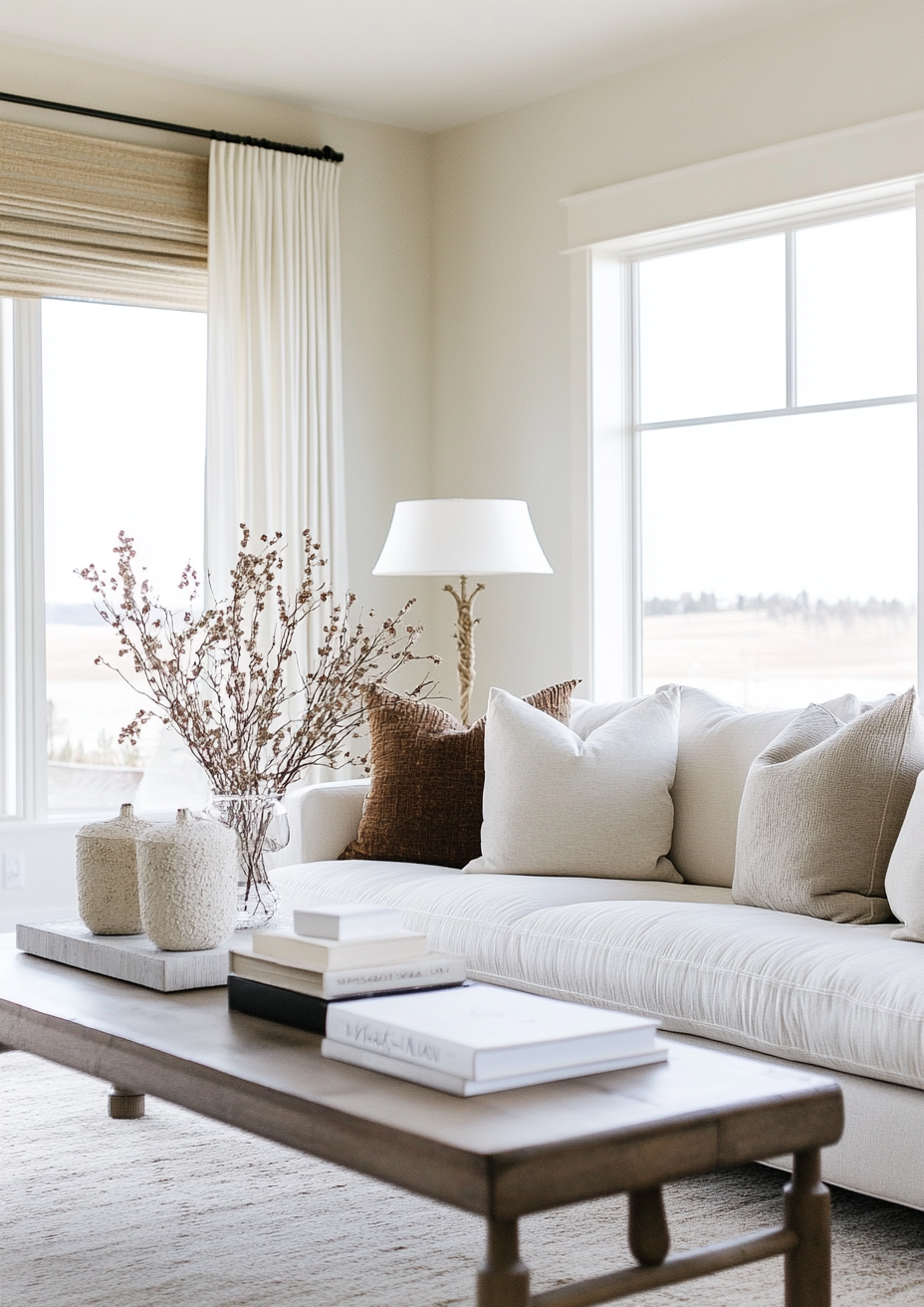
Choose Shoji White when the brief is sophisticated, complex, warm off-white with earthy depth and genuine character. Organic modern, Japandi, and transitional schemes where the brief calls for warmth and sophistication without obvious cream or obvious greige. South-facing rooms with good natural light where the warm chameleon quality activates beautifully. Rooms with warm wood floors, stone, rattan, and natural materials where the grey-green complexity sits naturally within the organic palette.
Shoji White is the right choice when Sanctuary feels too muted, too quiet, or too flat for the warmth the brief requires. I reach for Shoji White when the client brief includes words like 'warm but sophisticated' or 'not obviously cream but clearly not white' - it is the colour that lives in that specific territory more convincingly than any other SW off-white. For how Shoji White compares to the SW off-white it is most directly compared against at a similar depth, the Shoji White vs Natural Linen guide covers that close-LRV within-range distinction.
How the Pairings Differ

For Sanctuary on walls, Alabaster SW 7008 on trim is the most natural pairing - the cream quality of Alabaster provides warm definition without fighting Sanctuary's muted character. Pure White SW 7005 gives a crisper, more contemporary result. The quiet restraint of Sanctuary means it suits trim whites that are clean and unobtrusive - avoid anything that introduces strong warmth or obvious cream quality on trim, which would make Sanctuary's walls read as too muted and grey by contrast.
For Shoji White on walls, Alabaster SW 7008 on trim is the warmest, most tonal within-system choice. Chantilly Lace OC-65 from Benjamin Moore on trim gives a crisper, high-contrast result that suits contemporary and transitional schemes where the definition between wall and trim is part of the brief. Both work well - the right choice depends on how much contrast the scheme calls for. Sanctuary on trim alongside Shoji White walls should be avoided: the 2-point LRV near-match with slightly different undertone characters reads as an unresolved depth mismatch rather than a considered tonal relationship.
For how Sanctuary compares to Natural Linen - a warm tan-beige that carries an entire home rather than a single accent room - the Sanctuary vs Natural Linen guide lays out the case for using both colors together, each in the room it is built for.
For flooring, both colours work most naturally above warm wood floors. Sanctuary's quiet, muted warmth is most at home alongside light oak, blonde wood, and stripped timber where the restraint reads as intentional and considered. Warm darker woods can make Sanctuary's walls read as slightly colder by contrast. Shoji White handles a broader range of wood tones - light oak, warm oak, medium walnut - because the grey-green chameleon quality adapts to the warmth level of the floor rather than fighting it.
For hardware, both suit aged brass, warm bronze, and matte black in organic modern and Japandi schemes. Sanctuary is particularly elegant alongside matte black hardware where the muted warmth of the walls and the precision of the black creates a quiet, editorial quality. Shoji White alongside matte black has a slightly richer, earthier character because the warmth is more complex. Both are less comfortable with polished chrome or cool steel hardware.
For the comparison between Sanctuary and Creamy - two SW neutrals separated by 5 LRV points but by a much larger undertone gap - the Sanctuary vs Creamy guide explains which one holds up in mixed-material, uncertain-light rooms.
Architect's Verdict - Sanctuary or Shoji White?

This is one of the closest and most genuinely difficult SW off-white comparisons - 2 LRV points apart, same broad family, similar style fit. The decision comes down to one question: do you want the walls to stay quiet or do you want them to be interesting?
If the brief calls for walls that disappear completely - muted, restrained, settled, consistent across all light conditions - Sanctuary is the answer. It is the most quietly warm off-white in the SW range and there is nothing else quite like it for the brief where the palette relies entirely on materials and the walls need to recede without reading as grey or cool.
If the brief calls for walls with genuine earthy warmth and character - complex, chameleon-like, warm in warm light and earthy in cool light - Shoji White is the answer. It is one of the most sophisticated and most rewarding off-whites in the SW range in the right conditions, and the 2-point LRV advantage over Sanctuary translates into noticeably more warmth and more depth on the wall.
The test: sample both at large scale in your room under morning natural light and evening artificial lighting. Sanctuary should read warm, quiet, and consistent in both. Shoji White should read warmer in natural light and more earthy-greige in the evening. If the morning-to-evening shift of Shoji White is appealing - choose Shoji White. If it feels like uncertainty - choose Sanctuary.
For how Chantilly Lace compares to Sanctuary - a warm, muted Sherwin-Williams neutral that sits at the opposite end of the LRV scale - the Sanctuary vs Chantilly Lace guide covers the 16-point brightness gap and the trim-and-wall pairing it creates.
Frequently Asked Questions

Is Sanctuary the same as Shoji White?
No - despite being 2 LRV points apart, they have meaningfully different undertone characters. Sanctuary has a quiet, muted warmth that holds consistently across light conditions. Shoji White has a warmer, more complex grey-green quality that shifts chameleon-like with the light. Sanctuary is still. Shoji White moves.
Which is warmer - Sanctuary or Shoji White?
Shoji White reads as warmer in most conditions. Its grey-green quality activates beautifully in warm natural light and the colour reads as genuinely earthy and warm. Sanctuary's grey quality mutes the warmth more consistently - it is warm, but the warmth is delivered so quietly that Shoji White reads as the more obviously warm of the two in side-by-side samples.
Which is better for north-facing rooms?
Sanctuary handles north-facing rooms slightly more predictably than Shoji White. The quiet grey muting quality adapts without the grey-green chameleon shifts that Shoji White's more complex undertone can produce in cool indirect light. That said, both are more reliable in north-facing rooms than committed cream whites - the grey quality in both colours prevents the reading-as-yellow risk that direct warm whites carry. For either colour in a north-facing room, warm 2700K artificial lighting is recommended.
Can Sanctuary and Shoji White be used in the same home?
Yes - in separate rooms with clear visual boundaries. The 2-point LRV near-match means they should never appear on adjacent surfaces - the near-miss reads as a mistake rather than a decision. In separate rooms with different material contexts they can coexist comfortably - Sanctuary in a quieter, more restrained space and Shoji White in a warmer, more complex one.
What is the LRV of Sanctuary vs Shoji White?
Sanctuary SW 9583 has an LRV of approximately 76 and Shoji White SW 7042 has an LRV of 74. The 2-point gap is one of the smallest in any off-white VS comparison. The meaningful difference is entirely in undertone character: Sanctuary's quiet muted warmth versus Shoji White's complex chameleon grey-green warmth.
Final Thought
Sanctuary and Shoji White are the most closely matched and most genuinely nuanced same-brand off-white comparison in the SW range. The 2-point LRV gap hides a real character difference that only becomes clear at large sample scale in the specific room.
Muted, restrained, consistently quiet warm backdrop - Sanctuary with Alabaster SW on trim. Warm, complex, earthy off-white with chameleon character and genuine depth - Shoji White with Alabaster SW or Chantilly Lace BM on trim. Sample both at large scale under both natural and artificial lighting. The difference will be clear and the answer will follow from which one feels right in your room.
Want a complete colour scheme built around Sanctuary or Shoji White? Our design packages cover full palette selection, finish recommendations, and 3D visualisations - see our packages. |
About the Author
Beril Yilmaz is a qualified architect and interior designer based in the UK. She runs BY Design And Viz, a design platform covering paint colour reviews, interior design guidance, and residential design projects. Beril has specified both Sherwin Williams Sanctuary and Shoji White across residential projects in the UK and internationally - Sanctuary in minimalist and Japandi schemes where the quietest possible warm off-white is the brief, Shoji White in organic modern and transitional schemes where earthy warmth with genuine complexity is what the room calls for.


Comments