


Sherwin Williams Sanctuary vs Alabaster - Which SW Off-White Does Your Room Need?

Updated: Sep 10
Sherwin Williams Sanctuary SW 9583 and Alabaster SW 7008 get compared constantly - and the confusion makes complete sense. Both are warm SW off-whites. Both are light and broadly appealing. Both appear on the same shortlists when the brief is a sophisticated, inviting neutral that feels warm without committing to cream. On a chip they look like close relatives. On a wall the 6-point LRV gap is clearly visible, and the undertone difference creates two noticeably different rooms. Choosing the wrong one for your space is an easy and costly mistake.
I have used both across residential projects across the UK. Alabaster is the more widely used of the two - it appears on more projects, in more room types, and handles a broader range of conditions. Sanctuary is the more specific choice - quieter, more muted, slightly greige-forward - and when the conditions are right it creates a result Alabaster cannot replicate. This guide covers the complete comparison, including the Sanctuary vs Shoji White question that comes up almost as often.

Side by Side
| Sanctuary SW 9583 | Alabaster SW 7008 |
LRV | ~76 | ~82 |
Undertone | Warm beige-greige with subtle grey - muted, soft | Warm cream-greige - broader, more obvious warmth |
Character | Quiet, muted, sophisticated, understated | Warm, creamy, inviting, broadly versatile |
North-facing | Good - grey can surface but warmth holds with care | Better - cream warmth holds reliably in cool light |
South-facing | Beautiful - warm and settled without overwhelm | Excellent - glows warmly, the most flattering conditions |
Best for | Rooms needing a quieter, more muted off-white | Most rooms - whole-house, trim, cabinets, walls |
Trim pairing | Pure White SW 7005 or Extra White SW 7006 | Pure White SW 7005 or Extra White SW 7006 |
Main risk | Can feel flat or cool in very dark rooms | Can feel too creamy in very bright south-facing rooms |
Same brand? | Yes - both Sherwin Williams | Yes - both Sherwin Williams |
Sanctuary SW 9583 - What It Actually Is

Sanctuary SW 9583 is from Sherwin Williams' Designer Color Collection - a relatively newer colour compared to the long-established Alabaster, and one that has built a dedicated following precisely because it fills a gap that Alabaster does not. At LRV ~76 it sits mid-range in the off-white zone - deeper than Alabaster, lighter than Shoji White - with a warm beige-greige undertone that is more muted and more restrained than Alabaster's obvious cream warmth.
The most important thing to understand about Sanctuary is what it is not. It is not a cool colour. It is not grey. Several sources describe it as having 'green undertones' - this is misleading. Sanctuary reads as warm, but with a subtle grey quality that moderates the warmth and gives it a quieter, more restrained character than Alabaster. The result is a colour that feels sophisticated and considered rather than obviously cosy or creamy.
For the full head-to-head comparison of Sanctuary against Shoji White - the warmer, more complex off-white 2 LRV points below - the Sanctuary vs Shoji White guide covers exactly how the quiet vs chameleon character difference plays out on a wall.
WHICH IS WARMER?
Alabaster. Sanctuary is warm but its subtle grey quality moderates that warmth - the colour reads as muted and quiet rather than obviously warm. Alabaster's cream-greige undertone is broader and more obviously warm in most conditions. Side by side, Alabaster will look noticeably creamier and more overtly warm. Sanctuary will look quieter and more sophisticated. Both are warm - the difference is the character and confidence of that warmth.
WHICH HAS THE HIGHER LRV?
Alabaster, by 6 points. LRV ~82 versus Sanctuary's ~76 is a clearly visible gap on a wall - Alabaster is brighter, more reflective, and makes rooms feel more open. In a small room or one with limited light, those 6 points of reflectance are meaningful. Sanctuary at LRV ~76 is still a light, open colour - but it has more body and presence than Alabaster in the same space.
WHICH IS BETTER FOR NORTH-FACING ROOMS?
Alabaster is the safer north-facing choice. The cream-greige undertone holds its warm character more reliably in cool indirect light. Sanctuary's subtle grey quality can surface more visibly in north-facing conditions - it remains warm but can read as slightly more neutral and less obviously warm than expected. With warm wood floors, warm brass, and 2700K bulbs throughout Sanctuary holds well. But for a challenging north-facing room where reliability is the priority, Alabaster is the lower-risk choice.
WHICH IS BETTER FOR CABINETS AND TRIM?
Alabaster is the stronger cabinet and trim choice. Its LRV ~82 and cream-greige warmth create the kind of warm, bright, broadly reliable cabinet and trim result that suits the widest range of kitchen styles and schemes. Sanctuary at LRV ~76 on cabinets can read as slightly soft or muted - it works better as a wall colour than a cabinet colour. On trim, Sanctuary's lower LRV means it reads as a proper colour rather than a crisp white boundary - Pure White SW 7005 is the correct trim choice alongside Sanctuary walls.
MY VERDICT ON SANCTUARY
Sanctuary for rooms where Alabaster feels too creamy or too obviously warm. It is the correct choice when the brief is a warm off-white that reads as quietly sophisticated rather than cosy and inviting. South-facing rooms with warm materials, bedrooms, and studies where a more restrained warmth is the goal. Not the obvious first choice for whole-house use or trim - that is Alabaster's territory.
For the comparison between Sanctuary and Creamy - two SW neutrals separated by 5 LRV points but by a much larger undertone gap - the Sanctuary vs Creamy guide explains which one holds up in mixed-material, uncertain-light rooms.
Alabaster SW 7008 - What It Actually Is

Alabaster SW 7008 needs no introduction - it has been one of the most widely used warm whites in residential design for years and its popularity is completely deserved. At LRV ~82 it sits at the bright end of the off-white spectrum with a warm cream-greige undertone that reads as clearly and confidently warm in virtually every condition. It is the warm white that works everywhere: walls, trim, cabinets, ceilings, exteriors.
The cream-greige undertone is what makes Alabaster so broadly reliable. It is warm enough to feel inviting and prevent the clinical quality of cool whites, but the greige anchor prevents it from reading as obviously yellow or buttery in most conditions. The warmth is broad and consistent rather than directional or conditional - it does not demand specific light conditions the way Greek Villa's sandy yellow does. This reliability is its defining quality.
For how Sanctuary compares to Pale Oak - a Benjamin Moore greige with real depth rather than a restrained off-white quality - the Sanctuary vs Pale Oak guide covers the seven-point LRV gap and which rooms can carry Pale Oak's added weight.
WHICH IS WARMER?
Alabaster, clearly. The cream-greige undertone is more obvious and more broadly present across different light conditions. Next to Sanctuary, Alabaster will look noticeably creamier and warmer. This is its greatest strength in most rooms and its only limitation in very bright south-facing rooms where the cream quality can become more obvious than intended.
WHICH HAS THE HIGHER LRV?
Alabaster at LRV ~82 is 6 points brighter. In practice this means Alabaster makes rooms feel visibly more open and airy. In a side-by-side sample test on the actual wall, the LRV difference is immediately clear. Alabaster will look bright and luminous. Sanctuary will look quieter and slightly more settled. Both are off-whites with real presence - the question is whether you want bright warmth or muted warmth.
WHICH IS MORE VERSATILE?
Alabaster is significantly more versatile. It works on walls, trim, cabinets, ceilings, and exteriors across a wider range of room types, orientations, and interior styles than Sanctuary. If you want one off-white that handles everything in a home - Alabaster is the answer. Sanctuary is more specific: it does one thing very well, which is creating a quietly sophisticated, muted warm backdrop in rooms where Alabaster's cream warmth is slightly too obvious.
MY VERDICT ON ALABASTER
Alabaster for whole-house use, trim, cabinets, and any room where a warm, bright, reliable off-white is the brief. It is the most versatile warm off-white in the SW range and the default correct choice for most rooms and most people. The full picture of what it pairs with alongside Shoji White is in the Shoji White vs Alabaster guide.
The LRV Gap - What 6 Points Looks Like
The 6-point LRV gap between Sanctuary (~76) and Alabaster (~82) is smaller than the gaps in many white comparisons, but it is clearly visible at sample scale. Alabaster will consistently look brighter, more luminous, and more obviously warm. Sanctuary will consistently look quieter, more settled, and slightly more greige-forward. In a small or dark room the gap matters - Alabaster's additional reflectance keeps rooms from feeling flat.
The 6 points between them is not huge - but it changes the feel of the room from 'warm and creamy' to 'warm and quiet.' That shift is exactly the difference between the rooms each one is right for.
The depth difference also affects how each colour reads alongside trim. Alabaster at LRV ~82 on walls with Pure White at ~84 on trim creates a very subtle, barely-there contrast. Sanctuary at LRV ~76 on walls with Pure White on trim creates a more visible, considered contrast - the 8-point gap between Sanctuary and Pure White is more defined and reads as more deliberate. Some people prefer this slightly more pronounced wall-to-trim relationship.
For how Sanctuary compares to Greek Villa - the reliably bright warm white that never swings toward gray the way Sanctuary can - the Sanctuary vs Greek Villa guide explains which of the two is the safer whole-house default.
How Each Colour Behaves in Different Light
North-Facing Rooms
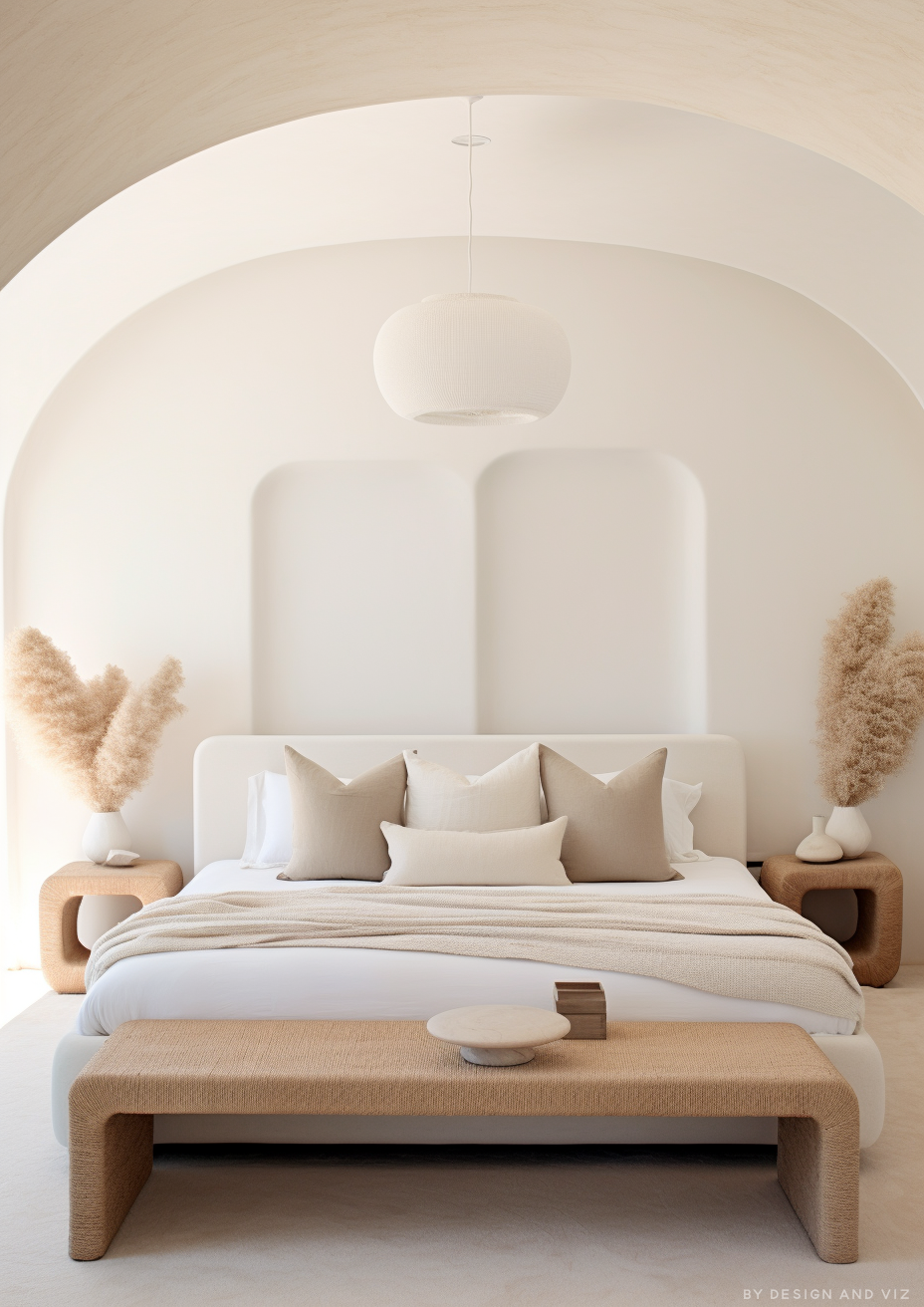
Alabaster is the more reliable north-facing off-white of the two. The cream-greige undertone holds its warm character in cool indirect light and the room reads as warm and inviting rather than flat. I have used Alabaster in north-facing rooms across multiple projects with consistent results. Sanctuary in a north-facing room requires more attention - the subtle grey component can surface in cool light and the colour can read as more neutral and greige-forward than expected. Warm materials and 2700K lighting are more critical with Sanctuary in these conditions.
For how Sanctuary compares to Chantilly Lace - a Benjamin Moore true white 16 LRV points brighter, making this a pairing decision rather than a close call - the Sanctuary vs Chantilly Lace guide explains why the two work best together rather than as alternatives.
South-Facing Rooms
Both are beautiful in south-facing rooms but Sanctuary is at its best here. The muted warmth glows gently without the risk of reading as too creamy - the grey component that can be a limitation in cool light is suppressed by warm natural light and the colour reads as a beautiful, settled warm off-white. Alabaster in south-facing strong light can occasionally tip toward obviously creamy - clients who expected a clean bright warm white occasionally find it warmer than anticipated in very bright rooms. Sanctuary avoids this risk entirely.
Artificial Lighting
Both colours benefit from 2700K warm-spectrum bulbs. Under cool 4000K lighting, Sanctuary's grey component surfaces more than Alabaster's cream warmth - Alabaster holds a warmer reading under cool artificial light more reliably. For rooms where the lighting specification cannot be changed from cool bulbs, Alabaster is the safer choice. Under warm 2700K bulbs both colours are warm, inviting, and beautiful.
Not sure which one is right for your room? Book a colour consultation here - bydesignandviz.com/book-online |
Sanctuary vs Shoji White - The Question That Comes Up Just as Often

The Sanctuary vs Shoji White comparison is one of the most searched SW off-white questions - and one of the most genuinely confusing because both sit at very similar LRVs. Sanctuary is LRV ~76. Shoji White is LRV ~74. Two points is barely perceptible on a wall. The difference that matters is entirely in the undertone character.
Shoji White has a warm beige-greige undertone with a subtle grey-green complexity - it is warm but complex, shifting slightly between conditions. It reads as a warm off-white with a sophisticated, slightly shifting quality that designers love for its chameleon-like behaviour. Sanctuary has a warm beige-greige undertone with a subtle grey quality - it is also warm but more straightforwardly muted, without the grey-green complexity that makes Shoji White shift between conditions. Sanctuary is the quieter, less complex of the two.
If Shoji White feels slightly too complex or too shifting for your room, Sanctuary is the simpler, more stable version of the same depth zone.
The practical difference: Sanctuary is the more predictable of the two - it does not shift between conditions the way Shoji White can. For people who love Shoji White's depth but find its undertone complexity unpredictable, Sanctuary is worth testing. For people who love the warmth of Alabaster but want something with more body and quieter warmth, Sanctuary is also the natural step. It is the off-white that bridges these two.
For how Sanctuary compares to Natural Linen - a warm tan-beige that carries an entire home rather than a single accent room - the Sanctuary vs Natural Linen guide lays out the case for using both colors together, each in the room it is built for.

Sanctuary vs Shoji White - Key Differences
| Sanctuary SW 9583 | Shoji White SW 7042 |
LRV | ~76 | ~74 |
Undertone | Warm beige-greige, subtle grey - muted, stable | Warm beige-greige, grey-green complexity - shifting |
Character | Quiet, muted, predictable warmth | Sophisticated, slightly shifting, complex warmth |
North-facing | Good with warm anchors | Good - well-documented versatility |
South-facing | Beautiful - muted warmth glows | Beautiful - complex warmth reads richly |
Complexity | Less complex - more predictable | More complex - more interesting |
Best for | Rooms needing quiet, stable warmth | Rooms where complexity and character are the brief |
For the full in-depth breakdown of Shoji White across every condition and application, the Shoji White Sherwin Williams review covers everything you need.
Sanctuary vs Alabaster Room by Room
Bedrooms

Sanctuary is a beautiful bedroom colour - the quiet, muted warmth creates a calm and restful atmosphere that suits bedrooms naturally. It reads as a warm backdrop that recedes and lets the textiles and furnishings perform without the cream warmth of Alabaster reading as too obvious or too cosy. Alabaster in a bedroom is equally beautiful and more broadly reliable across orientations - for north-facing bedrooms or rooms with mixed light, Alabaster is the safer choice.
Living Rooms

In a south-facing living room with a contemporary or organic modern brief, Sanctuary creates a more refined result than Alabaster - the muted warmth reads as considered and sophisticated. Alabaster in the same room would read as warmer, cosier, and more inviting. The choice depends entirely on the brief: restrained sophistication or warm invitation. In a north-facing living room, Alabaster is the more reliable choice.
Kitchens - Cabinets
Alabaster on kitchen cabinets is one of the most consistently reliable and most widely used SW cabinet choices. The warm, bright off-white result suits shaker, slab, and contemporary cabinetry across almost any kitchen style. Sanctuary on cabinets is more specific - it works in organic modern and transitional kitchens where a quieter, more muted off-white cabinet is the brief, but its lower LRV and greige quality can read as slightly dull in kitchens with cool stone or limited light. When in doubt on cabinets, Alabaster.
Whole-House
Alabaster is the stronger whole-house off-white of the two. The cream-greige warmth handles mixed orientations consistently and the LRV ~82 keeps rooms feeling bright across different light levels throughout the home. Sanctuary whole-house is more demanding - in rooms with cool north-facing light the grey quality can surface and the colour reads differently to south-facing rooms in the same house. Alabaster holds more consistently across a mixed-orientation whole-house scheme.
Exteriors

Alabaster is the more proven and more widely used exterior choice of the two. The LRV ~82 holds visual presence in all weather conditions and the cream warmth reads as elevated and inviting on facades across a wide range of architectural styles. Sanctuary as an exterior colour is less commonly seen but can be effective on contemporary and transitional homes where a quieter, less obviously cream off-white is the brief.
Choose Sanctuary If

Alabaster feels too creamy or too obviously warm for your room or your taste - Sanctuary is the quieter, more muted version of the same depth zone.
The interior style is contemporary or minimalist - Sanctuary's muted warmth reads as more architectural and restrained than Alabaster's obvious cream quality.
The room is south-facing and you want a warm off-white that won't tip toward creamy in strong natural light.
You want walls with quiet sophistication rather than warm cosiness - Sanctuary sits further from the cosy end of the off-white spectrum than Alabaster.
For how Sanctuary compares to Fog Mist - the warmer, more committed Benjamin Moore greige it's most often confused with once mixed materials enter the room - the Sanctuary vs Fog Mist guide covers the undertone gap and the classic wall-and-trim pairing between the two.
Choose Alabaster If

The brief is whole-house, trim, or cabinets - Alabaster handles all three applications reliably and across the widest range of room types and orientations.
The room is north-facing or has limited or mixed light - the cream-greige warmth holds more reliably in cool conditions than Sanctuary's more muted character.
You want a warm, inviting, clearly warm off-white - Alabaster's cream quality reads as obviously warm and cosy in a way Sanctuary does not.
You are uncertain about the conditions - Alabaster is the safer default between the two. It handles more rooms well and surprises fewer people. The full picture of what it pairs with in the Shoji White family is in the Shoji White vs Alabaster guide.
Sanctuary and Alabaster vs Other SW Off-Whites

VS SHOJI WHITE SW 7042
Shoji White at LRV ~74 is 2 points deeper than Sanctuary and more complex in undertone. It has a grey-green quality that shifts with changing light. Sanctuary is the simpler, more stable alternative at almost the same depth. The full Shoji White breakdown is in the Shoji White Sherwin Williams review.
VS GREEK VILLA SW 7551
Greek Villa at LRV ~84 is slightly brighter than Alabaster with a sandy yellow-beige undertone that is more directionally warm. Where Alabaster's cream warmth is broad and steady, Greek Villa's warmth is sunny and luminous in good light but risks reading yellow in cool conditions. The full comparison is in the Pure White vs Greek Villa guide.
VS NATURAL LINEN SW 9109
Natural Linen at LRV ~73 is slightly deeper than Sanctuary with a purely warm beige-yellow undertone - warmer and more earthy than Sanctuary's muted beige-greige. Where Sanctuary is quiet and restrained, Natural Linen is warm and grounded. The full Natural Linen picture is in the Shoji White vs Natural Linen guide.
VS PURE WHITE SW 7005
Pure White at LRV ~84 is brighter than Alabaster with a near-neutral undertone - it reads as a proper white rather than an off-white. It is the correct trim choice alongside both Sanctuary and Alabaster walls. The full comparison is in the Pure White vs Greek Villa guide.
Frequently Asked Questions
Is Sanctuary warmer or cooler than Alabaster?
Alabaster is warmer. Sanctuary is warm but has a subtle grey quality that moderates its warmth and gives it a quieter, more muted character. Alabaster's cream-greige undertone is broader and more obviously warm in most conditions. Side by side, Alabaster looks noticeably creamier.
Can Sanctuary and Alabaster be used in the same house?
With care, yes - but not on adjacent visible surfaces. The undertone and LRV difference is visible when both can be seen simultaneously. In separate rooms with clear visual breaks - a hallway, a door - Sanctuary in a south-facing living room and Alabaster on all trim and ceilings throughout is a completely considered approach.
Is Sanctuary good for trim?
No - Pure White SW 7005 for trim alongside Sanctuary walls. Sanctuary's LRV ~76 and greige quality read as a wall colour rather than a crisp white boundary. The contrast between Sanctuary walls and Pure White trim is clean and considered. Using Sanctuary on trim creates a colour-on-colour effect rather than a proper white trim.
What is the difference between Sanctuary and Shoji White?
Almost identical depth - Sanctuary LRV ~76, Shoji White LRV ~74 - but different undertone character. Sanctuary is more stable; Shoji White is more complex. Shoji White has a grey-green component that shifts subtly between conditions. Sanctuary is a more straightforwardly muted warm beige-greige that reads more consistently across different light conditions.
Is Sanctuary good for the whole house?
It can work in homes with good warm natural light throughout, but Alabaster is more reliable whole-house. Sanctuary's grey quality can surface in north-facing rooms and the colour reads differently across mixed orientations in a way that Alabaster handles more consistently.
The Verdict
Sanctuary and Alabaster are not competing for the same brief. Alabaster is the warm, reliable workhorse - the off-white that handles everything from trim to cabinets to whole-house walls with consistent, broadly appealing warmth. It is the default correct choice for most rooms and most people.
Sanctuary is the choice for people who find Alabaster slightly too creamy, too obviously warm, or too cosy for their brief. The quieter, more muted warmth sits closer to the contemporary end of the off-white spectrum and creates a more restrained, sophisticated result in the rooms where that character is what is needed. South-facing rooms, contemporary schemes, organic modern interiors - these are Sanctuary's territory.
And for the Sanctuary vs Shoji White question: at almost identical LRVs, the choice comes down to complexity. Shoji White's grey-green shifting is fascinating and beautiful in the right room. Sanctuary's stable, muted warmth is more predictable and easier to live with. Sample both at large scale in the actual room in the actual light. The right one will be obvious.
Need help choosing between Sanctuary, Alabaster, or Shoji White? See our design packages here - bydesignandviz.com/#interiordesignpackages |
About the Author
Beril Yilmaz is a qualified architect and interior designer based in the UK. She runs BY Design And Viz, a design platform covering paint colour reviews, interior design guidance, and residential design projects.


Comments